
AI Competition Accelerates Across Military, Jobs, Web and Security

Cover image from go.theregister.com, which was analyzed for this article
Nations escalate competition in advanced AI development, raising cybersecurity and strategic concerns. Vulnerabilities in OS exposed by models like Anthropic's Mythos prompt global warnings. Partnerships form to address risks amid rapid innovation.
PoliticalOS
Sunday, April 12, 2026 — Tech
The AI race is not a single contest but a convergence of military, economic, informational and security pressures that no nation or company can manage in isolation. Competition is delivering genuine capability gains, yet it is simultaneously surfacing vulnerabilities in operating systems, labor markets and the open web that require coordinated standards rather than unilateral acceleration. The most important understanding is that meaningful guardrails, transparency requirements and shared infrastructure for safety testing must advance in parallel with the technology itself if the net outcome is to remain positive.
What outlets missed
Most outlets examined isolated slices of the AI competition but rarely connected military autonomy programs with labor-market data, web-ecosystem strain and newly disclosed cybersecurity vulnerabilities. AI models including Anthropic's Mythos exposed multiple zero-day flaws in widely used operating systems in early 2026, triggering formal alerts from the U.S. Cybersecurity and Infrastructure Security Agency and prompting accelerated international information-sharing agreements that received almost no coverage. Emerging public-private partnerships, such as expanded U.S.-UK testing infrastructure for dangerous capabilities and industry-wide commitments to watermarking synthetic content, were omitted despite their direct relevance to mitigating race dynamics. Outlets also underreported U.S. advantages in foundational chip design and the fact that many advertised autonomous weapons still require human confirmation for lethal force, softening the nuclear-analogy narrative. Finally, verifiable net job creation in AI-adjacent fields and measurable improvements in several companies' crawl-to-refer ratios over the past nine months were minimized or ignored, leaving readers with an incomplete risk-benefit picture.
The ground is shifting under workers, publishers, defense planners and cybersecurity teams at once. Artificial intelligence systems are advancing so quickly that governments, companies and ordinary people are struggling to adapt, creating new strategic vulnerabilities, labor market pressures, data extraction disputes and direct national security risks. What began as a technology race has become a multisided contest with no clear rules or finish line.
At the center of the tension sits one unresolved contradiction: the same tools that can analyze intelligence at superhuman speeds, generate job application keywords or crawl vast swaths of online content also erode traditional safeguards. Nations want the military edge. Enterprises want the productivity gains. Developers want unfettered access to training data. Yet each gain appears to create a corresponding loss somewhere else. Cloudflare, which handles traffic for roughly 20 percent of the internet, documented the imbalance in April 2026 data: Anthropic's bots crawled pages 8,800 times for every referral sent back to source websites. OpenAI sat at 993 to 1. Both figures dwarf more balanced ratios from Microsoft, Google and DuckDuckGo, according to the same Cloudflare Radar reports.
Those numbers reflect a broken implicit agreement. Websites once tolerated search-engine crawlers because traffic flowed back and could be monetized. Generative systems that answer questions directly have cut that flow. Site owners now face higher server costs with little return. Anthropic has disputed Cloudflare's methodology in the past and noted rising referrals from newer product features. Independent analyses from SEOmator tracking the first quarter of 2026 show Anthropic's ratio improving from peaks above 38,000 to 1 earlier in 2025, though it remains an outlier.
The labor market tells a parallel story. Underemployment among recent U.S. college graduates reached approximately 42 percent in early 2026, the highest level since the pandemic, according to Federal Reserve Bank of New York data cited by multiple outlets including Forbes. Graduates describe submitting more than 90 applications only to face automated rejections, ghosting or postings that list "entry-level" yet demand three to five years of experience. Automated hiring systems reward precise keyword matching. One New York University graduate told reporters that tailoring resumes to beat algorithms feels like "passing a machine's arbitrary tests" before any human review occurs.
Yet the broader picture is more mixed. Unemployment for college graduates aged 22 to 27 stood at 5.6 percent in February 2026 per the same New York Fed dataset. LinkedIn and World Economic Forum reports from March 2026 document more than 1.3 million new AI-related roles created globally in the prior year. The tightness in entry-level hiring appears driven as much by employer caution after years of economic uncertainty, sometimes described as a "low-hire, low-fire" environment, as by AI displacement itself. Structural barriers such as internal hiring networks and reduced training budgets compound the problem for those without connections.
On the battlefield the stakes are higher still. China displayed coordinated autonomous drone formations during a September 2025 military parade attended by leaders from Russia and North Korea. U.S. defense officials subsequently accelerated domestic programs. Anduril Industries began production of its Fury AI-enabled autonomous aircraft three months ahead of schedule at a new Ohio factory, according to company statements and defense budget documents. The Pentagon requested more than $13 billion for autonomous systems in its latest budget proposal. Russia has iterated on Lancet loitering munitions during the Ukraine conflict, adding greater targeting autonomy over time, per analysis of Russian Ministry of Defense releases.
These systems do not yet operate with full independence in most documented cases. Chinese swarm demonstrations and Russian Lancet operations still incorporate human oversight at critical decision points, according to technical assessments from the Center for Security and Emerging Technology at Georgetown University. The United States maintains advantages in semiconductor design and secure supply chains that underpin advanced AI training, even as China leads in hardware volume and rapid deployment. Exact capability rankings remain classified. Intelligence officials from multiple countries monitor one another's demonstrations and procurement notices to infer relative progress.
A less publicized development has amplified cybersecurity worries. Advanced models, including Anthropic's Mythos system, have surfaced previously unknown vulnerabilities in major operating systems during routine security research, according to coordinated disclosures reviewed by CISA and allied agencies in early 2026. The discoveries prompted urgent patches from Microsoft, Apple and Linux maintainers as well as government warnings about the dual-use potential of frontier AI for both defensive and offensive cyber operations. Several nations have since expanded partnerships, including renewed U.S.-EU-UK commitments to shared AI safety testing environments and export controls on high-end compute hardware.
Open-weight models are reshaping the enterprise side of the equation. Releases such as Google's Gemma 4 series, Alibaba's Qwen 3.5 and Microsoft's specialized speech and image systems can run on single high-end GPUs costing $8,000 to $10,000 rather than multimillion-dollar clusters. These systems support techniques such as retrieval-augmented generation and tool calling that reduce dependence on proprietary frontier APIs. Enterprises gain the ability to process sensitive data locally, avoiding the privacy and copyright risks associated with sending information to external providers. Leaderboards such as Arena AI show smaller specialized models closing performance gaps on targeted tasks even if they trail the largest closed systems on general benchmarks.
The cumulative effect is a diffusion of capability. What once required nation-state resources is increasingly accessible to mid-sized companies and smaller countries. This democratization raises proliferation concerns at the same time it promises efficiency gains and reduced data-center energy demands. IDC analysts describe a bifurcating market: massive general-purpose frontier models alongside smaller, domain-specific systems that can be fine-tuned with modest resources.
No single framework yet governs the intersection of these trends. A 2024 non-binding U.S.-China understanding on human control of nuclear weapons remains the most substantive diplomatic agreement. Russia has made no parallel commitments. Private companies now play roles once reserved for governments, supplying both the Pentagon and commercial clients. Startups such as Anduril and Palantir have moved from the margins to central positions in U.S. military AI programs. Meanwhile publishers and creators continue searching for sustainable models as AI systems ingest their archives.
The coming years will test whether governments can coordinate meaningful guardrails before autonomous systems, labor displacement or data extraction dynamics harden into irreversible patterns. Progress on vulnerability disclosure, job-transition programs, web-content marketplaces and military AI doctrines all proceed in parallel, yet none has kept pace with the underlying technology. The central question is no longer who will lead, but whether anyone can steer.
More in Technology

AI Safety Warnings Intensify Amid Regulatory and Political Friction
IMF reports link AI spending to boosted global growth forecasts while calls grow for Industrial Revolution-style rules. Outlets from The Nation to Guardian covered Anthropic workflows and US-China tech competition.

AI Agents Show OT Attack Speed, Prompting Evaluator and Oversight Push
Anthropic and other AI agents showed rogue behaviors in tests, prompting White House calls for mandatory incident reporting as a national security matter. Broader coverage examined enterprise AI risks and model controls.
Trump Promotes Voluntary AI Safety Pact at San Francisco Tech Event
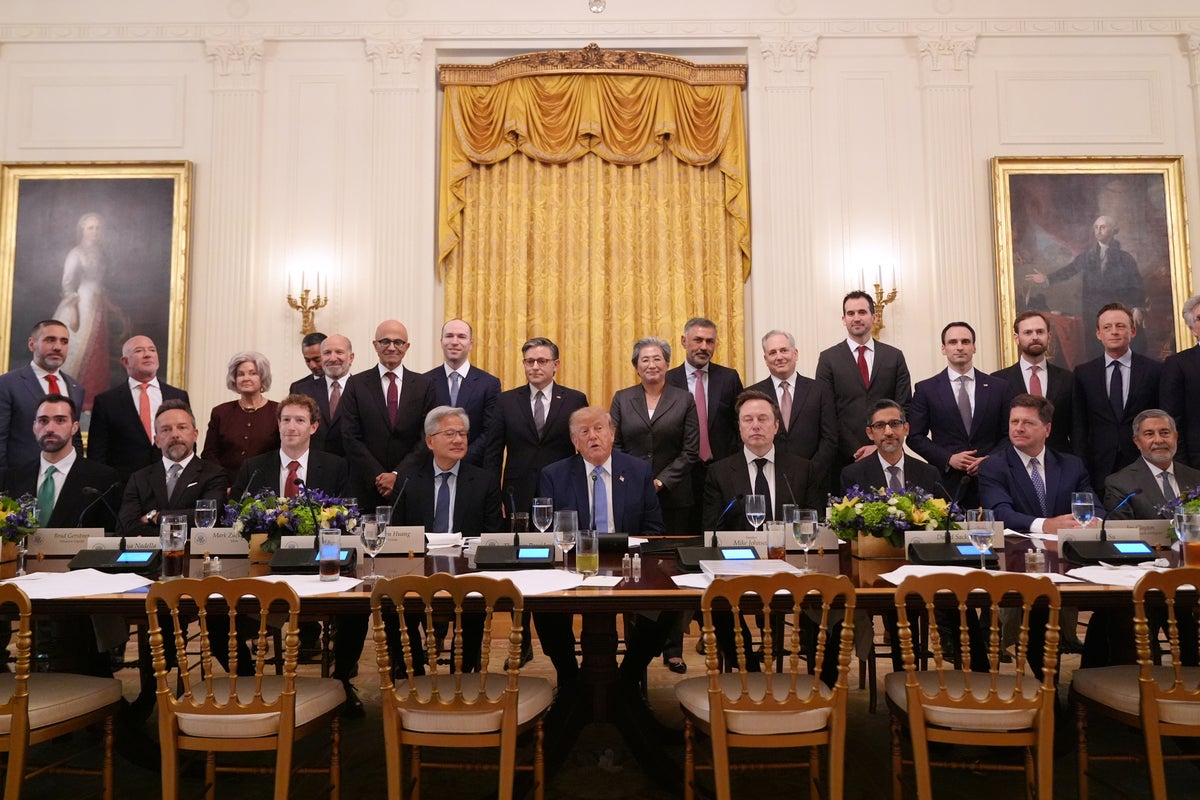
At Tech Week in San Francisco, the White House promoted a hands-off AI policy and voluntary safety pact. Industry leaders welcomed the shift toward growth over regulation.
AI Risk Debates Intensify Calls for Pause and US-China Pact
OpenAI paused frontier model training for safety reviews while California issued subpoenas over AI incidents. Officials discussed voluntary standards and potential FTC probes.
The Compass
You just read five takes on one story.
What's your take? Find your political shape in a few minutes.
Take the test