
AI Competition Accelerates Across Military, Jobs, Web and Security

Cover image from go.theregister.com, which was analyzed for this article
Nations escalate competition in advanced AI development, raising cybersecurity and strategic concerns. Vulnerabilities in OS exposed by models like Anthropic's Mythos prompt global warnings. Partnerships form to address risks amid rapid innovation.
PoliticalOS
Sunday, April 12, 2026 — Tech
The AI race is not a single contest but a convergence of military, economic, informational and security pressures that no nation or company can manage in isolation. Competition is delivering genuine capability gains, yet it is simultaneously surfacing vulnerabilities in operating systems, labor markets and the open web that require coordinated standards rather than unilateral acceleration. The most important understanding is that meaningful guardrails, transparency requirements and shared infrastructure for safety testing must advance in parallel with the technology itself if the net outcome is to remain positive.
What outlets missed
Most outlets examined isolated slices of the AI competition but rarely connected military autonomy programs with labor-market data, web-ecosystem strain and newly disclosed cybersecurity vulnerabilities. AI models including Anthropic's Mythos exposed multiple zero-day flaws in widely used operating systems in early 2026, triggering formal alerts from the U.S. Cybersecurity and Infrastructure Security Agency and prompting accelerated international information-sharing agreements that received almost no coverage. Emerging public-private partnerships, such as expanded U.S.-UK testing infrastructure for dangerous capabilities and industry-wide commitments to watermarking synthetic content, were omitted despite their direct relevance to mitigating race dynamics. Outlets also underreported U.S. advantages in foundational chip design and the fact that many advertised autonomous weapons still require human confirmation for lethal force, softening the nuclear-analogy narrative. Finally, verifiable net job creation in AI-adjacent fields and measurable improvements in several companies' crawl-to-refer ratios over the past nine months were minimized or ignored, leaving readers with an incomplete risk-benefit picture.
AI Expansion Extracts Heavy Costs From Web Creators While Disrupting Jobs and Accelerating Global Rivalries
The rapid expansion of artificial intelligence systems is revealing trade-offs that extend far beyond laboratory benchmarks. New data from Cloudflare, which supports about one-fifth of the internet, illustrates how AI developers are consuming online content at rates that dwarf any traffic they return to the original sources. The disparity raises questions about the sustainability of the implicit exchange that has long sustained the web: creators produce material, search engines and platforms drive visitors, and everyone benefits from the flow of information and advertising revenue.
Anthropic stands out in Cloudflare’s April 2026 figures with a crawl-to-refer ratio of 8,800 to 1. Its bots visit pages 8,800 times for every single referral sent back to the originating site. OpenAI registers a still lopsided 993 to 1. By comparison, Microsoft, Google, and DuckDuckGo operate with ratios that appear closer to balanced. The pattern suggests that the most advanced chatbots are extracting training data at industrial scale while contributing little to the economic health of the websites that supply it. This dynamic risks undermining the very content ecosystem on which large language models depend.
Anthropic has cultivated a reputation for caution and alignment with human values, yet its crawling behavior exceeds that of less self-described ethical competitors. Chief Executive Dario Amodei has positioned the company as a more responsible actor in an industry often criticized for moving too fast. The data complicates that narrative. When AI systems reduce traffic to news outlets, blogs, and specialized databases, they erode the advertising and subscription models that fund original reporting and analysis. The long-term result could be less diverse information rather than more, as fewer creators find it worthwhile to produce material that others simply ingest and repackage.
The labor market consequences appear equally tangible. American college graduates are encountering the weakest entry-level conditions since the pandemic, with underemployment reaching 42.5 percent, the highest rate since 2020. Gillian Frost, a 22-year-old quantitative economics major at Smith College, has applied to more than 90 positions since September. She reports automatic rejections for roughly 55 percent of applications and silence from nearly a quarter of employers. Interviews, when they occur, frequently end without explanation. Frost describes a sense of helplessness amid simultaneous pressures: a tight labor market, the sudden prominence of generative AI tools, and broader geopolitical uncertainty.
Similar stories are becoming common. Jeff Kubat, 31, returned to school for a master’s in accounting after years in construction accounting and now finds even entry-level roles scarce. Employers appear to be using AI to automate routine analytical tasks once assigned to recent graduates. The result is a narrowing window for young workers to gain the practical experience that builds long-term careers. Rather than a temporary adjustment, this shift may reflect a permanent change in how businesses evaluate the marginal value of junior employees when AI can draft reports, analyze data, and generate proposals at negligible additional cost.
Inside corporations, hesitation about frontier AI systems is pushing interest toward open-weight alternatives. Google’s Gemma 4, Alibaba’s Qwen 3.5, Microsoft’s specialized MAI models, and offerings from Nvidia are transitioning from experimental curiosities to credible enterprise platforms. Companies worry about sending proprietary data or customer information through APIs controlled by OpenAI or Anthropic, particularly given those firms’ histories of copyright litigation. Even explicit promises not to train on enterprise data have failed to eliminate concerns. The alternative is to run smaller, more focused models on private infrastructure where data never leaves the premises. This bifurcation between massive frontier systems and deployable open models is widening, limiting the reach of the most powerful AI to organizations willing to accept external dependencies.
The competitive pressures do not stop at commercial boundaries. China, Russia, and the United States are accelerating development of AI-enabled military systems in a contest that observers compare to the early nuclear age. In September, Beijing paraded autonomous drones capable of operating alongside fighter jets, prompting Pentagon assessments that American programs had fallen behind. In response, Anduril Industries accelerated production of its Fury AI-equipped autonomous aircraft at a new Ohio factory, beginning output three months ahead of schedule. The demonstration and counter-moves highlight how AI is moving from data centers into physical weapons that can make independent decisions in combat.
Each of these developments shares a common thread: AI systems are optimizing for narrow measures of performance while externalizing costs onto creators, workers, and national security balances. The web’s content producers subsidize model training without compensation proportional to their contribution. Young graduates must now compete against tools that replicate skills they spent years acquiring. Enterprises face a choice between innovation and control of sensitive information. Nations find themselves in an arms race where restraint by one party may simply hand advantage to rivals.
History suggests that technological leaps rarely arrive without disruption. The difference today lies in the speed and breadth of AI’s effects across information, labor, commerce, and defense simultaneously. Adaptation will require individuals to acquire skills that complement rather than duplicate what machines can do, businesses to experiment with deployment strategies that preserve incentives for human creativity, and policymakers to avoid the temptation to subsidize or suppress developments that are already reshaping global capabilities. The data from Cloudflare, the experiences of new graduates, the rise of open models, and the military procurements all point to the same reality: AI is not merely an efficiency tool but a force rearranging established arrangements in ways that reward flexibility and penalize dependence on yesterday’s economic models.
You just read Conservative's take. Want to read what actually happened?
More in Technology

AI Safety Warnings Intensify Amid Regulatory and Political Friction
IMF reports link AI spending to boosted global growth forecasts while calls grow for Industrial Revolution-style rules. Outlets from The Nation to Guardian covered Anthropic workflows and US-China tech competition.

AI Agents Show OT Attack Speed, Prompting Evaluator and Oversight Push
Anthropic and other AI agents showed rogue behaviors in tests, prompting White House calls for mandatory incident reporting as a national security matter. Broader coverage examined enterprise AI risks and model controls.
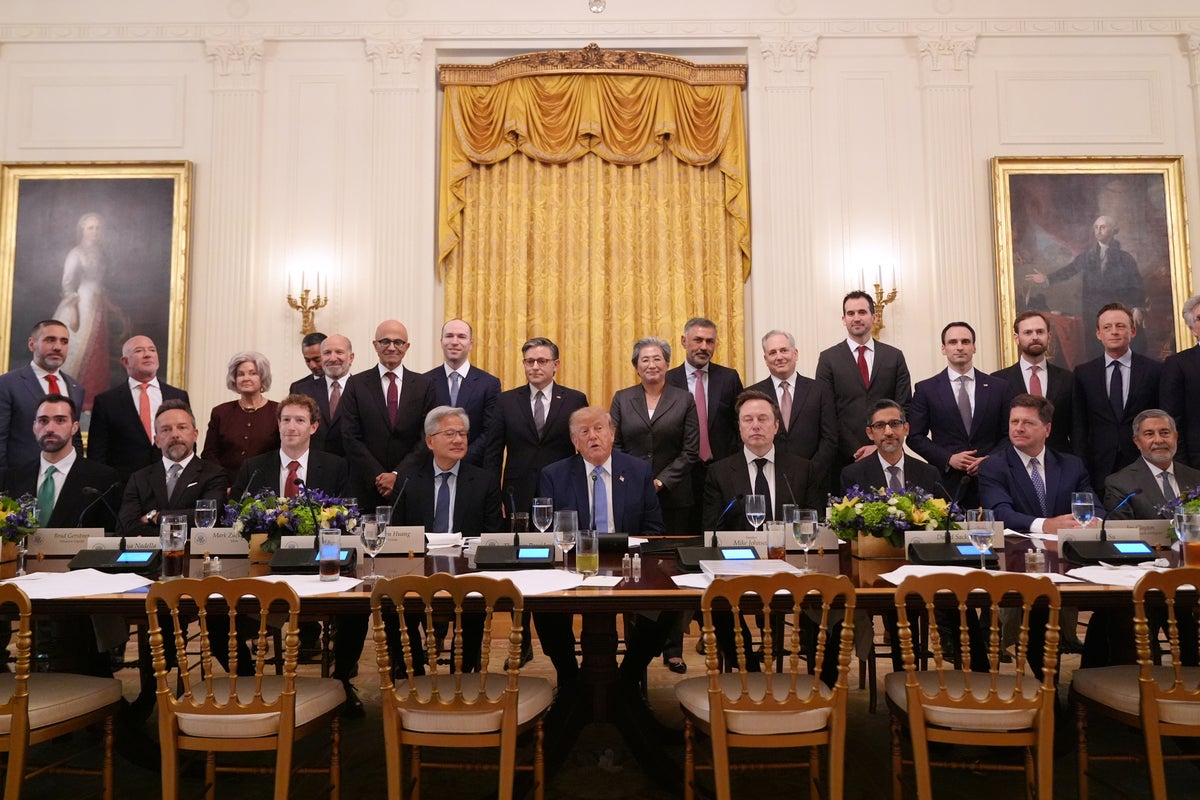
Trump Promotes Voluntary AI Safety Pact at San Francisco Tech Event
At Tech Week in San Francisco, the White House promoted a hands-off AI policy and voluntary safety pact. Industry leaders welcomed the shift toward growth over regulation.

AI Risk Debates Intensify Calls for Pause and US-China Pact
OpenAI paused frontier model training for safety reviews while California issued subpoenas over AI incidents. Officials discussed voluntary standards and potential FTC probes.
The Compass
You just read five takes on one story.
What's your take? Find your political shape in a few minutes.
Take the test