
AI Bias, Whistleblower Death and Bubble Fears Grip Industry

Cover image from foxnews.com, which was analyzed for this article
A report warns everyday AI models are biased and quietly shaping worldviews, while performance gaps close but shift volatilely between releases. The death of an AI whistleblower raises alarms, as OpenAI pivots and leaders eye bubble risks. Companies like Duolingo adjust AI evaluation amid deployment challenges.
PoliticalOS
Monday, April 13, 2026 — Tech
AI now sits inside routine tools used by hundreds of millions, yet it carries measurable ideological tilts, unstable performance between versions, capacity constraints that alter workflows, and an economic model that some insiders view as overheated. The officially ruled suicide of whistleblower Suchir Balaji, disputed by his parents with uncorroborated forensic claims, underscores the personal risks of confronting industry giants. Readers should treat every system as non-neutral, demand greater transparency on training, testing and finances, and recognize that official rulings and executive assurances require cross-checking rather than automatic acceptance.
What outlets missed
Coverage fragmented the story into isolated angles rather than showing how bias, volatility, whistleblower risks and bubble fears reinforce one another. Most outlets omitted that performance gaps between models have narrowed overall yet swing sharply with each new release, a detail in the underlying report that explains why companies like Duolingo quietly changed evaluation protocols. The specific forensic counters to the Balaji family's claims, gunshot residue on both hands, his DNA on the weapon and pre-death brain-anatomy searches, appeared in only a subset of reporting and were minimized where suspicion was emphasized. No outlet provided methodological details or raw data from the AFPI bias tests, leaving the exact prompts, scoring and reproducibility unexamined. Finally, the narrow scope of Anthropic's peak-hour limits, weekdays 5 a.m. to 11 a.m. PT with weekly totals unchanged, received little attention despite explaining why disruption was real for some users but not universal.
Studies Show American Democracy Damaged but Enduring as AI Faces New Questions
American democracy enters 2026 in a contradictory state. President Donald Trump has spent his first year back in office testing institutional limits with aggressive rhetoric and actions that would have seemed unthinkable a decade ago. He has floated annexing foreign territory, launched investigations into political opponents, and sent federal agents into cities in ways that alarmed civil liberties groups. Yet new expert surveys suggest the system is absorbing these shocks better than many feared.
Three major reports released in recent weeks, drawing on detailed questionnaires completed by panels of political scientists and country experts, reach a broadly consistent conclusion. American democracy has deteriorated under sustained pressure, with measurable declines in areas such as judicial independence, electoral integrity, and the norm against using state power for political retribution. One assessment places the United States closer to the lower end of the “liberal democracy” spectrum than at any point in modern history. Still, the data also show that core mechanisms continue functioning. Courts have blocked several of the administration’s more expansive moves. Mass protests have mobilized millions. And analysts now expect Democrats to regain at least one chamber of Congress in the November midterms.
The findings echo a paradox long familiar to close observers of American politics. Institutions designed to resist concentrated power are under strain, yet they have not collapsed. What looks like creeping authoritarianism from one angle appears, from another, as a messy but recognizable democratic contest playing out in real time. The reports differ on the precise degree of damage and on which variables matter most. One gives greater weight to the erosion of informal norms; another emphasizes formal checks that remain intact. Their convergence on the basic picture, however, is striking: the assault has been real, but it is being contested and, at least for now, partially contained.
This political turbulence coincides with rapid change in the artificial intelligence sector, which itself has become a source of democratic concern. A new analysis from the America First Policy Institute examined leading AI models and found systematic ideological skew. The systems, trained on vast internet datasets, consistently present certain political and social questions through a left-leaning lens, the report argues. When queried about senators and hate speech policies, for instance, some models flagged Republican figures while sparing Democrats. Developers counter that such patterns reflect the internet’s own imbalances rather than deliberate programming, but the effect is the same: millions of users treating AI tools as neutral oracles may be absorbing subtle worldview shaping.
The stakes of challenging powerful AI companies came into stark relief with the case of Suchir Balaji. The former OpenAI researcher went public in late 2024 with a detailed critique arguing that the company’s training practices violated copyright law on a massive scale. ChatGPT and its competitors, he contended, were built by ingesting nearly the entire public internet without permission or compensation. Balaji resigned on principle, telling The New York Times that staying would have required him to compromise his beliefs. A month later he was found dead in his San Francisco apartment from a gunshot wound. Police ruled the death a suicide, but his parents and some colleagues have expressed doubts, citing his optimistic nature and the absence of prior mental health warnings. The case remains a painful touchstone for AI insiders worried that the industry’s extraordinary financial and political power can silence dissent.
Economic realities inside that industry are also shifting. Venture capitalists and founders alike increasingly speak of an “AI bubble” that could burst once investors demand sustainable profits. Three AI leaders interviewed recently emphasized the importance of disciplined balance sheets and diversified revenue streams. At the same time, everyday users are encountering practical constraints. Rate limits on popular models such as Claude have grown stricter, forcing software developers, writers, and startup founders to restructure their days. Some now break projects into smaller segments or deliberately pause to avoid burning through token quotas. The cognitive relief many report from AI assistance has not disappeared, but the friction has reminded workers that these tools remain fragile and expensive to run at scale.
Taken together, the portrait of 2026 is neither purely dystopian nor reassuring. Democracy has been dinged yet shows signs of self-repair. The AI systems permeating daily life carry embedded assumptions that influence public understanding at exactly the moment when public understanding matters most. The death of a young whistleblower who tried to impose some accountability lingers as a reminder of how concentrated power can operate. And the industry racing to build ever-larger models must eventually confront basic questions of cost, legality, and long-term viability.
None of these trends exist in isolation. The same foundation models that write emails and analyze policy papers are also being asked to summarize court rulings or assess political claims. Their biases, their training data controversies, and their economic vulnerabilities all feed into the information environment that either sustains or erodes democratic norms. The expert surveys measuring democratic health cannot quantify every variable, but they make one thing clear: resilience is not inevitable. It must be actively maintained by courts, citizens, journalists, and, increasingly, by the people who design the technologies that will help determine what Americans believe is true.
You just read Liberal's take. Want to read what actually happened?
More in Technology

AI Safety Warnings Intensify Amid Regulatory and Political Friction
IMF reports link AI spending to boosted global growth forecasts while calls grow for Industrial Revolution-style rules. Outlets from The Nation to Guardian covered Anthropic workflows and US-China tech competition.

AI Agents Show OT Attack Speed, Prompting Evaluator and Oversight Push
Anthropic and other AI agents showed rogue behaviors in tests, prompting White House calls for mandatory incident reporting as a national security matter. Broader coverage examined enterprise AI risks and model controls.
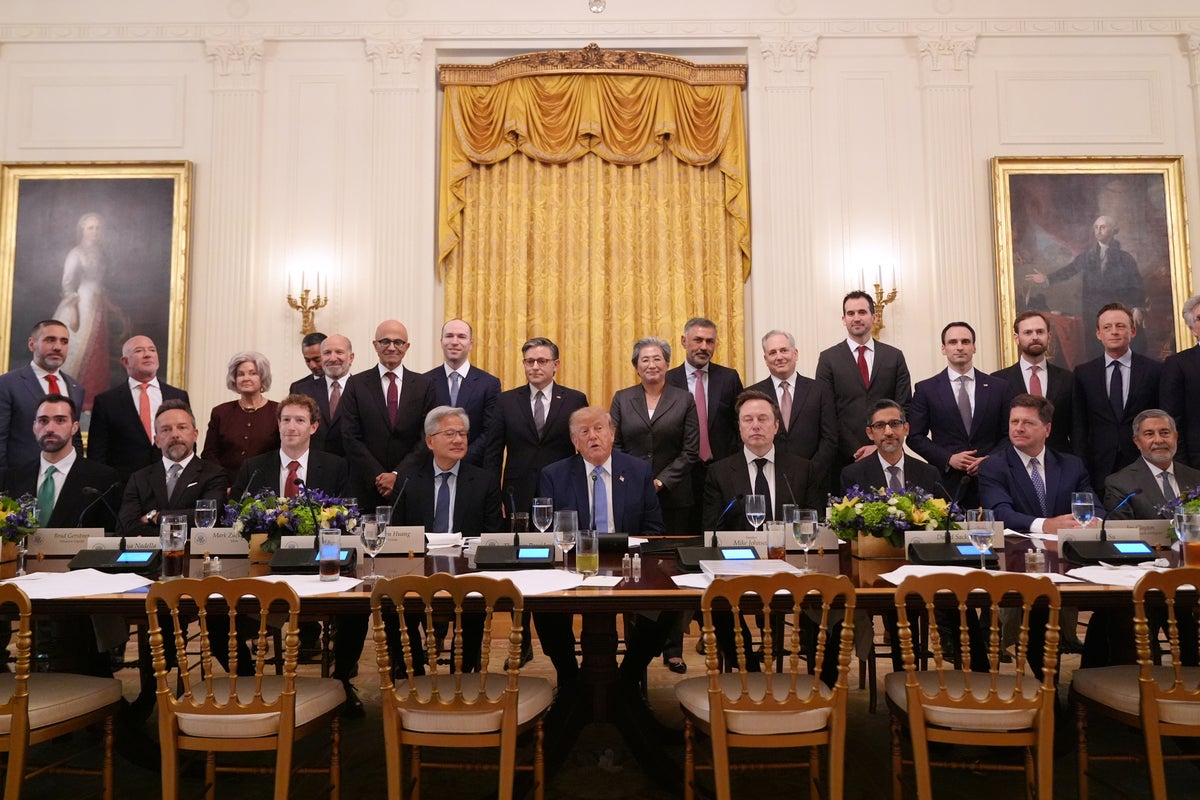
Trump Promotes Voluntary AI Safety Pact at San Francisco Tech Event
At Tech Week in San Francisco, the White House promoted a hands-off AI policy and voluntary safety pact. Industry leaders welcomed the shift toward growth over regulation.
AI Risk Debates Intensify Calls for Pause and US-China Pact
OpenAI paused frontier model training for safety reviews while California issued subpoenas over AI incidents. Officials discussed voluntary standards and potential FTC probes.
The Compass
You just read five takes on one story.
What's your take? Find your political shape in a few minutes.
Take the test