
Data Center Backlash Emerges as Bipartisan Midterm Flashpoint
Cover image from thefederalist.com, which was analyzed for this article
Local opposition to data center energy use and noise is emerging as a bipartisan midterm issue. Companies and candidates face pressure over land and power costs.
PoliticalOS
Tuesday, April 14, 2026 — Tech
Local noise, power, and water complaints are generating bipartisan candidate positions in multiple districts, yet the scale of any foreign amplification and the precise engineering mitigations at individual sites remain only partially documented across available reporting.
What outlets missed
No outlet supplied independent verification of actual megawatt-hour consumption or water-gallon figures for the Vineland project itself. County testing records on vibration versus airborne sound were referenced by plaintiffs but not released. Candidate fundraising tied to data-center opposition and any counter-donations from tech firms remain unreported. The 42 percent and 125 percent growth in Flock data-sharing networks cited by Wired has no documented connection to energy or noise complaints.
Data Center Construction Booms in Midwest and Texas Despite Rising Opposition
The artificial intelligence revolution is redrawing the map of American infrastructure. Once concentrated in Northern Virginia, the largest and most power-hungry data centers are now rising across the Midwest and Texas, drawn by abundant electricity, cheaper land, and local governments more willing to accommodate explosive demand for computing capacity. A new report from Synergy Research finds that Texas and the Midwest represented one-third of hyperscale data center capacity at the end of 2025. Those same regions are expected to capture 53 percent of new capacity coming online in the next several years.
The shift reflects simple economics. Hyperscale facilities that train and run generative AI systems consume enormous amounts of power. Northern Virginia’s grid has grown congested. Developers have therefore moved inland to places where electricity is more readily available and transmission upgrades can be completed faster. Meta has broken ground on a large campus in Beaver Dam, Wisconsin. Similar multibillion-dollar projects from Oracle, OpenAI, and other operators are advancing in multiple Midwestern states and across Texas. These investments bring construction jobs, ongoing employment for technicians and support staff, and increased local tax revenue in regions that have sometimes struggled with population loss and manufacturing decline.
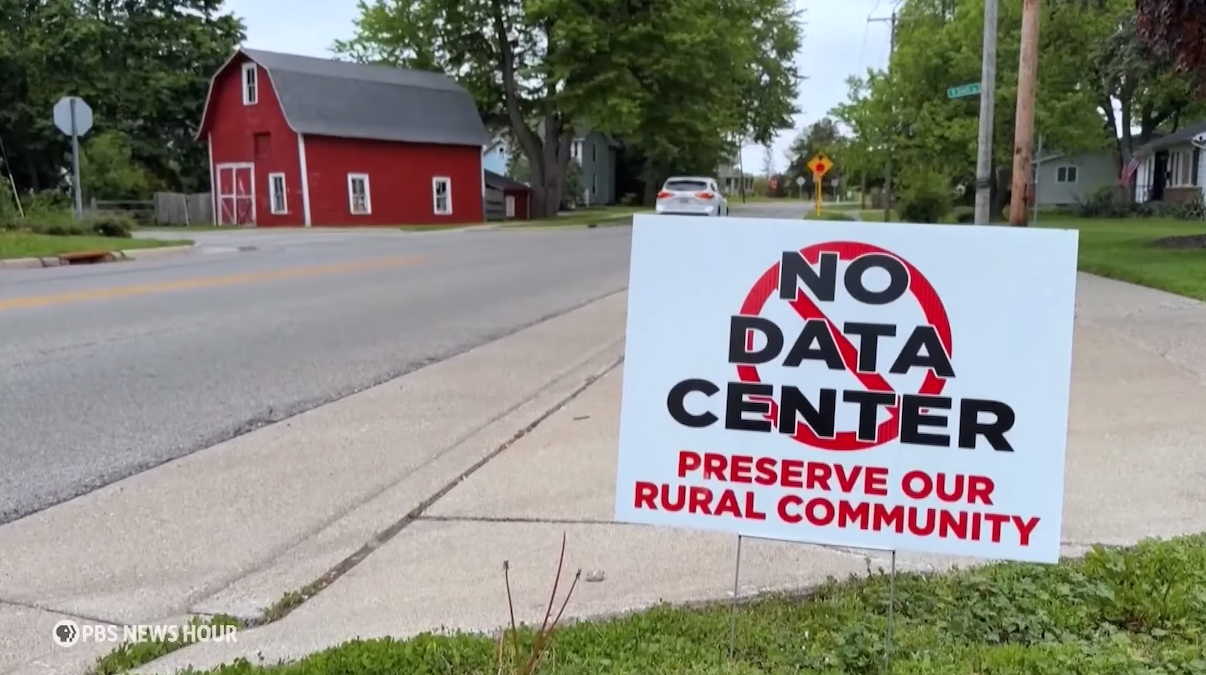
Not every community is rolling out the welcome mat. A parallel story of resistance has emerged, driven by concerns over energy use, water consumption for cooling, noise from cooling fans, and the transformation of rural landscapes. Maine’s legislature recently imposed the first statewide moratorium on data centers larger than 20 megawatts, halting new projects until November 2027. Lawmakers in at least a dozen other states have introduced similar measures. In Port Washington, Wisconsin, voters approved a referendum by roughly two-to-one requiring public approval before the city can grant tax incentives for projects costing $10 million or more. The vote responded to a $15 billion Oracle and OpenAI proposal already approved by city officials. That project is grandfathered, but the signal is clear. In Festus, Missouri, all four incumbent board members who supported a $6 billion data center development by CRG were voted out of office last week.
These episodes reveal a tension between national technological momentum and local control. Data centers are not new. Facilities supporting cloud storage, streaming video, and conventional internet traffic have operated for years. The International Energy Agency estimates that roughly half the electricity demand from new projects through 2030 will come from AI-related facilities, with the remainder serving more traditional computing needs. Critics sometimes reduce the entire industry to its least attractive uses, invoking military applications or adult content. Yet the core drivers today are broader: scientific research, logistics optimization, medical imaging, financial modeling, and the everyday tools millions of Americans use for work and communication. Blocking infrastructure that supports these functions carries trade-offs.
Supply constraints are compounding the political friction. Bloomberg reported this month that nearly half of the 12 gigawatts of data center capacity planned for this year have been delayed or canceled. Only about one-third of those projects are currently under construction. Prospects for 2027 look even thinner, with less than a third of announced projects breaking ground. Shortages of transformers, batteries, and other electrical equipment explain much of the slowdown. In some cases, local opposition has added costly delays to already strained timelines.
The pattern echoes a familiar economic reality: demand for valuable services tends to find its way around obstacles. While Maine erects moratoriums and Wisconsin suburbs tighten referendum requirements, Texas and large parts of the Midwest are absorbing the bulk of new investment. That divergence is not accidental. Communities welcoming these projects tend to view them through the lens of opportunity costs. Forgoing data center revenue and jobs means slower growth, fewer infrastructure upgrades, and less ability to fund local services without raising taxes on existing residents. The facilities themselves, once built, generate steady property tax payments that can dwarf those from traditional agriculture or light manufacturing.
Whether the current resistance slows AI progress in any meaningful way remains uncertain. Computing demand has proven remarkably resilient, and developers continue to seek locations where power contracts can be secured without protracted litigation. The equipment shortages may prove more binding in the short term than political pushback. Over a longer horizon, however, sustained local vetoes risk pushing development toward even more remote sites or encouraging operators to look abroad.
For now the market is delivering a clear verdict. The same forces that built the internet economy are directing capital toward the American heartland, where land is plentiful and policymakers have so far proven more accommodating. How communities weigh the tangible benefits of investment against the visible costs of construction and energy use will determine which regions capture the next wave of technological infrastructure and which watch it pass them by. The data centers are being built. The only question is where.
You just read Conservative's take. Want to read what actually happened?
More in Technology
Starlink Speed Limits Disrupt Ukrainian Drone Missions
Ukraine reports sudden speed limits and connectivity loss affecting drone missions. Tensions rise as Russia strikes energy infrastructure.

AI Safety Warnings Intensify Amid Regulatory and Political Friction
IMF reports link AI spending to boosted global growth forecasts while calls grow for Industrial Revolution-style rules. Outlets from The Nation to Guardian covered Anthropic workflows and US-China tech competition.

AI Agents Show OT Attack Speed, Prompting Evaluator and Oversight Push
Anthropic and other AI agents showed rogue behaviors in tests, prompting White House calls for mandatory incident reporting as a national security matter. Broader coverage examined enterprise AI risks and model controls.

Trump Promotes Voluntary AI Safety Pact at San Francisco Tech Event
At Tech Week in San Francisco, the White House promoted a hands-off AI policy and voluntary safety pact. Industry leaders welcomed the shift toward growth over regulation.
The Compass
You just read five takes on one story.
What's your take? Find your political shape in a few minutes.
Take the test