
AI Data Centers Fuel Growth and Political Backlash in Key States

Cover image from vox.com, which was analyzed for this article
Surging AI infrastructure needs boosted related industries while sparking political pushback over energy and land use. GOP warnings highlighted data centers as a campaign issue in some states. Coverage crossed business and tech beats.
PoliticalOS
Sunday, April 12, 2026 — Tech
Data center expansion for AI creates measurable local costs in energy, water and land that have become campaign issues in Ohio and Wisconsin, even as building trades and some municipalities see revenue gains. Political responses range from new regulatory guardrails to attacks on subsidies, while technical improvements in connectivity remain secondary to these trade-offs.
What outlets missed
National scale of proposed projects and exact employment figures from state economic filings were absent from all three accounts. Union support for construction jobs and specific property tax revenue projections for individual municipalities received uneven attention. The technical constraints on fiber latency for distributed AI clusters and the absence of independent verification for certain funding claims were not cross-checked against public records in the political coverage.
While China Races Toward Autonomous Weapons US Enterprises Turn to Open AI Models
As Chinese drones capable of autonomous combat flight parade through Beijing alongside Vladimir Putin and Kim Jong-un, American businesses are quietly abandoning the closed frontier AI systems peddled by Silicon Valley giants in favor of more trustworthy open weights alternatives. New releases this spring from Google, Microsoft, Alibaba, and Nvidia signal that the gap between flashy experimental models and genuinely useful enterprise technology has narrowed dramatically, even as the national security stakes of artificial intelligence grow more serious by the day.
The timing is not coincidental. Enterprises have grown wary of feeding sensitive customer data or proprietary information into the black boxes controlled by OpenAI, Anthropic, or even Google itself. Those companies maintain they do not train on enterprise data, yet the same firms have faced repeated copyright lawsuits and maintain business models built on harvesting information at industrial scale. For corporations guarding trade secrets or customer privacy, the risk is simply too high. Pentagon officials have already expressed alarm at China's rapid progress in unmanned systems. The last thing American industry needs is to subsidize potential adversaries by handing over valuable data through convenient APIs.
Andrew Buss, senior research director at IDC, sees a clear divergence forming. "We're getting these larger, holistic models that are almost trying to be everything to everyone," he said. "But then we're also seeing the rise of smaller, more specialized models that are tailored and geared toward more specific outcomes or query types." The latest wave of open weights models, including Google's Gemma 4 and Alibaba's Qwen 3.5, appear to have crossed an important threshold. No longer mere research curiosities, they function as legitimate enterprise platforms that organizations can run locally or under their own control.
This shift matters beyond corporate efficiency. While progressive politicians in blue states push to criminalize the infrastructure that makes advanced AI possible, America's competitors pour resources into military applications that could soon render current defenses obsolete. Last September's display in Beijing of drones flying in formation with fighter jets set off urgent alarms inside the Pentagon. U.S. officials determined that China's unmanned combat aircraft program had pulled ahead, prompting accelerated production at Anduril's new Ohio factory. The California defense startup began manufacturing AI-backed autonomous drones three months ahead of schedule in an explicit bid to close the gap.
The contrast could hardly be more stark. In Washington, Senator Bernie Sanders and Representative Alexandria Ocasio-Cortez have called for outright federal bans on new data center construction, claiming the facilities threaten "democracy and maybe the human race." Maine's Democratic legislature has already voted for a moratorium. Their rhetoric frames the AI revolution as an existential threat requiring humanity to choose "over profit," a familiar refrain from those who never met a productive economic activity they didn't want to regulate out of existence.
Yet the data centers these politicians seek to block are precisely what America needs to maintain technological superiority. The electricity demands of frontier AI training are enormous and growing. Red states that welcome this infrastructure with reasonable regulation and reliable baseload power will inevitably pull ahead, while blue strongholds burdened by NIMBY opposition, intermittent renewable mandates, and punitive rules will fall behind. As Travis Fisher of the Cato Institute noted, the original Luddites made the same mistake about machines replacing manual labor. Each technological leap freed humans to pursue higher-value work rather than impoverishing them.
The national security implications cannot be ignored. China has integrated AI into its military modernization with characteristic discipline. Russian and North Korean cooperation with Beijing on these systems suggests an axis of authoritarian powers developing capabilities that could challenge American forces in any future conflict. America's response cannot succeed if domestic political factions treat the necessary power plants and server farms as environmental heresies.
The rise of capable open weights models offers one partial solution. By allowing enterprises to deploy sophisticated AI without surrendering control of their data to Silicon Valley intermediaries, these systems reduce the incentive to rely on foreign or unaccountable providers. Microsoft and Google releasing genuinely competitive open models represents an acknowledgment that the old approach of hoarding capabilities behind expensive APIs has limits, particularly when trust has eroded.
None of this suggests the AI race is won. The frontier models from leading labs still hold advantages in raw capability, and the military applications being developed in Beijing appear genuinely impressive. But the emergence of practical, controllable alternatives for American business at least offers a path forward that does not require placing blind faith in corporations with dubious records on intellectual property and data stewardship.
The coming months will test whether the United States can marshal the resources and political will to match China's pace. That effort will require more than clever model weights. It will demand the physical infrastructure to train and run these systems, the regulatory environment that allows rapid deployment, and the strategic clarity to recognize that ceding AI leadership to the Chinese Communist Party carries far greater risks than any data center ever could. Progressives may prefer to halt construction and lecture about existential threats. The rest of the country, particularly those states embracing the technology, appear ready to build.
You just read America First's take. Want to read what actually happened?
More in Technology

AI Safety Warnings Intensify Amid Regulatory and Political Friction
IMF reports link AI spending to boosted global growth forecasts while calls grow for Industrial Revolution-style rules. Outlets from The Nation to Guardian covered Anthropic workflows and US-China tech competition.

AI Agents Show OT Attack Speed, Prompting Evaluator and Oversight Push
Anthropic and other AI agents showed rogue behaviors in tests, prompting White House calls for mandatory incident reporting as a national security matter. Broader coverage examined enterprise AI risks and model controls.
Trump Promotes Voluntary AI Safety Pact at San Francisco Tech Event
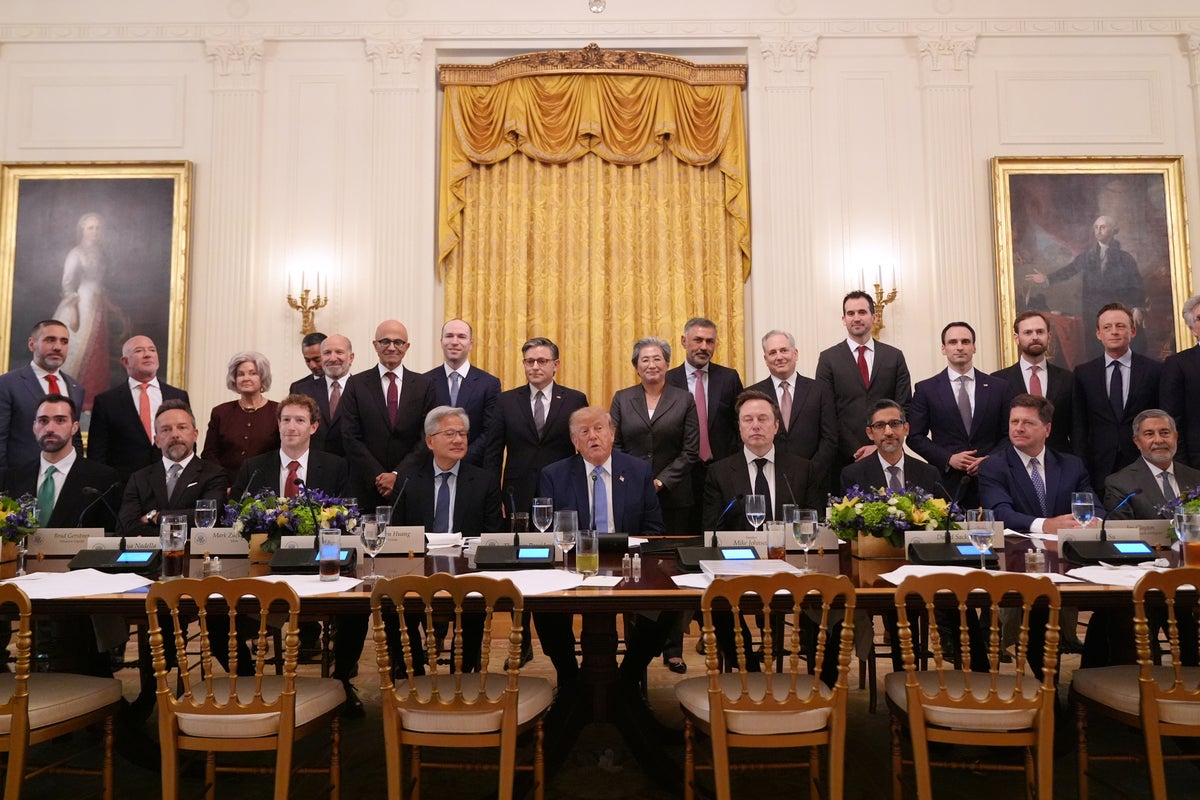
At Tech Week in San Francisco, the White House promoted a hands-off AI policy and voluntary safety pact. Industry leaders welcomed the shift toward growth over regulation.

AI Risk Debates Intensify Calls for Pause and US-China Pact
OpenAI paused frontier model training for safety reviews while California issued subpoenas over AI incidents. Officials discussed voluntary standards and potential FTC probes.
The Compass
You just read five takes on one story.
What's your take? Find your political shape in a few minutes.
Take the test