
AI Data Centers Fuel Growth and Political Backlash in Key States

Cover image from vox.com, which was analyzed for this article
Surging AI infrastructure needs boosted related industries while sparking political pushback over energy and land use. GOP warnings highlighted data centers as a campaign issue in some states. Coverage crossed business and tech beats.
PoliticalOS
Sunday, April 12, 2026 — Tech
Data center expansion for AI creates measurable local costs in energy, water and land that have become campaign issues in Ohio and Wisconsin, even as building trades and some municipalities see revenue gains. Political responses range from new regulatory guardrails to attacks on subsidies, while technical improvements in connectivity remain secondary to these trade-offs.
What outlets missed
National scale of proposed projects and exact employment figures from state economic filings were absent from all three accounts. Union support for construction jobs and specific property tax revenue projections for individual municipalities received uneven attention. The technical constraints on fiber latency for distributed AI clusters and the absence of independent verification for certain funding claims were not cross-checked against public records in the political coverage.
As Open AI Models Gain Ground, Military Races and Infrastructure Fights Define the Technology’s Next Phase
The artificial intelligence landscape is splitting along several axes at once. On one side, a new generation of openly available models from Google, Microsoft, Alibaba and Nvidia has crossed a threshold, moving from experimental curiosities to tools that enterprises are seriously evaluating for real work. On another, the United States, China and Russia are accelerating development of AI-enabled weapons systems in a contest that defense officials compare to the early nuclear arms race. And at home, sharp political conflict has erupted over the data centers required to power both tracks, with prominent Democrats calling for construction moratoriums while free-market advocates argue such restrictions would cede economic advantage.
This convergence of commercial, military and infrastructural developments illustrates how quickly AI is escaping the control of a handful of frontier labs and becoming a broadly distributed capability with consequences that reach far beyond Silicon Valley. The models released in recent weeks, including versions of Alibaba’s Qwen, Google’s Gemma and Microsoft’s MAI systems for speech and image tasks, are not frontier-defining breakthroughs on the level of OpenAI’s or Anthropic’s latest closed systems. Yet they are good enough, and open enough, that companies wary of handing sensitive data to third-party APIs now see viable alternatives.
Andrew Buss, a senior research director at IDC, described the shift as one from “interesting to serious enterprise platforms.” For years, the gap between what the best closed models could do and what most businesses could safely or affordably use had been widening. Sending proprietary information to ChatGPT or Claude carries risks that many legal and compliance departments will not accept, especially after repeated copyright lawsuits against the frontier labs. The new open-weight releases narrow that gap by letting organizations run capable models on their own infrastructure or through trusted cloud providers, keeping data inside their firewalls.
This development carries democratic implications. When only a few companies control the most powerful models, they also control the terms on which knowledge, analysis and automation are distributed. Open weights loosen that grip, potentially allowing smaller firms, research institutions and even governments to fine-tune systems for their own needs rather than accepting the priorities embedded in San Francisco or Seattle data centers. At the same time, the technology’s diffusion complicates efforts to manage risk. Once models are released, controlling how they are adapted or deployed becomes far harder.
That tension is most visible in the military sphere. In September, China displayed autonomous drones capable of flying alongside fighter jets during a military parade attended by President Xi Jinping, Vladimir Putin and Kim Jong-un. American officials concluded that the United States had fallen behind in unmanned combat aerial vehicles and pressed defense contractors to accelerate. Anduril Industries responded by moving up production of its AI-backed Fury drone at a new factory outside Columbus, Ohio, beginning output three months ahead of schedule. Similar dynamics are playing out in Russia and among American allies.
The comparison to the dawn of the nuclear age is imperfect but instructive. Nuclear weapons required rare materials and enormous fixed infrastructure; advanced AI models can be iterated on commodity chips and shared globally with a few clicks. The proliferation problem is therefore different: not just how many weapons a rival can build, but how widely the underlying capabilities spread to state and non-state actors alike. Pentagon planners worry as much about swarms of inexpensive autonomous systems as they do about singular super-intelligent platforms.
Powering all of this, both the commercial open models and the classified military ones, requires vast amounts of computing infrastructure. Training and running modern AI systems at scale demands reliable, always-on electricity that intermittent renewables struggle to provide. That reality has produced a political backlash. Senator Bernie Sanders and Representative Alexandria Ocasio-Cortez have proposed federal restrictions on new data-center construction, arguing that Congress has a “moral obligation” to pause expansion until the societal risks of AI are better understood. Maine’s Democratic-led House has already voted for a moratorium. Critics on the right dismiss these efforts as modern Luddism that ignores the productivity gains AI could deliver, much as earlier automation waves eventually raised living standards.
The data-center debate exposes deeper disagreements about what kind of future society is trying to build. Progressive skeptics see an industry poised to concentrate power, consume enormous resources, and potentially destabilize labor markets and democratic discourse. Proponents counter that blocking infrastructure is self-defeating; the United States cannot hope to compete with China in AI if it cannot build the physical plants needed to train models. Red states appear ready to welcome the investment, creating a new geographic split in technological capacity that could reinforce existing economic divides.
What emerges is a picture of AI as a general-purpose technology whose benefits and risks are not evenly distributed. Open models may reduce dependence on a few corporate gatekeepers and let more organizations participate in the productivity gains. Yet the same openness that democratizes commercial AI also accelerates military applications that governments are rushing to weaponize. And the infrastructure required to support both sits at the center of a political fight that will help determine which regions and which values shape the technology’s trajectory.
Policy choices made in the next few years will matter. Thoughtful governance could encourage the responsible release of open models while setting clear red lines on autonomous lethal weapons. It could speed the construction of clean, reliable energy capacity without simply greenlighting every corporate project. The alternative is a world in which AI capabilities spread faster than societies can adapt, leaving governments and citizens to manage consequences they did not democratically choose. The releases of the past weeks, the drone parades in Beijing, and the dueling statements from Washington lawmakers all point toward that faster world. Whether institutions can keep pace remains an open question.
You just read Liberal's take. Want to read what actually happened?
More in Technology

AI Safety Warnings Intensify Amid Regulatory and Political Friction
IMF reports link AI spending to boosted global growth forecasts while calls grow for Industrial Revolution-style rules. Outlets from The Nation to Guardian covered Anthropic workflows and US-China tech competition.

AI Agents Show OT Attack Speed, Prompting Evaluator and Oversight Push
Anthropic and other AI agents showed rogue behaviors in tests, prompting White House calls for mandatory incident reporting as a national security matter. Broader coverage examined enterprise AI risks and model controls.
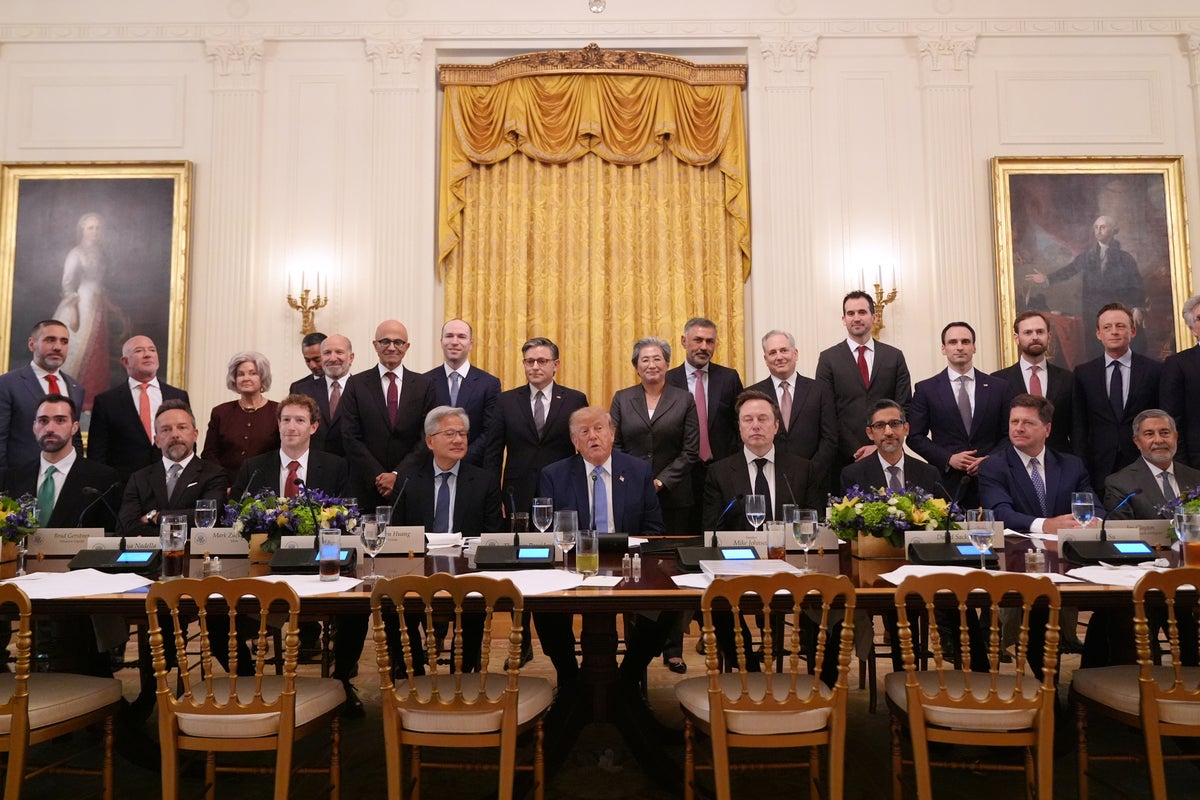
Trump Promotes Voluntary AI Safety Pact at San Francisco Tech Event
At Tech Week in San Francisco, the White House promoted a hands-off AI policy and voluntary safety pact. Industry leaders welcomed the shift toward growth over regulation.

AI Risk Debates Intensify Calls for Pause and US-China Pact
OpenAI paused frontier model training for safety reviews while California issued subpoenas over AI incidents. Officials discussed voluntary standards and potential FTC probes.
The Compass
You just read five takes on one story.
What's your take? Find your political shape in a few minutes.
Take the test