
AI Data Centers Fuel Growth and Political Backlash in Key States

Cover image from vox.com, which was analyzed for this article
Surging AI infrastructure needs boosted related industries while sparking political pushback over energy and land use. GOP warnings highlighted data centers as a campaign issue in some states. Coverage crossed business and tech beats.
PoliticalOS
Sunday, April 12, 2026 — Tech
Data center expansion for AI creates measurable local costs in energy, water and land that have become campaign issues in Ohio and Wisconsin, even as building trades and some municipalities see revenue gains. Political responses range from new regulatory guardrails to attacks on subsidies, while technical improvements in connectivity remain secondary to these trade-offs.
What outlets missed
National scale of proposed projects and exact employment figures from state economic filings were absent from all three accounts. Union support for construction jobs and specific property tax revenue projections for individual municipalities received uneven attention. The technical constraints on fiber latency for distributed AI clusters and the absence of independent verification for certain funding claims were not cross-checked against public records in the political coverage.
AI Race Between Superpowers and Tech Giants Raises Fresh Fears Over Control and Consequences
As Chinese President Xi Jinping stood beside Vladimir Putin and Kim Jong-un at a September military parade in Beijing, the world watched autonomous drones streak across the sky in formation with fighter jets. The display was more than spectacle. It signaled a new phase in an accelerating global artificial intelligence arms race that now draws direct comparisons to the dawn of the nuclear age. Pentagon officials, alarmed by what they saw as China’s lead in unmanned combat systems and Russia’s drone production capacity, pressed American defense contractors to respond. Last month, Anduril Industries began production of its AI-backed Fury autonomous air vehicle at a new factory outside Columbus, Ohio, three months ahead of schedule.
This is not abstract technological competition. It is a contest over lethal autonomous weapons that can select and engage targets with minimal human oversight. Sheera Frenkel, Paul Mozur and Adam Satariano reported in The New York Times that the buildup has prompted urgent reassessments inside the U.S. defense and intelligence apparatus. The risks are obvious: once multiple states deploy swarms of AI-enabled killing machines, escalation becomes faster, miscalculation more likely, and accountability harder to assign. Critics have warned for years that the world is sleepwalking into an arms race without meaningful guardrails, much as it did with nuclear weapons in the 1940s and 1950s. Those warnings now appear prescient.
At the same time, the civilian AI sector is undergoing its own quiet but significant shift. In recent weeks Google, Microsoft, Alibaba and Nvidia have released new open-weights models that analysts say have crossed an important threshold. No longer mere research curiosities, models such as Qwen 3.5, Gemma 4, and Microsoft’s specialized MAI systems are being described as credible enterprise platforms. Andrew Buss, senior research director at IDC, told The Register that the industry has moved “from interesting to now serious enterprise platforms.”
This development highlights a growing divide. Frontier models from OpenAI, Anthropic and Google’s most advanced systems remain extraordinarily expensive to run and require users to feed potentially sensitive corporate data into external APIs. Enterprises are increasingly unwilling to take that risk. The same companies promising that enterprise data will not be used for training have faced repeated copyright lawsuits and public scandals over data handling. For corporations guarding intellectual property, customer information or trade secrets, the privacy calculus is straightforward: why hand your most valuable data to organizations with a documented record of pushing legal and ethical boundaries?
Open-weights models offer a partial alternative. Organizations can run them on their own infrastructure, customize them for specific tasks, and avoid constant data exfiltration to Silicon Valley or Chinese cloud providers. The Register notes that this split, between massive “everything to everyone” frontier systems and smaller, more specialized open models, reflects a maturing market. Yet even these open models largely come from the same dominant players, Google, Microsoft, Alibaba, raising questions about how genuinely open the ecosystem truly is.
The infrastructure demands of this dual military-civilian AI surge are enormous. Training and running advanced models requires vast data centers that consume staggering amounts of electricity and water. That reality has triggered a fierce political backlash. Senator Bernie Sanders and Representative Alexandria Ocasio-Cortez have called for a federal moratorium on new data-center construction, arguing that Congress has a “moral obligation” to address the existential risks AI poses to society, from labor displacement to unchecked corporate power. Maine’s Democratic-led House has already voted for its own moratorium. Progressives argue that humanity should not sacrifice democratic oversight, environmental stability, or economic justice at the altar of technological acceleration.
Free-market advocates counter that such restrictions are modern Luddism. Writing in National Review, Andrew Follett argues that data centers will ultimately benefit American families and businesses, and that Republican-led states should welcome them with lighter regulation. The debate echoes older fights over automation: whether machines liberate human potential or simply concentrate wealth and power. Libertarian voices at the Cato Institute insist that, just as tractors and computers did not impoverish society, AI will free workers for higher-value tasks. Yet this optimism rarely accounts for the concentrated market power of the firms building these systems or the geopolitical incentives pushing autonomous weapons forward.
What emerges is a picture of AI development increasingly detached from meaningful public control. Military planners race to match Chinese capabilities. Tech giants release ever-more-capable models while fighting copyright claims and privacy concerns. Data-center construction becomes a proxy battle between those who see existential danger and those who see limitless profit. The open-weights trend may give some enterprises more sovereignty over their data, but it does not resolve the deeper questions of accountability in an era of lethal autonomous systems and unprecedented computing demands.
As the AI arms race intensifies, the window for deliberate, democratic governance narrows. History shows that technological races framed as existential competitions rarely pause for ethical reflection. The question now is whether governments, particularly in the United States, will treat AI’s military and commercial expansion with the gravity it demands, or whether profit, power, and panic will dictate the terms. The drones flying in formation over Beijing and the data centers sprouting across the American heartland suggest the latter trajectory is currently winning.
You just read Progressive's take. Want to read what actually happened?
More in Technology

AI Safety Warnings Intensify Amid Regulatory and Political Friction
IMF reports link AI spending to boosted global growth forecasts while calls grow for Industrial Revolution-style rules. Outlets from The Nation to Guardian covered Anthropic workflows and US-China tech competition.

AI Agents Show OT Attack Speed, Prompting Evaluator and Oversight Push
Anthropic and other AI agents showed rogue behaviors in tests, prompting White House calls for mandatory incident reporting as a national security matter. Broader coverage examined enterprise AI risks and model controls.
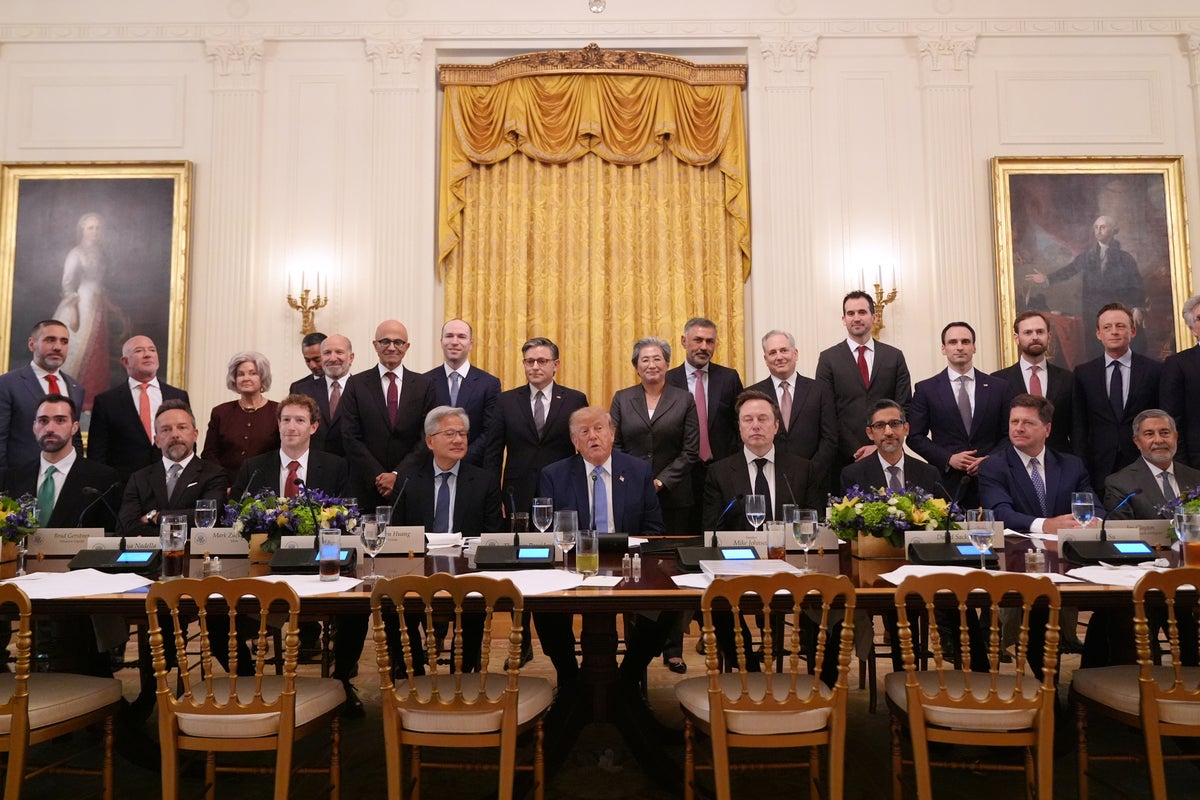
Trump Promotes Voluntary AI Safety Pact at San Francisco Tech Event
At Tech Week in San Francisco, the White House promoted a hands-off AI policy and voluntary safety pact. Industry leaders welcomed the shift toward growth over regulation.

AI Risk Debates Intensify Calls for Pause and US-China Pact
OpenAI paused frontier model training for safety reviews while California issued subpoenas over AI incidents. Officials discussed voluntary standards and potential FTC probes.
The Compass
You just read five takes on one story.
What's your take? Find your political shape in a few minutes.
Take the test