
Cubans Scrape By as Decades-Old Ration System Collapses
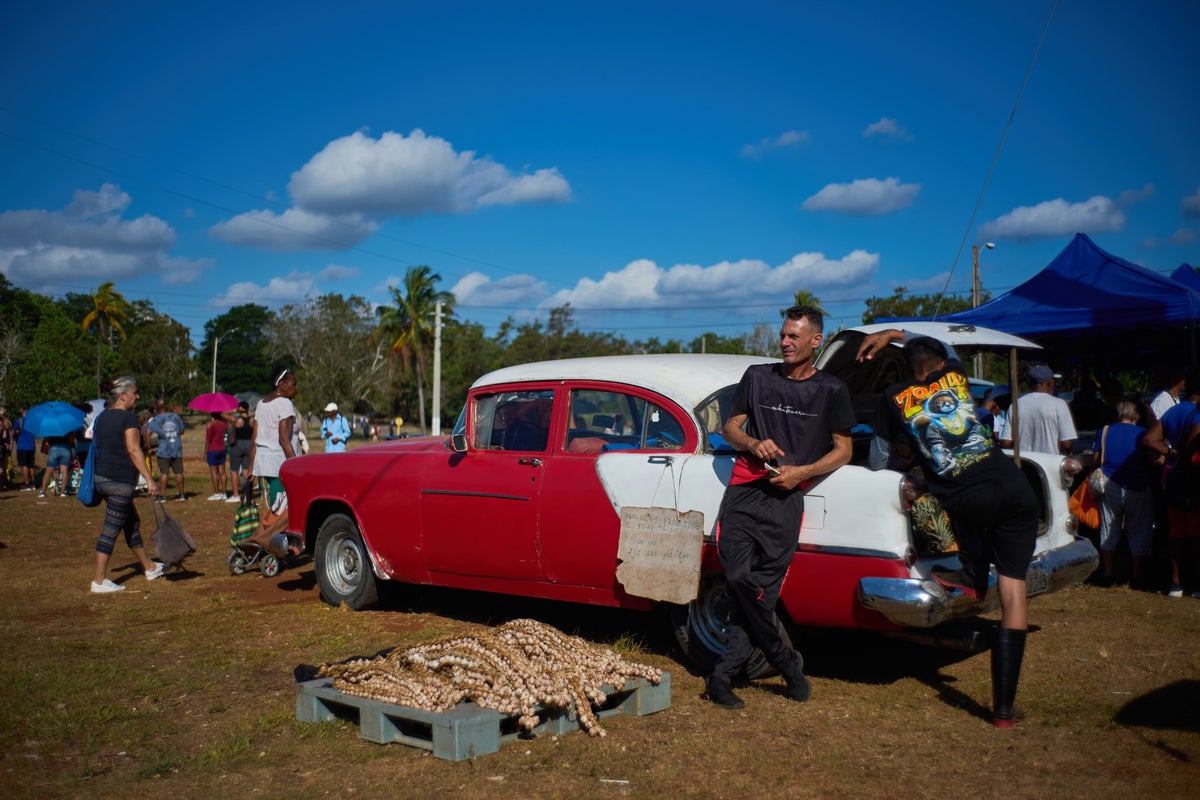
Cover image from independent.co.uk, which was analyzed for this article
Cubans are struggling to survive as the economy collapses, prices soar, and long-standing government ration books provide fewer and fewer products. Pocket-size rations are insufficient amid dwindling supplies.
PoliticalOS
Sunday, May 3, 2026 — Business
Cuba's ration system, the backbone of daily survival for more than six decades, is failing under the combined weight of chronic fiscal mismanagement, currency disasters, military dominance of hard-currency sectors, longstanding U.S. sanctions and the loss of Venezuelan oil. The crisis is real, multidimensional and worsening; residents are already choosing between beans and sugar, one meal or none. How the government executes its promised shift to targeted aid — and whether external pressures ease — will decide if this becomes a managed transition or a deeper social rupture.
What outlets missed
Most accounts omitted the military conglomerate GAESA's central role in controlling tourism revenue, foreign currency inflows and food import decisions, facts documented in CSIS and Miami Herald reporting that shift emphasis from pure scarcity to allocation priorities. Coverage also underplayed verifiable U.S. agricultural exports to Cuba — hundreds of millions of dollars in chicken, pork and rice sold on cash terms in 2025 — which demonstrate that some hard-currency food trade continues despite sanctions. The government's April 2026 pilot program to begin phasing out universal rations in favor of targeted subsidies for vulnerable groups received almost no attention, even though it directly addresses the libreta's future. Finally, compensatory Russian oil shipments of roughly 730,000 barrels in March 2026 and precise pre-2026 inflation and peso-devaluation data (77 percent inflation in 2021, 88 percent peso loss 2021-2023) were rarely quantified, leaving readers without a clear chronological or multi-causal picture.
Cubans Struggle to Survive as Historic Ration System Falls Apart
In a dimly lit state-run bodega in central Havana, José Luis Amate López has watched the foot traffic dwindle to almost nothing. For nearly two weeks in late April, the only living thing to enter the store with any regularity was a scrawny brown kitten. The shelves that once groaned under the weight of subsidized goods during his childhood now stand bare, collecting dust on old posters that list prices no longer relevant to the reality outside. For the roughly 5,000 Cubans assigned to this single outlet, the monthly trip to collect their rations has become a hollow ritual.
The ration book, known as the libreta, was one of the earliest and most visible promises of the Cuban Revolution. Established by Fidel Castro in the early 1960s, it guaranteed every citizen access to a basket of heavily subsidized basics, milk, rice, beans, fish, eggs, even cigarettes, delivered reliably to neighborhood bodegas by the first of each month. For generations it functioned as a nutritional floor, however modest. That floor is collapsing.
Government rations have been shrinking for years, but the pace has accelerated as Cuba’s economy enters what many describe as its worst crisis in decades. Inflation has pushed prices into the stratosphere while salaries, paid in the local currency, have not kept pace. Increasingly, essential goods are priced and sold in U.S. dollars, a de facto dollarization that excludes the majority of Cubans who have no easy access to hard currency. The result is a society where the revolutionary commitment to equality through distribution has been replaced by a grim triage: those with dollars survive, those without do not.
“No Cuban can truly survive on the products from the ration book anymore,” Amate López told reporters. His words carry the weight of someone who has spent decades watching the system erode from within. During his childhood, the same bodega was so well stocked “you could barely walk.” Today it is an empty room. The contrast is not lost on older Cubans who lived through the “Special Period” after the Soviet Union collapsed in the early 1990s. Back then, the sudden loss of subsidized oil, food, and machinery triggered a humanitarian emergency. Average body weight fell between 5 and 25 percent, according to a study published in a medical journal. Bread, milk, eggs and chicken became luxuries. Many who endured that decade say the current situation feels worse, not only because supplies are thinner but because hope has thinned along with them.
The libreta’s retreat has not been a policy choice announced from a podium. It has happened incrementally, through quiet reductions in allotted quantities and the quiet removal of items once considered staples. What remains is often insufficient in both quantity and nutritional value. Families stretch the rations with whatever they can find, but the gap between what the state promises and what it can deliver has become unbridgeable for millions.
This is not merely a story of empty shelves. It is a story about the slow unraveling of the social contract that has defined Cuban life for more than six decades. The ration system was never perfect; even in better times it bred inefficiency and black-market activity. Yet it represented an ideological commitment that the state would guarantee a baseline of survival regardless of individual wealth. That commitment is now visibly failing. In a country of nearly 11 million people, the spectacle of government stores without goods, and government salaries that cannot cover government prices, raises fundamental questions about the sustainability of the current model.
External pressures have played a role. The long-standing U.S. embargo, the loss of Venezuelan oil subsidies, and the lingering effects of the pandemic have all strained an economy already hobbled by central planning and low productivity. But the internal mechanics are equally stark. Without meaningful reforms to increase domestic production or allow broader private enterprise, the state finds itself rationing scarcity rather than abundance. The libreta, once a symbol of revolutionary solidarity, has become a ledger of decline.
Cubans have responded with characteristic resilience and quiet desperation. Some turn to family members who receive remittances from abroad. Others risk dangerous sea crossings to Florida. Many simply make do, skipping meals, stretching rice with whatever filler is available, and hoping the next shipment of subsidized chicken or cooking oil actually arrives. The kitten in Amate López’s bodega is not the only thin creature in Havana.
What makes the present moment feel different from previous crises is the absence of any clear horizon. During the Special Period, Cubans could at least imagine that external conditions might improve once the Soviet shock had been absorbed. Today the crisis feels structural, the product of accumulated policy failures, demographic pressures, and a leadership class that appears unable or unwilling to chart a new course. The government has introduced limited reforms in recent years, but they have been too modest and too slow to reverse the downward spiral.
As the shelves remain empty and the ration books grow thinner, ordinary Cubans are left to navigate a daily arithmetic of survival that no longer adds up. The revolutionary dream of a society organized around collective provision has, for many, been reduced to a pocket-size booklet that no longer feeds them. The question now is not whether the libreta can be saved in its current form, but what, if anything, will replace it before the human cost grows even higher. For José Luis Amate López and the thousands who rely on his bodega, that question is no longer abstract. It is measured in missed meals, lost weight, and the long silences between customers in an empty store.
You just read Liberal's take. Want to read what actually happened?
More in Business & Economy

Stocks Rise on Earnings as Home Sales Hit Low
Major indices closed mixed to higher, led by healthcare and defensive stocks, as companies like Eli Lilly and UnitedHealth reported strong results. Pending home sales hit record lows.

US Stocks Mixed as Tech Rebounds on AI Optimism
The Dow slipped slightly while the S&P 500 and Nasdaq rose, led by Nvidia, AMD, and Intel gains on renewed AI sector confidence after prior drops. Broader market volatility tied to earnings and data center demand.

Trump Unveils $8 Billion Diesel Relief for Farmers
The Agriculture Department launched the program to offset record diesel prices for farmers, framed as economic aid and a midterm pitch in Kansas amid ongoing inflation and energy cost pressures.

CPI Rises to 3.7 Percent as Energy Costs Climb Amid Iran Conflict
Hotter-than-expected CPI figures fueled rate hike fears and contributed to sharp declines in AI and tech stocks. Left and right economic commentary debates Trump policies versus Fed actions.
The Compass
You just read five takes on one story.
What's your take? Find your political shape in a few minutes.
Take the test