
Voters Reject Data Centers Over Energy Strain and Local Impacts
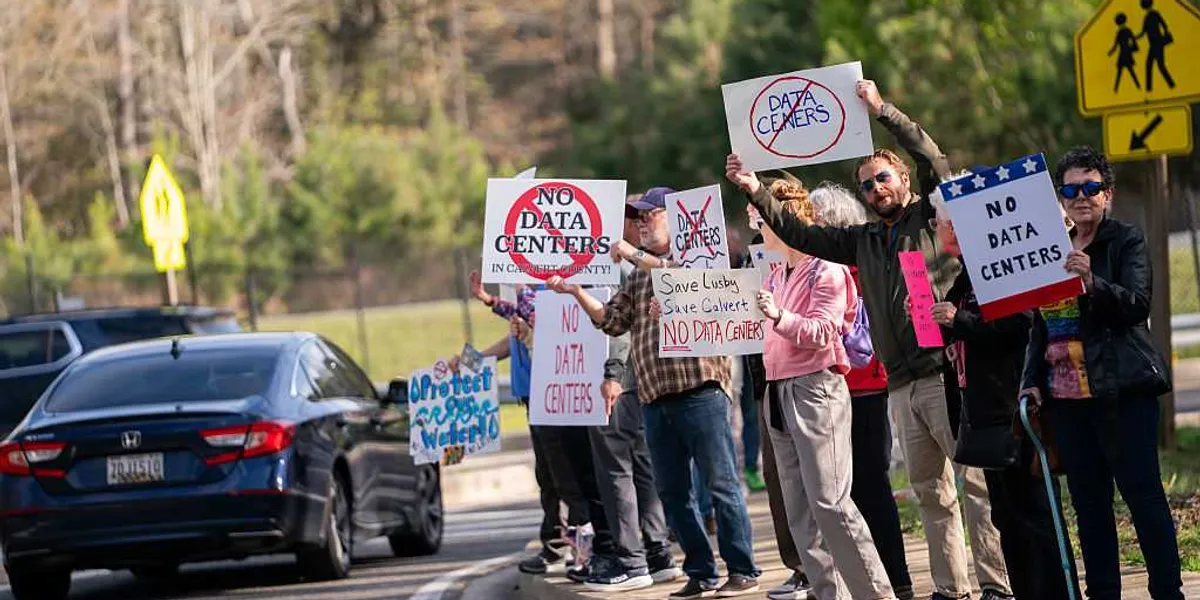
Cover image from theblaze.com, which was analyzed for this article
Voters in key areas oppose new data centers due to energy demands and land use, pressuring Republicans politically. Outlets warn of electoral risks if Big Tech grabs continue. The boom ties to AI but faces community resistance.
PoliticalOS
Wednesday, April 15, 2026 — Tech
Local resistance to data centers is real, driven by verifiable spikes in electricity demand, water use and landscape changes that directly affect residents even as the projects deliver jobs and tax revenue elsewhere. The central tension pits immediate community burdens against the national imperative to sustain AI leadership; politicians in both parties are adjusting their positions accordingly. Readers should recognize that while opposition is strong near proposed sites, many facilities are still advancing and the long-term economic and strategic stakes extend far beyond any single local referendum.
What outlets missed
Both outlets underplayed the scale of projected electricity demand, with data centers forecast to reach nearly 12% of total U.S. consumption by 2028 according to the EIA and Goldman Sachs. They also omitted that many communities have successfully negotiated concessions such as infrastructure funding, local job pipelines and university partnerships, and that at least 36 states still offer incentives because data centers generate billions in investment and tax revenue. Nuanced policy responses were flattened: several cited Democratic governors are not imposing outright bans but requiring developers to cover grid upgrade costs fully. Finally, several specific anecdotes, including exact referendum margins in Wisconsin and a Ravenna, Ohio moratorium, could not be independently verified in cross-reporting and should have been labeled as such.
Communities nationwide are confronting the physical weight of the artificial intelligence boom: towering data centers that consume vast amounts of electricity, reshape rural landscapes and drive up power costs for residents. From Missouri to Wisconsin and Oklahoma, voters have begun rejecting these projects at the ballot box, creating an emerging political liability for officials in both parties who have courted the tech industry. The tension is straightforward. What benefits the national economy and technological edge often lands as an unwanted burden next door.
Last month in Festus, Missouri, voters ousted all four city council incumbents who had supported rezoning for a proposed $6 billion data center, according to local election results reported by both conservative outlets and subsequent coverage. A recall effort against the mayor and remaining council members gained traction over concerns that the facility would raise utility rates, depress property values and create noise. In Port Washington, Wisconsin — a community that voted for Donald Trump by a narrow margin in 2024 — residents approved a referendum requiring future data center projects above a certain size to win public approval at the ballot box. Exact vote margins and petition details cited in some reporting could not be independently verified across all sources.
Similar resistance surfaced elsewhere. In Oklahoma, the Tulsa City Council approved a nine-month moratorium on new data centers after unanimous public comment against them. Osage County fire officials declined a $250,000 donation from Google tied to a hyperscale proposal. Oklahoma City council members who rezoned farmland for another Google project now face a recall petition. In Indianapolis, a city councilor's home was struck by gunfire following his support for data center development; police have described the incident as under investigation without confirming motive. A separate proposed moratorium in Ravenna, Ohio, referenced in one account, was not corroborated by other reporting.
These episodes reflect documented local worries. Data centers can require hundreds of acres and draw power equivalent to thousands of households. The U.S. Energy Information Administration and Goldman Sachs have projected that data centers could consume nearly 12 percent of national electricity by 2028, up from 4.4 percent in 2023, with especially acute pressure on regional grids such as PJM Interconnection. Residents also cite increased water consumption for cooling — one Amazon proposal in Indiana projected 1.6 million gallons per day during peak heat — and the transformation of farmland or residential-adjacent zones. A Quinnipiac poll found 65 percent of Americans oppose construction of AI data centers in their own communities, even as broader national surveys show plurality support when the facilities are framed as abstract economic infrastructure.
Political responses have crossed party lines but vary in degree. Florida Gov. Ron DeSantis has called for restrictions to protect residents from rushed development. Missouri Sen. Josh Hawley co-sponsored legislation with Connecticut Sen. Richard Blumenthal aimed at preventing data centers from increasing electricity costs for families. On the Democratic side, governors Josh Shapiro of Pennsylvania, J.B. Pritzker of Illinois and Wes Moore of Maryland have shifted from aggressive recruitment to demanding that developers fully fund grid upgrades rather than shifting costs to ratepayers, according to reporting by Axios and NOTUS. Rep. Ro Khanna, Transportation Secretary Pete Buttigieg and Rep. Alexandria Ocasio-Cortez have also voiced concerns. Many of these positions focus on cost allocation and local consent rather than categorical bans.
Yet the facilities bring measurable upsides that some localities have accepted. They generate construction jobs, long-term tax revenue and economic activity; Pennsylvania alone sees more than $1 billion annually from data center operations. Communities can negotiate for better terms — including workforce training partnerships, dedicated computing resources for local universities or elimination of certain tax abatements. Brookings Institution analysis notes that high demand gives towns leverage to secure concessions from hyperscalers. At least 36 states currently offer targeted incentives, reflecting a policy consensus that data centers support AI competitiveness against international rivals, particularly China.
The central unresolved question is whether local veto power will meaningfully slow AI expansion or simply shift projects to more welcoming jurisdictions. National polls indicate Americans accept data centers elsewhere; resistance spikes when proposals arrive locally. Some referendums and moratoria remain in legal flux, and not every project has been blocked. One Indianapolis shooting does not represent a pattern of violence, and claims of universal “revolt” in red strongholds were not uniformly corroborated. What is clear is that the surge in demand — driven by training and operating large AI models — has outpaced infrastructure planning in many regions, forcing a reckoning between innovation speed and community consent. Future elections will test whether politicians prioritize immediate voter grievances or the longer-term case for technological primacy.
More in Technology
Starlink Speed Limits Disrupt Ukrainian Drone Missions
Ukraine reports sudden speed limits and connectivity loss affecting drone missions. Tensions rise as Russia strikes energy infrastructure.

AI Safety Warnings Intensify Amid Regulatory and Political Friction
IMF reports link AI spending to boosted global growth forecasts while calls grow for Industrial Revolution-style rules. Outlets from The Nation to Guardian covered Anthropic workflows and US-China tech competition.

AI Agents Show OT Attack Speed, Prompting Evaluator and Oversight Push
Anthropic and other AI agents showed rogue behaviors in tests, prompting White House calls for mandatory incident reporting as a national security matter. Broader coverage examined enterprise AI risks and model controls.

Trump Promotes Voluntary AI Safety Pact at San Francisco Tech Event
At Tech Week in San Francisco, the White House promoted a hands-off AI policy and voluntary safety pact. Industry leaders welcomed the shift toward growth over regulation.
The Compass
You just read five takes on one story.
What's your take? Find your political shape in a few minutes.
Take the test