
Voters Reject Data Centers Over Energy Strain and Local Impacts
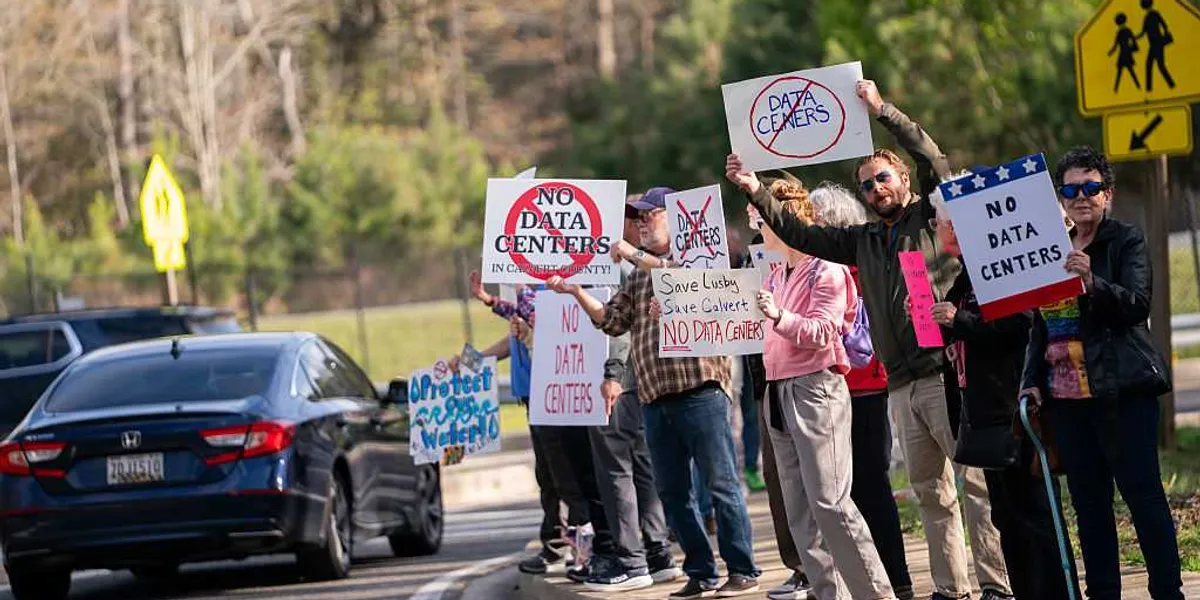
Cover image from theblaze.com, which was analyzed for this article
Voters in key areas oppose new data centers due to energy demands and land use, pressuring Republicans politically. Outlets warn of electoral risks if Big Tech grabs continue. The boom ties to AI but faces community resistance.
PoliticalOS
Wednesday, April 15, 2026 — Tech
Local resistance to data centers is real, driven by verifiable spikes in electricity demand, water use and landscape changes that directly affect residents even as the projects deliver jobs and tax revenue elsewhere. The central tension pits immediate community burdens against the national imperative to sustain AI leadership; politicians in both parties are adjusting their positions accordingly. Readers should recognize that while opposition is strong near proposed sites, many facilities are still advancing and the long-term economic and strategic stakes extend far beyond any single local referendum.
What outlets missed
Both outlets underplayed the scale of projected electricity demand, with data centers forecast to reach nearly 12% of total U.S. consumption by 2028 according to the EIA and Goldman Sachs. They also omitted that many communities have successfully negotiated concessions such as infrastructure funding, local job pipelines and university partnerships, and that at least 36 states still offer incentives because data centers generate billions in investment and tax revenue. Nuanced policy responses were flattened: several cited Democratic governors are not imposing outright bans but requiring developers to cover grid upgrade costs fully. Finally, several specific anecdotes, including exact referendum margins in Wisconsin and a Ravenna, Ohio moratorium, could not be independently verified in cross-reporting and should have been labeled as such.
Voters Reject Data Centers in Surprise Election Results
Across scattered communities in the Midwest and beyond, a pattern is emerging that could reshape how America accommodates the artificial intelligence boom. In the past two weeks, local voters have ousted elected officials, approved binding referendums, and even resorted to violence over plans to build massive data centers that promise economic growth but demand enormous amounts of land, electricity, and public resources.
The clearest repudiation came in Festus, Missouri, where the entire slate of city council incumbents who supported a data center deal lost their seats last week. The vote amounted to a recall by ballot box. Residents there had grown furious over the council’s decision to greenlight the project despite concerns about its impact on the local power grid and quality of life. A separate recall drive is now targeting the mayor and remaining council members. Similar discontent surfaced in Monterey Park, California, where lawn signs protesting a proposed facility have proliferated in neighborhoods that once anticipated the tax revenue and jobs such projects bring.
In Port Washington, Wisconsin, voters delivered an even more explicit verdict. By a roughly two-to-one margin, they approved a referendum requiring future data center projects valued over $10 million to win approval in a public vote. The measure was prompted by Oracle and OpenAI’s Stargate project, a proposed 1.3-gigawatt facility that would consume as much electricity as more than a million typical households. Organizers collected more than 1,000 signatures to force the issue onto the ballot. Michael Baester, a leader of the Great Lakes Neighbors United group behind the effort, framed the victory as proof that residents want development they can understand and control, not projects negotiated behind closed doors.
The political geography of that result is notable. Port Washington went for Donald Trump by a narrow 52-48 margin in 2024. Its swing nature makes the lopsided rejection of the data center model difficult for either party to dismiss as partisan noise. Republicans in particular face a tension: many have courted tech investment and deregulation, yet their voters in rural and exurban areas appear increasingly wary of what they see as Big Tech land grabs that socialize costs while privatizing gains.
Even in Indianapolis, the backlash turned ugly. One city councilor’s home was sprayed with bullets after he voiced support for data center development, an episode that local authorities are investigating as potentially linked to the controversy.
The opposition draws from several converging complaints. Data centers require vast tracts of land, often in places where housing shortages already pinch families. Their cooling systems can strain municipal water supplies. Most critically, their electricity demand is staggering at a moment when the United States is struggling to decarbonize its grid and when many regions face tight power margins. A single large facility can rival the consumption of a mid-sized city. Proponents tout job creation and tax base expansion, but skeptics note that many of the positions are temporary construction roles and that the long-term fiscal benefits can be undercut by tax abatements offered to lure the projects.
What makes this moment distinct is its bipartisan character. Progressive environmentalists worry about the climate arithmetic of powering ever-larger AI models. Conservative populists resent the way distant corporations appear to override local control and reshape landscapes for technologies whose everyday payoffs remain abstract for most residents. Both groups share a skepticism that the AI gold rush will deliver broadly shared prosperity rather than concentrated wealth in coastal tech hubs.
The political implications are already rippling. Anti-tech sentiment helped fuel voter revolts in disparate localities that rarely make national headlines. If these scattered protests coalesce, they could complicate the massive capital investment now flowing into data infrastructure. Tech executives argue that such facilities are essential to maintain American leadership in artificial intelligence. Yet the speed and scale of construction have outrun the ability of many communities to absorb them.
Local officials often welcome these projects at first, lured by promises of economic revitalization. The rapid shift toward opposition in Festus and Port Washington suggests that pitched battles may become the norm as more proposals advance. The referendum model tested in Wisconsin could spread, forcing companies to make their case directly to voters rather than relying on deals cut with sympathetic councils.
For years, data centers operated in the background, largely invisible to the public. The AI surge has dragged them into the foreground. As communities weigh the tangible burdens of noise, heat, water use, and higher electricity rates against the intangible promise of technological progress, many are deciding the trade-off is not worth it. That judgment may prove one of the more consequential political facts of the next several years, forcing both parties to grapple with how to site the infrastructure of the future without alienating the people who live near it. The early returns from Missouri and Wisconsin indicate the current approach is failing that test.
You just read Liberal's take. Want to read what actually happened?
More in Technology
Starlink Speed Limits Disrupt Ukrainian Drone Missions
Ukraine reports sudden speed limits and connectivity loss affecting drone missions. Tensions rise as Russia strikes energy infrastructure.

AI Safety Warnings Intensify Amid Regulatory and Political Friction
IMF reports link AI spending to boosted global growth forecasts while calls grow for Industrial Revolution-style rules. Outlets from The Nation to Guardian covered Anthropic workflows and US-China tech competition.

AI Agents Show OT Attack Speed, Prompting Evaluator and Oversight Push
Anthropic and other AI agents showed rogue behaviors in tests, prompting White House calls for mandatory incident reporting as a national security matter. Broader coverage examined enterprise AI risks and model controls.

Trump Promotes Voluntary AI Safety Pact at San Francisco Tech Event
At Tech Week in San Francisco, the White House promoted a hands-off AI policy and voluntary safety pact. Industry leaders welcomed the shift toward growth over regulation.
The Compass
You just read five takes on one story.
What's your take? Find your political shape in a few minutes.
Take the test