
Voters Reject Data Centers Over Energy Strain and Local Impacts
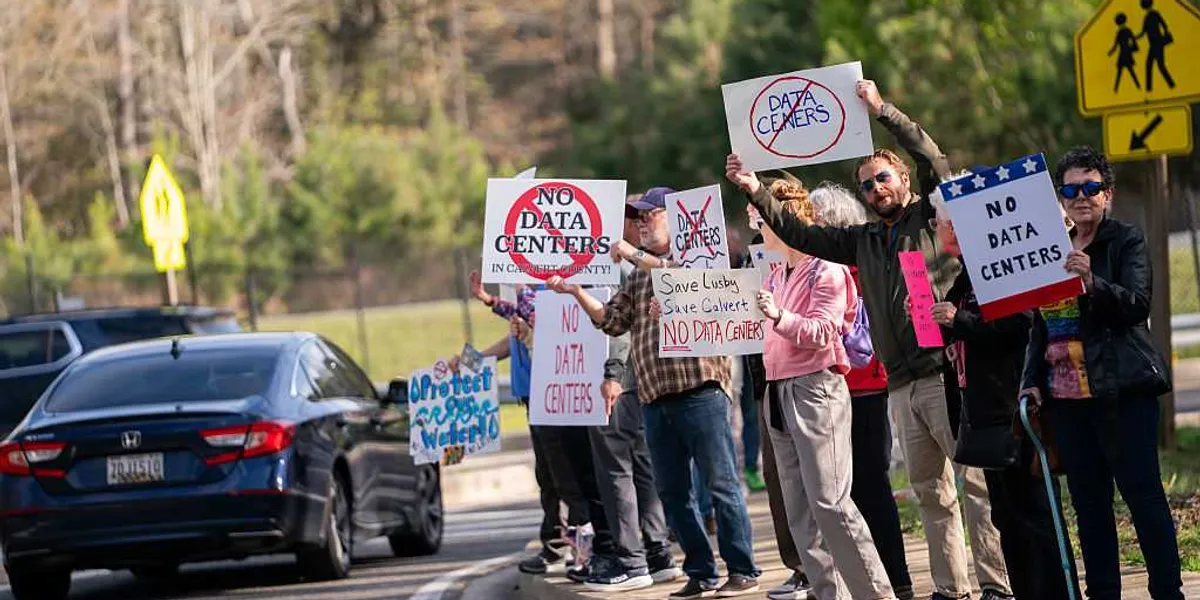
Cover image from theblaze.com, which was analyzed for this article
Voters in key areas oppose new data centers due to energy demands and land use, pressuring Republicans politically. Outlets warn of electoral risks if Big Tech grabs continue. The boom ties to AI but faces community resistance.
PoliticalOS
Wednesday, April 15, 2026 — Tech
Local resistance to data centers is real, driven by verifiable spikes in electricity demand, water use and landscape changes that directly affect residents even as the projects deliver jobs and tax revenue elsewhere. The central tension pits immediate community burdens against the national imperative to sustain AI leadership; politicians in both parties are adjusting their positions accordingly. Readers should recognize that while opposition is strong near proposed sites, many facilities are still advancing and the long-term economic and strategic stakes extend far beyond any single local referendum.
What outlets missed
Both outlets underplayed the scale of projected electricity demand, with data centers forecast to reach nearly 12% of total U.S. consumption by 2028 according to the EIA and Goldman Sachs. They also omitted that many communities have successfully negotiated concessions such as infrastructure funding, local job pipelines and university partnerships, and that at least 36 states still offer incentives because data centers generate billions in investment and tax revenue. Nuanced policy responses were flattened: several cited Democratic governors are not imposing outright bans but requiring developers to cover grid upgrade costs fully. Finally, several specific anecdotes, including exact referendum margins in Wisconsin and a Ravenna, Ohio moratorium, could not be independently verified in cross-reporting and should have been labeled as such.
Voters Reject Big Tech Data Centers in Bipartisan Revolt Against Corporate Overreach
Across the heartland and suburbs of America a grassroots backlash against sprawling data centers is reshaping local politics and exposing the deep unpopularity of Big Tech’s relentless expansion. In the past week alone voters have thrown elected officials out of office thrown bullets at a lawmaker’s home and overwhelmingly approved measures to block future projects that would consume staggering amounts of electricity and land while delivering questionable benefits to the communities forced to host them.
The clearest warning came in Festus Missouri where the entire slate of city council incumbents who supported a data center deal were defeated in last week’s election. Anger ran so deep that residents have now launched recall efforts against the mayor and remaining council members. City leaders had pitched the project as a boon bringing jobs and tax revenue. Instead it became a symbol of distant corporations imposing their infrastructure on working communities without genuine consent.
Similar rejection unfolded in Port Washington Wisconsin a politically divided town that narrowly backed Donald Trump in 2024. Voters there approved a referendum by a two-to-one margin requiring all future data center projects worth more than ten million dollars to win approval in a public vote. The measure was triggered by plans for a massive Oracle and OpenAI facility known as Stargate a 1.3-gigawatt installation that would draw as much power as more than one million households. Organizers collected more than one thousand signatures to place the question on the ballot. Michael Baester a founder of the community group Great Lakes Neighbors United framed the victory in straightforward terms. “We are not against development” he said. “We are for development that the community understands supports and has chosen together.”
These results arrive as data centers become the physical backbone of the artificial intelligence boom. Tech giants promise transformative innovation yet the infrastructure required looks increasingly like a classic tale of concentrated corporate power extracting resources from ordinary Americans. The facilities demand enormous quantities of electricity water for cooling and large tracts of land often in rural or semi-rural areas already struggling with aging infrastructure. Many residents complain about constant noise from cooling fans increased traffic and the risk that local utility rates will rise as power is diverted to serve Silicon Valley’s priorities rather than neighborhood homes and small businesses.
The discontent is not confined to conservative strongholds. In Monterey Park California protesters have planted yard signs opposing a proposed data center after city officials initially embraced it for the tax base. In Indianapolis a city councilor’s home was hit with gunfire following his vocal support for such projects illustrating how raw the frustration has grown. Political analysts from both parties acknowledge that anti-tech sentiment now crosses traditional lines. Democrats wary of unchecked corporate power and environmental costs find themselves aligned with Republicans who see the centers as another example of elite institutions disregarding local sovereignty.
This convergence poses a particular problem for Republican officeholders who have often courted Big Tech investment in the name of economic growth. Conservative columnists now warn that continuing to greenlight these projects without robust community oversight could cost the party at the ballot box. The Port Washington referendum is especially telling because it occurred in a swing area that decides not only Wisconsin but often the direction of national politics. A two-to-one rejection of the data-center model in such a place suggests the issue has the potential to realign suburban and exurban voters who feel their quality of life is being sacrificed for speculative technology whose public benefits remain vague.
Critics of the industry point to broader patterns. The same companies building these centers have spent years consolidating market power dodging antitrust scrutiny and shaping national policy to suit their needs. Now they are asking communities to shoulder the environmental and infrastructural burden of powering generative AI systems that primarily enrich distant shareholders. Electricity consumption on this scale raises urgent questions about carbon emissions and the strain on grids already facing extreme weather and rising demand. In many cases utilities must construct new substations and transmission lines subsidized in part by ratepayers who will never use the AI tools being developed.
Community organizers say their objections are rooted in practical realities rather than blanket opposition to technology. They want transparency about energy and water usage binding commitments on local hiring and the right to reject projects that fail a basic cost-benefit test for residents. In Port Washington the new referendum does not dismantle the existing Stargate proposal but ensures that future initiatives cannot bypass public scrutiny. That compromise itself reveals how little say citizens have had until now.
The wave of opposition arrives at a moment when data centers are projected to multiply across the country to meet the demands of an AI arms race fueled by hype as much as proven societal need. Tech executives speak of artificial general intelligence and revolutionary productivity gains yet the tangible local experience often amounts to roaring fans twenty-four hours a day potential spikes in utility bills and the transformation of farmland or neighborhoods into industrial zones. When elected leaders appear more responsive to corporate lobbyists than to the people who voted for them the political backlash becomes predictable.
Both major parties now face a test. Democrats who have historically positioned themselves as defenders of communities and the environment must decide whether they will challenge the tech monopolies they have sometimes courted. Republicans who rail against coastal elites risk looking hypocritical if they continue trading local autonomy for data-center ribbon-cuttings. Early evidence from Festus and Port Washington suggests voters are prepared to punish either side that fails to listen.
For now the momentum belongs to the residents organizing petition drives attending marathon city council meetings and refusing to accept that their towns must become unwilling hosts in Big Tech’s expansion. Their message is simple. Infrastructure that reshapes daily life and consumes public resources at this scale requires genuine democratic consent not backroom deals. As more communities discover the true costs behind the glittering promises of artificial intelligence that demand is likely only to grow louder. The political class in both parties would be wise to take notice before the next round of evictions at the ballot box.
You just read Progressive's take. Want to read what actually happened?
More in Technology
Trump Pushes Community Dividends to Ease Data Center Backlash
Trump suggested tech companies pay local communities a 'dividend' to gain support for massive AI data centers amid growing backlash over energy use and infrastructure.
Musk Pledges One SpaceX Share to Every U.S. Child
Musk announced plans to distribute one SpaceX share to each of roughly 73 million American children next year, drawing praise from Trump and signaling closer alignment between the two.

Trump Administration Bans DeepSeek AI From Federal Civilian Agencies
Tech stocks rebounded on AI optimism while hyperscalers and firms navigate data center infrastructure, earnings focus, and regulatory scrutiny including bans on certain Chinese AI tools.

Musk Says He Will Give One SpaceX Share to Every US Child
Elon Musk announced plans to distribute one SpaceX share to every American child in 2027, with hints of further giveaways. The pledge drew coverage across outlets amid broader discussions of AI philanthropy and Musk entities.
The Compass
You just read five takes on one story.
What's your take? Find your political shape in a few minutes.
Take the test