
Democrats Launch Long-Shot 25th Amendment Push to Review Trump's Fitness
Cover image from breitbart.com, which was analyzed for this article
House Democrats led by Raskin propose an expert panel to evaluate Trump's fitness under the 25th Amendment amid war strains. Critics call him unstable, tying to low polls. Long odds but highlights partisan divides.
PoliticalOS
Wednesday, April 15, 2026 — Politics
Democrats' bill to create an expert panel reviewing Trump's fitness under the 25th Amendment is real but faces insurmountable procedural barriers in a Republican-controlled Congress and White House. It reflects genuine partisan fury over the president's Iran policy and rhetoric yet functions primarily as political messaging rather than a viable removal mechanism. Readers should weigh the documented decline in some polling segments and allied friction against the absence of bipartisan consensus required to alter the constitutional order during an active conflict.
What outlets missed
Most accounts underplayed the sequence of events that produced the current crisis, including specific Iranian threats against U.S. assets that preceded American and Israeli strikes in February 2026. A two-week ceasefire reached in early April received only glancing mention despite its potential to alter threat assessments. Coverage also gave short shrift to the exact legal threshold for the 25th Amendment: even a commission recommendation would still require Vice President Vance and a cabinet majority or supermajorities in Congress. Finally, the distinction between Trump's targeting of Iranian regime infrastructure and hyperbolic characterizations of his language as "genocidal" toward an entire civilization was rarely clarified with primary quotes.
Trump Faces Mounting Backlash Over Iran Conflict as Support Erodes Among Core Voters
President Donald Trump’s decision to launch military action against Iran has produced a cascade of political consequences at home and abroad, isolating him from traditional allies, fracturing parts of his own coalition, and prompting fresh Democratic efforts to constrain his authority. The developments come as new polling shows a striking collapse in Trump’s standing even among non-college-educated white voters, a group long considered the bedrock of his political strength.
The latest flashpoint involves one of Trump’s few remaining international partners. Italian Prime Minister Giorgia Meloni, a populist conservative who has often aligned with Trump, sided with Pope Francis’s criticism of the Iran conflict. In response, Trump unleashed a public tirade, calling Meloni “unacceptable” and accusing her of not caring whether Iran acquires a nuclear weapon. He further labeled her a coward for declining to assist in efforts to reopen the Strait of Hormuz, a critical shipping lane disrupted by the fighting.
The episode underscores how the war, now weeks old, has strained relationships that once seemed durable. Meloni’s government had been viewed inside MAGA circles as a European counterpart to Trump-style nationalism. Her willingness to echo the Pope’s concerns about civilian casualties and regional destabilization appears to have caught Trump off guard, producing a level of vitriol typically reserved for domestic opponents.
At home, the political costs are becoming harder to ignore. An analysis by CNN polling expert Harry Enten found that Trump’s net approval rating among non-college whites has plummeted by 34 points in recent weeks. Even more telling, the president is now underwater with this cohort on the very issue that was supposed to demonstrate strength: his handling of the Iran war. The shift represents what analysts describe as an unusual breach in a constituency that has remained loyal to Trump through two impeachments, a felony conviction, and the events of January 6.
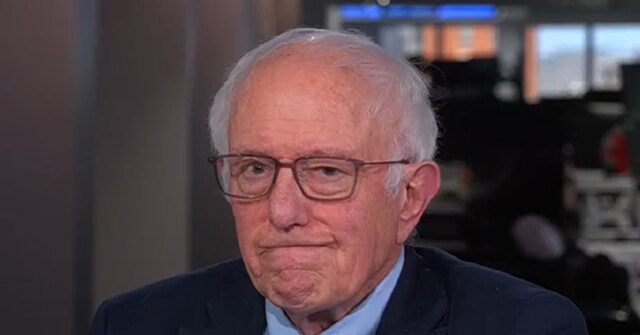
The erosion has exposed deeper tensions within the broader conservative movement. While some hard-line voices continue to back the strikes on Iran, others have grown uneasy with the conflict’s open-ended nature and its overlap with Israeli Prime Minister Benjamin Netanyahu’s regional ambitions. Vermont Sen. Bernie Sanders, an independent who caucuses with Democrats, spoke bluntly on MSNBC this week, calling Trump “mentally unstable.” Sanders pointed to the president’s habit of circulating images depicting himself in Christ-like form as particularly offensive to Catholics and people of faith worldwide. He tied the Iran operation to what he called Netanyahu’s long-standing desire for American-backed conflict with Tehran, and announced plans to introduce resolutions blocking further U.S. funding for Netanyahu’s government over its actions in Gaza, the West Bank, and now Iran.
Sanders’s remarks reflect a growing willingness on the left to question not just Trump’s policies but his basic fitness for office. On Tuesday, House Democrats introduced legislation that would create a bipartisan commission to examine whether the 25th Amendment should be invoked. The bill, with 50 Democratic co-sponsors, envisions a 17-member panel of former high-ranking officials who could recommend a medical evaluation of the president’s capacity to discharge his duties. Rep. Jamie Raskin of Maryland, the lead sponsor, cited Trump’s “violent rhetoric toward Iran,” his violation of congressional war powers, his insults directed at the Pope, and the messianic imagery as evidence that public trust in his judgment has reached “unprecedented lows.”
The legislation faces long odds. The 25th Amendment requires the vice president and a majority of the cabinet, or a specially constituted body, to declare the president unable to serve. Vice President JD Vance, a close ideological ally of Trump, is unlikely to participate in any such effort. Still, the move serves as a formal marker of Democratic alarm and a reminder that Congress retains tools, however imperfect, to respond to perceived presidential instability.
The convergence of these stories paints a picture of a presidency under strain. The Iran conflict was sold by the administration as a decisive blow against a nuclear threat. Yet it has instead produced a messy stalemate, diplomatic friction with even right-wing European leaders, and domestic political hemorrhage. Trump’s characteristic response, lashing out at Meloni and doubling down on personal grievances, has done little to reassure those worried about escalation.
For years, Trump’s appeal rested on an image of strength and defiance of elite consensus. That image is now being tested by the realities of governing during an unpredictable war. Non-college white voters, many of whom supported the president precisely because they distrusted endless Middle East entanglements, appear to be signaling limits to how much chaos they will tolerate in the name of toughness.
The coming weeks will test whether the fractures within MAGA deepen or whether Trump can once again consolidate support by framing criticism as weakness or disloyalty. Democrats, for their part, are using the moment to highlight institutional safeguards, even if those safeguards currently appear insufficient. What began as a foreign policy decision has become a stress test for American politics, exposing divisions that extend well beyond the usual partisan lines. The president’s own base is watching closely, and early returns suggest many are not pleased with what they see.
You just read Liberal's take. Want to read what actually happened?
More in Politics

Federal Agents Search Omar Home in Ongoing Immigration Probe
Homeland Security agents searched the Minnesota Democrat's DC residence in a criminal probe, prompting accusations of political intimidation from Omar and Democratic leaders. Coverage spans left-leaning outlets like NPR, BBC, and The Guardian alongside right-leaning criticism from The Federalist and Daily Wire.

Trump Diesel Import Plan Draws Pushback Over Russia Ties
The weekend agreement drew bipartisan congressional pushback and criticism from Ukraine's Zelenskyy, with analysts downplaying US fuel price impacts. Right-leaning outlets like National Review, Dispatch, and Washington Examiner questioned its legality and effectiveness.

Independents Test Voter Appetite for Middle Ground in 2026 Midterms
Nearly 200 independents are running in competitive races as voters weigh ballot measures on housing costs in states like Massachusetts. Left-leaning coverage from NYT, NPR, and Guardian highlights turnout and key races while right outlets focus on GOP strategy.
Trump Rallies in Alaska, Ohio to Bolster GOP Senate Candidates
The president rallied in Wasilla for Sen. Dan Sullivan and faced empty seats at an Ohio event amid midterm concerns. Outlets across the spectrum covered the trips as signals of GOP vulnerability weeks before Election Day.
The Compass
You just read five takes on one story.
What's your take? Find your political shape in a few minutes.
Take the test