
Trump Attacks Former MAGA Allies Over Iran Policy Criticism
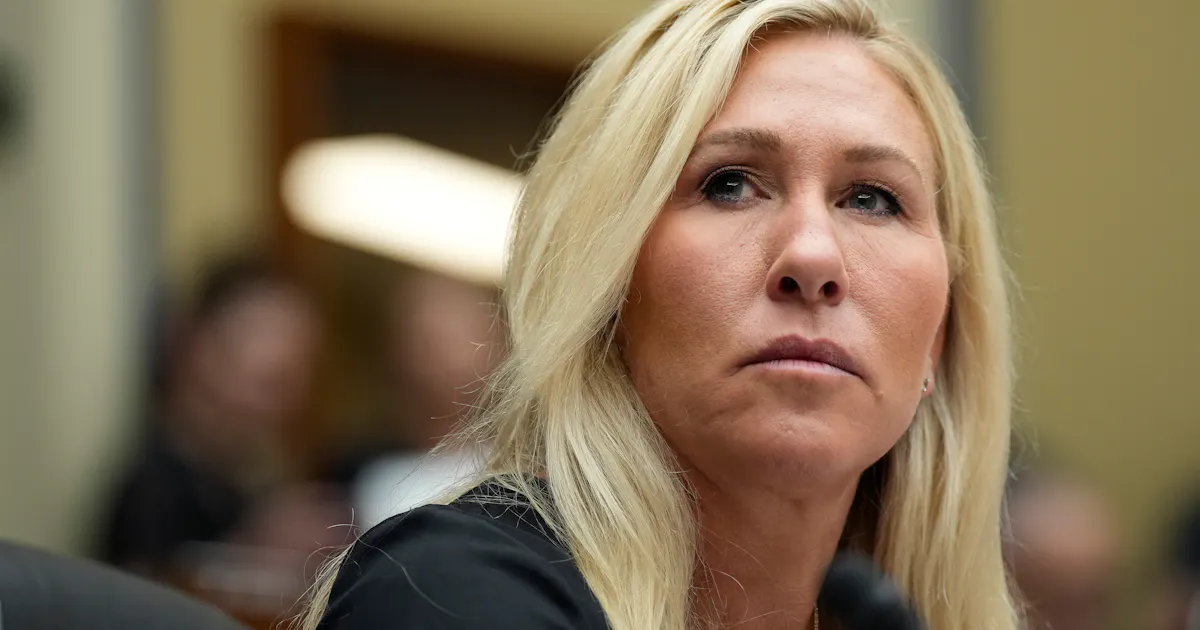
Cover image from newrepublic.com, which was analyzed for this article
Rep. Marjorie Taylor Greene publicly attacked Trump and Netanyahu on Iran strategy, exposing MAGA fractures, while Trump lashed out at critics like Tucker Carlson and MTG. The rifts highlight tensions within Republicans over war escalation and future direction. Outlets note growing disillusionment among Trump supporters.
PoliticalOS
Friday, April 10, 2026 — Politics
The public break between Trump and former allies like Tucker Carlson, Candace Owens and Marjorie Taylor Greene reveals genuine tensions inside the Republican coalition over the use of military force and adherence to campaign promises on avoiding new wars. Trump retains strong polling support among Republican voters and frames the critics as marginal, yet the episode—coming after a short conflict that ended in ceasefire—raises questions about the durability of the MAGA coalition on foreign policy. The most important reality is that these divisions exist at the elite level and have not yet translated into measurable erosion of Trump's base, but they signal competing visions for the party's future direction.
What outlets missed
Most coverage omitted that Marjorie Taylor Greene resigned from Congress on January 5, 2026, and was speaking as a private citizen rather than a current lawmaker with direct influence. Outlets underplayed the specific sequence of the Iran conflict, including its start after Iranian missile strikes on Israel and the assassination of Supreme Leader Khamenei, followed by a ceasefire agreement on April 8 just before Trump's post. Several reports treated critic statements such as Carlson calling threats "evil" or Owens labeling the administration "satanic" as fully verified without noting that exact phrasing could not be located in public records or primary sources. The mutual escalation was often framed as one-sided, with less attention to Owens and Jones explicitly calling for Trump's removal before his response. Finally, coverage gave limited context on the Strait of Hormuz shutdown as the immediate trigger for Trump's deadlines and threats, instead emphasizing personal insults over the underlying policy dispute.
Trump Faces Revolt From Core Supporters Over Reckless Iran Escalation
President Donald Trump’s military confrontation with Iran has produced the sharpest internal rupture yet within the MAGA coalition, as longtime allies and grassroots voters openly question both his judgment and his fitness for office. Rather than unifying conservatives behind a clear-eyed defense of American interests, the conflict has triggered personal tirades from the president, a wave of defections from influential voices on the right, and visible erosion of support among the very voters who backed him three times.
The episode began with Trump’s own rhetoric. In the days before announcing a two-week ceasefire, the president issued profane public warnings that Iran would face “Power Plant Day, and Bridge Day, all wrapped up in one” and that “a whole civilization will die tonight” if Tehran failed to reopen the Strait of Hormuz. The threats were not abstract. They followed American strikes inside Iran and appeared to contemplate widespread destruction of civilian infrastructure, a step that even many hawks have historically treated as a last resort rather than a negotiating tactic.
That rhetoric broke the dam. Tucker Carlson, who campaigned vigorously for Trump in 2024, called the Easter message “vile on every level” and urged military aides to refuse orders targeting Iranian civilians. Megyn Kelly told the president to “f***ing shut up about that sh*t.” Candace Owens labeled the administration’s conduct “satanic” and called on Congress to remove “the Mad King Trump.” Alex Jones described the episode in terms of dementia. Each had been a consistent amplifier of Trump’s message until the Iran operation exposed what they viewed as a dangerous departure from prudent statecraft.
The most striking defection came from Representative Marjorie Taylor Greene. Once among Trump’s fiercest defenders in Congress, Greene sat for a CNN interview and delivered a clinical indictment. She described the president as “mentally unfit for the presidency,” said advisers must “rein him in,” and argued that his behavior proved he is “catastrophically failing.” When Trump responded on Truth Social by nicknaming her “Marjorie ‘Traitor’ Brown,” mocking her complexion under stress, and suggesting she smelled, Greene replied with calm detachment: one does not negotiate with bullies who are visibly losing control.
Trump followed with a 482-word Truth Social post that read like a pressure valve releasing. He called the critics “losers,” “stupid people,” and “low IQs,” insisted their families know it, and claimed he no longer cared what they thought. The tone suggested a man rattled less by foreign adversaries than by the sudden realization that his base is no longer monolithic. Subsequent posts repeated the attacks, indicating the episode is not a one-off outburst but a sustained breach.
The reaction from ordinary supporters proved more damaging than the elite criticism. On Truth Social, self-described “triple Trumpers” posted farewells. One voter who claimed to have supported him in every election wrote that the president had turned on the very people “who fought for him to win” and that “MAGA left me too.” Another announced she was “hanging up my MAGA hat,” citing the Iran war, the Jeffrey Epstein files, and a sense that the administration had abandoned the restraint it once promised. These are not suburban moderates or Never Trump holdouts. They are the core demographic that delivered Rust Belt states and supplied the volunteer energy of two successful campaigns.
The fracture matters because it tracks long-standing conservative warnings about foreign policy conducted on emotion rather than interest. Military action without clearly defined, limited objectives tends to consume political capital at home while producing uncertain gains abroad. The current Iran operation has already disrupted global energy markets, invited retaliation, and forced a premature ceasefire that leaves core issues unresolved. That pattern, repeated across administrations of both parties, has historically eroded public tolerance for sustained engagement. Trump’s innovation was to package skepticism of forever wars as a central campaign theme. The irony of his current predicament is not lost on the movement he once led.
Greene’s willingness to speak plainly on national television may prove the more consequential development. Her critique was not ideological; it was practical. She argued that a president lashing out at allies, issuing apocalyptic threats, and appearing unable to absorb dissent is simply not functioning at the level the office requires. That assessment, delivered by a politician with impeccable populist credentials, carries weight that generic media criticism cannot match. It also signals that loyalty alone may no longer paper over observable failures of temperament and execution.
For now, Trump insists the critics are marginal and that he has moved on. Yet the volume and repetition of his responses suggest otherwise. When a president spends consecutive days insulting the commentators and lawmakers who formed his praetorian guard, he is not projecting strength but revealing isolation. The grassroots comments on his own platform reinforce the point: once supporters begin telling a leader he has squandered their trust, the political math changes quickly.
The Iran episode therefore stands as more than a foreign-policy dispute. It is a stress test of whether the conservative movement that coalesced around Trump can survive his presidency or whether it will splinter into factions that remember the original America First critique yet no longer see its author as its champion. Early returns indicate the coalition is under genuine strain, and the president’s instinct to treat dissent as treason has only accelerated the damage. Prudent leadership would recognize the warning signs. So far, the response has been rage, repetition, and further alienation of the very people who provided his margin of victory.
You just read Conservative's take. Want to read what actually happened?