
Iran Ceasefire Uncertainty Drives Record US Gas Prices, Economic Strain
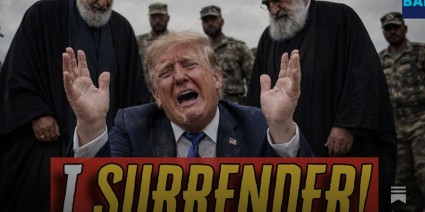
Cover image from crooksandliars.com, which was analyzed for this article
Strait of Hormuz disruptions from the Iran war have driven record gas prices, higher inflation, and revised Q4 GDP to a sluggish 0.5%, hurting construction and consumers. Analysts call the oil shock worse than apparent with persistent pressures. Calls grow for expanding domestic energy supply.
PoliticalOS
Saturday, April 11, 2026 — Business
The Iran conflict and incomplete reopening of the Strait of Hormuz have translated distant geopolitical tension into immediate higher prices at American gas pumps, renewed inflation and slower economic growth. No single energy source or diplomatic formula solves the vulnerability overnight. A sustained all-of-the-above domestic supply build-out paired with verifiable, rules-based access to international chokepoints offers the clearest path to cushioning future shocks.
What outlets missed
Most outlets downplayed or omitted the precise mix of verified partial traffic increases reported by U.S. officials alongside persistent restrictions, creating a false binary of 'open' or 'closed.' Coverage largely ignored the substantial role of Inflation Reduction Act federal tax credits in enabling the solar boom in red states, which accounted for over two-thirds of 2025 installations according to EIA and SEIA data. Few pieces noted that France's nuclear doctrine update was driven primarily by Russia's Ukraine invasion and Belarus signaling, per the Bulletin of the Atomic Scientists, rather than U.S. policy alone. The combined macroeconomic revisions, specific sector impacts on construction payrolls, and consumer spending contraction figures from federal forecasters received scant attention amid partisan framing. Finally, the exact ceasefire text limiting its scope to Hormuz and sanctions discussions, without reference to Hezbollah, was rarely quoted directly, obscuring how Iran introduced new conditions.
Iran Maintains Leverage Over Global Energy as Hormuz Ceasefire Unravels
President Donald Trump's announced ceasefire with Iran this week has failed to restore reliable passage through the Strait of Hormuz, with Tehran allowing only token commercial traffic while keeping the critical waterway largely closed. The development underscores the persistent risks of relying on volatile foreign chokepoints for energy supplies at a time when several Republican-led states are demonstrating the benefits of aggressively expanding domestic production from every available source.
In a Tuesday evening announcement, Trump said the United States would suspend planned strikes on Iranian power plants and bridges for two weeks. Iran, in return, committed to the "complete, immediate, and safe opening" of the strait, which carries roughly one-fifth of global oil consumption and large volumes of liquefied natural gas. Yet Iranian state media reported only four non-tanker cargo ships cleared the passage on Wednesday and a handful more on Thursday. Iranian officials then declared that Israeli actions against Hezbollah in Lebanon violated the truce, even though the agreement made no reference to the Lebanese terrorist group.
This rhetorical shift appears calculated. Hezbollah has fired rockets at Israel for more than two years, beginning after the Hamas attack of October 2023 that itself flowed from Iranian support for proxy militias. Israel has responded with force against an organization explicitly dedicated to its destruction. By retrofitting the Hormuz ceasefire to an unrelated conflict, Tehran is using its remaining leverage after weeks of military degradation that left much of its Islamic Revolutionary Guard Corps leadership eliminated. With conventional capabilities diminished, control over the narrow strait between the Persian Gulf and the Gulf of Oman has become Iran's primary bargaining tool.
The economic consequences have been immediate. Energy markets swung on the initial ceasefire news, but persistent uncertainty has kept insurance rates and shipping costs elevated. Seafarers and Gulf exporters on both sides of the waterway share an interest in stable transit, yet Iran's selective reopening has done little to restore confidence. Observers note that the episode illustrates the limitations of temporary diplomatic pauses with a regime that has repeatedly used commercial shipping as a pressure point.
Some analysts, including energy consultant Roudi Baroudi writing in Al Jazeera, have called for a broader regional agreement grounded in the United Nations Convention on the Law of the Sea and related maritime treaties. Such frameworks establish rules for transit passage and encourage delimited borders based on equitable principles. Whether those legal structures can overcome decades of mistrust remains an open question. What is clearer is the incentive for nations dependent on imported energy to reduce that dependence.
Here at home, several states governed by Republicans are already acting on that logic without waiting for international accords. Texas, in particular, has seen explosive growth in solar and battery storage capacity, not because of federal mandates but because these technologies represent some of the fastest and least expensive ways to meet surging electricity demand. Solar accounted for 54 percent of all new U.S. generating capacity added last year. Texas now ranks among the fastest-growing markets for both solar and storage, helping stabilize the grid and attract manufacturing investment.
This pragmatic expansion aligns with the long-standing conservative preference for an all-of-the-above energy strategy. Energy Secretary Chris Wright recently emphasized unleashing next-generation geothermal, advancing storage, and developing new solar technologies alongside traditional sources. A senior Trump pollster reiterated that the president supports "nuclear, renewables" and conventional fuels alike. The approach recognizes a basic economic reality: global electricity demand is projected to double by 2050. Restricting options out of ideological purity serves no one's interest, least of all when competing with a China that dominates certain supply chains.
Red states have shown that market signals, not central planning, can drive innovation when regulatory barriers are reduced. Lower electricity prices flow from abundant supply rather than conservation lectures or subsidies that distort investment. The current Hormuz standoff offers a vivid reminder of why that abundance matters. Every barrel that does not need to transit a hostile-controlled strait is one less source of leverage for adversaries and one less variable for American families and manufacturers facing higher costs.
The Trump administration's initial attempt at a ceasefire reflected an understandable desire to avoid wider conflict after five weeks of hostilities. Yet Iran's swift renegotiation on terms unrelated to the original deal suggests Tehran believes it can still extract concessions by holding global commerce hostage. Whether the pause collapses entirely or limps forward, the episode reinforces a lesson Thomas Sowell has illustrated across decades of scholarship: incentives matter more than intentions. Regimes that derive power from disruption respond to strength and self-reliance, not appeals to shared vulnerability.
For the United States, the sound response lies in accelerating the domestic energy expansion already visible in red states. That means permitting reform for oil, gas, and nuclear projects; targeted research into advanced geothermal and next-generation solar; and grid enhancements that incorporate storage without picking winners through punitive taxes on conventional fuels. Such steps do not require new international bureaucracies. They require policymakers to recognize that true energy security begins at home, where supply can be increased according to economic logic rather than the shifting demands of foreign militias.
As the situation in the Gulf remains fluid, American consumers are once again seeing the hidden costs of dependence. The most effective antidote is not another round of diplomacy that treats Iranian behavior as negotiable. It is the steady accumulation of domestic capacity that renders such behavior irrelevant. Several states have already begun proving the model works. The question is whether Washington will clear the path for the rest of the country to follow.
You just read Conservative's take. Want to read what actually happened?