
Iran Ceasefire Uncertainty Drives Record US Gas Prices, Economic Strain
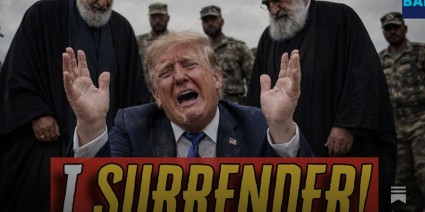
Cover image from crooksandliars.com, which was analyzed for this article
Strait of Hormuz disruptions from the Iran war have driven record gas prices, higher inflation, and revised Q4 GDP to a sluggish 0.5%, hurting construction and consumers. Analysts call the oil shock worse than apparent with persistent pressures. Calls grow for expanding domestic energy supply.
PoliticalOS
Saturday, April 11, 2026 — Business
The Iran conflict and incomplete reopening of the Strait of Hormuz have translated distant geopolitical tension into immediate higher prices at American gas pumps, renewed inflation and slower economic growth. No single energy source or diplomatic formula solves the vulnerability overnight. A sustained all-of-the-above domestic supply build-out paired with verifiable, rules-based access to international chokepoints offers the clearest path to cushioning future shocks.
What outlets missed
Most outlets downplayed or omitted the precise mix of verified partial traffic increases reported by U.S. officials alongside persistent restrictions, creating a false binary of 'open' or 'closed.' Coverage largely ignored the substantial role of Inflation Reduction Act federal tax credits in enabling the solar boom in red states, which accounted for over two-thirds of 2025 installations according to EIA and SEIA data. Few pieces noted that France's nuclear doctrine update was driven primarily by Russia's Ukraine invasion and Belarus signaling, per the Bulletin of the Atomic Scientists, rather than U.S. policy alone. The combined macroeconomic revisions, specific sector impacts on construction payrolls, and consumer spending contraction figures from federal forecasters received scant attention amid partisan framing. Finally, the exact ceasefire text limiting its scope to Hormuz and sanctions discussions, without reference to Hezbollah, was rarely quoted directly, obscuring how Iran introduced new conditions.
Iran Tightens Grip on Oil Lifeline as Trump Ceasefire Falls Apart
President Donald Trump announced a ceasefire with Iran earlier this week that was supposed to bring immediate relief to global energy markets. In exchange for the United States suspending strikes on Iranian power plants and bridges, Tehran pledged the complete, immediate, and safe reopening of the Strait of Hormuz. That has not happened. Aside from a handful of non-tanker cargo ships allowed through on Wednesday and Thursday, the narrow passageway that carries roughly one-fifth of the world’s oil trade remains effectively closed. Iran has simply moved the goalposts.
Iranian state media now claims Israel’s defensive operations against Hezbollah in Lebanon somehow violate the agreement. The ceasefire document made no mention of Hezbollah. This is not confusion. It is a calculated move by a regime that has spent years building proxy armies to fight its battles while holding the global economy hostage at the chokepoint. Hezbollah began its rocket campaign against Israel in October 2023, right after the Hamas attack Iran helped enable. Israel did not seek that fight. It responded to sustained aggression against its citizens. By dragging that separate conflict into the Hormuz discussion, Iran is retrofitting the deal to preserve its last major lever after weeks of military degradation.
The costs are already landing on American families. Higher insurance rates for tankers, rerouted shipping, and tightening supply have pushed energy prices upward at precisely the wrong moment. Working people in Ohio, Pennsylvania, and across the Midwest who are still recovering from years of inflation do not care about diplomatic wording. They see it at the gas pump and in their utility bills. Iran is charging a toll, and American drivers are paying it.
This episode exposes the folly of expecting a theocratic dictatorship to honor paper agreements. The Islamic Revolutionary Guard Corps has lost much of its senior leadership in the recent fighting. Mid-level functionaries now running the show appear more interested in survival and leverage than peace. Their control of the strait is the one card they have left, and they are playing it for all it is worth.
Meanwhile, major powers are taking notice. China, Russia, and even France have begun adjusting their nuclear doctrines in response to the instability and heated rhetoric. Nuclear policy analysts warn that loose talk combined with real disruptions in energy flows can accelerate proliferation pressures no one wants. The pattern is familiar: America gets pulled into another Middle Eastern crisis, our resources are diverted, our people bear the economic burden, and adversaries exploit the chaos.
Some voices are already calling for a grand regional treaty under the United Nations Convention on the Law of the Sea and other international frameworks. That is the same failed globalist reflex that has delivered one disappointment after another. Iran has never shown respect for those conventions when they conflict with its revolutionary aims. More conferences in Geneva will not change that.
The smarter path is the one already being followed in red states that refuse to let foreign crises dictate American prosperity. Texas has become one of the fastest-growing markets for solar and battery storage without heavy-handed mandates from Washington. These additions are not replacing baseload power; they are complementing it to meet exploding electricity demand that experts say will double by 2050. The approach aligns with the long-standing Republican commitment to all-of-the-above energy development.
Energy Secretary Chris Wright has emphasized unleashing geothermal, advancing storage technology, and supporting new solar alongside nuclear and traditional sources. President Trump has repeatedly described his vision the same way. Domestic manufacturing, including in the solar supply chain, can be strengthened without pretending we can wish away the need for oil and gas while the world still runs on them. The goal is straightforward: produce more energy here so decisions made in Tehran cannot rattle grocery prices in Toledo.
The contrast could not be clearer. While diplomats haggle over a strait halfway around the world, states governed by practical conservatives are expanding supply from every viable source. That is how you achieve real energy dominance instead of slogans. It is also how you eventually tell Iran and every other oil-state actor that their leverage has an expiration date.
The two-week suspension period Trump announced will test whether any meaningful reopening occurs. So far the signs are not encouraging. Iran’s behavior confirms what America First skeptics have argued for years: entangling ourselves deeper in the region’s ancient hatreds rarely serves our interests. Our priority must remain rebuilding strength at home, securing our own borders, and ensuring American workers are not the ones who pay every time Tehran decides to play games with the world’s oil lifeline.
The regime in Iran has lost significant military capacity. Its proxies are under pressure. Yet it still possesses the ability to inflict pain on distant economies. The lesson is not to launch another forever war. The lesson is to accelerate the domestic energy revolution already underway in red states so that future generations of Americans are no longer vulnerable to extortion by a hostile theocracy. Until that independence is achieved, expect more tolls, more broken promises, and more pain at the pump.
You just read America First's take. Want to read what actually happened?