
Iran Ceasefire Uncertainty Drives Record US Gas Prices, Economic Strain
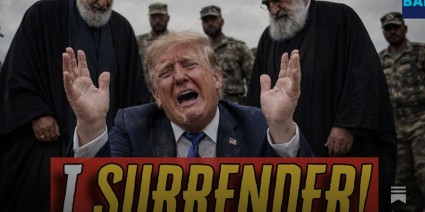
Cover image from crooksandliars.com, which was analyzed for this article
Strait of Hormuz disruptions from the Iran war have driven record gas prices, higher inflation, and revised Q4 GDP to a sluggish 0.5%, hurting construction and consumers. Analysts call the oil shock worse than apparent with persistent pressures. Calls grow for expanding domestic energy supply.
PoliticalOS
Saturday, April 11, 2026 — Business
The Iran conflict and incomplete reopening of the Strait of Hormuz have translated distant geopolitical tension into immediate higher prices at American gas pumps, renewed inflation and slower economic growth. No single energy source or diplomatic formula solves the vulnerability overnight. A sustained all-of-the-above domestic supply build-out paired with verifiable, rules-based access to international chokepoints offers the clearest path to cushioning future shocks.
What outlets missed
Most outlets downplayed or omitted the precise mix of verified partial traffic increases reported by U.S. officials alongside persistent restrictions, creating a false binary of 'open' or 'closed.' Coverage largely ignored the substantial role of Inflation Reduction Act federal tax credits in enabling the solar boom in red states, which accounted for over two-thirds of 2025 installations according to EIA and SEIA data. Few pieces noted that France's nuclear doctrine update was driven primarily by Russia's Ukraine invasion and Belarus signaling, per the Bulletin of the Atomic Scientists, rather than U.S. policy alone. The combined macroeconomic revisions, specific sector impacts on construction payrolls, and consumer spending contraction figures from federal forecasters received scant attention amid partisan framing. Finally, the exact ceasefire text limiting its scope to Hormuz and sanctions discussions, without reference to Hezbollah, was rarely quoted directly, obscuring how Iran introduced new conditions.
Trump's Iran Ceasefire Collapses Within Days as Strait of Hormuz Remains Choked
The ceasefire President Donald Trump announced on Tuesday with Iran has already frayed, exposing the limits of bilateral deals forged under military pressure and raising fresh questions about the stability of global energy flows and nuclear norms. In exchange for the United States suspending planned strikes on Iranian power plants and bridges for two weeks, Tehran had pledged the “complete, immediate, and safe opening” of the Strait of Hormuz. Yet the narrow waterway that carries roughly one-fifth of global oil trade has stayed largely closed. Iranian state media reported that only a handful of non-tanker cargo ships have been permitted to pass, while officials retroactively tied the reopening to Israeli strikes against Hezbollah in Lebanon, a conflict the original agreement never mentioned.
This maneuver was not a misunderstanding, according to analysts familiar with Iranian strategy. With much of its conventional military degraded after five weeks of fighting, Tehran has turned its control over the strait into leverage. The tactic holds the world economy hostage at a moment when energy demand is projected to double by 2050. Energy markets reacted with predictable nervousness; shipping insurance rates for the Persian Gulf spiked again on Thursday. The episode underscores a deeper structural problem: the world’s most critical maritime chokepoint lacks a durable, regionally owned legal framework capable of surviving great-power brinkmanship.
That vacuum is what makes the current breakdown more than a tactical setback. Roudi Baroudi, writing in Al Jazeera, argues that Iran and its Arab neighbors share the greatest stake in a lasting solution. All of them depend on the strait for exports and food imports. Repairing wartime damage to infrastructure is only the first step; restoring international confidence in the waterway will require something more ambitious. The legal scaffolding already exists in the United Nations Convention on the Law of the Sea and related treaties governing transit passage. What has been missing is political will to adapt those principles into a tailored regional agreement that accounts for local security concerns, environmental safeguards, and equitable burden-sharing for maintaining safe navigation.
Instead, the Trump administration bet on a transactional pause. The approach mirrors the president’s broader style: personal diplomacy paired with maximum leverage. Yet the early collapse has produced ripple effects beyond the Gulf. Nuclear policy experts report that China, Russia, and France are now revising their nuclear doctrines in response to what they view as erratic signaling from Washington. Rebecca Lubot, a nuclear policy analyst, warned in a recent interview that loose talk about striking Iranian nuclear sites has accelerated proliferation pressures rather than containing them. When the world’s remaining superpower treats arms control as an afterthought, others begin to hedge by tightening their own triggers.
The domestic political consequences inside the United States are also becoming visible. Rich Logis, founder of the group Leaving MAGA, described a growing trickle of former Trump supporters who cite foreign policy chaos as their breaking point. In conversations with those peeling away, Logis hears a consistent theme: the gap between promised strength and actual competence has become too wide to ignore. While the sample size remains anecdotal, it aligns with polling that shows Trump’s approval on national security eroding even among some who backed his return to office.
None of this negates the legitimate U.S. interest in energy security. Red states have quietly demonstrated that pragmatic supply expansion can lower costs without ideological litmus tests. Texas, in particular, has seen rapid growth in solar and battery storage not because of federal mandates but because these resources are among the fastest and cheapest ways to meet surging electricity demand. The Trump administration’s energy secretary has echoed an “all-of-the-above” approach that includes next-generation geothermal, advanced nuclear, and new solar manufacturing. In theory, greater domestic production should insulate America from Gulf disruptions. In practice, global markets remain tightly linked. A prolonged closure of Hormuz would still drive up prices at American gas stations and ripple through manufacturing supply chains.
The deeper problem is one of institutional erosion. Decades of U.S. policy assumed that freedom of navigation in international straits could be maintained through a combination of naval presence, diplomatic engagement, and accepted legal norms. That architecture is now under strain. Iran’s willingness to treat the strait as a toll road suggests a future in which regional powers assert unilateral control over global commons whenever it suits them. The United Nations Convention on the Law of the Sea, long criticized by some conservatives as overly restrictive, suddenly looks like an underutilized tool rather than an obstacle.
Whether the current pause can be salvaged into something more stable remains unclear. Iranian leaders have sidelined more experienced diplomats in favor of harder-line figures from the Islamic Revolutionary Guard Corps. The United States, for its part, continues to balance support for Israel’s right to defend itself against Hezbollah with the need to prevent a wider war. These tensions cannot be resolved by tweet or ultimatum.
What the past week has clarified is that transactional ceasefires are poor substitutes for patient, multilateral diplomacy rooted in shared legal principles. The Gulf states, including Iran, have more in common than their public rhetoric suggests: none can afford a permanently contested strait. Crafting an agreement that reflects that reality will require more than two-week pauses. It will demand the very thing currently in shortest supply: sustained, unglamorous negotiation grounded in law, precedent, and mutual interest. The alternative is repeated cycles of closure, crisis, and higher energy costs borne by consumers worldwide.
You just read Liberal's take. Want to read what actually happened?