
Iran Ceasefire Uncertainty Drives Record US Gas Prices, Economic Strain
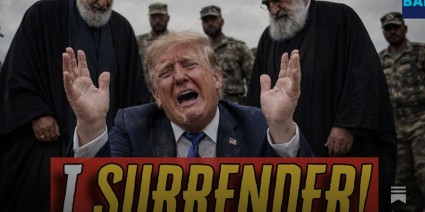
Cover image from crooksandliars.com, which was analyzed for this article
Strait of Hormuz disruptions from the Iran war have driven record gas prices, higher inflation, and revised Q4 GDP to a sluggish 0.5%, hurting construction and consumers. Analysts call the oil shock worse than apparent with persistent pressures. Calls grow for expanding domestic energy supply.
PoliticalOS
Saturday, April 11, 2026 — Business
The Iran conflict and incomplete reopening of the Strait of Hormuz have translated distant geopolitical tension into immediate higher prices at American gas pumps, renewed inflation and slower economic growth. No single energy source or diplomatic formula solves the vulnerability overnight. A sustained all-of-the-above domestic supply build-out paired with verifiable, rules-based access to international chokepoints offers the clearest path to cushioning future shocks.
What outlets missed
Most outlets downplayed or omitted the precise mix of verified partial traffic increases reported by U.S. officials alongside persistent restrictions, creating a false binary of 'open' or 'closed.' Coverage largely ignored the substantial role of Inflation Reduction Act federal tax credits in enabling the solar boom in red states, which accounted for over two-thirds of 2025 installations according to EIA and SEIA data. Few pieces noted that France's nuclear doctrine update was driven primarily by Russia's Ukraine invasion and Belarus signaling, per the Bulletin of the Atomic Scientists, rather than U.S. policy alone. The combined macroeconomic revisions, specific sector impacts on construction payrolls, and consumer spending contraction figures from federal forecasters received scant attention amid partisan framing. Finally, the exact ceasefire text limiting its scope to Hormuz and sanctions discussions, without reference to Hezbollah, was rarely quoted directly, obscuring how Iran introduced new conditions.
Trumps Iran Ceasefire Collapses Under Its Own Contradictions
President Donald Trump announced a ceasefire with Iran on Tuesday, promising a two-week suspension of American strikes on Iranian infrastructure in exchange for Tehran’s “complete, immediate, and safe opening” of the Strait of Hormuz. Less than forty-eight hours later the agreement is already in tatters, the strait remains effectively closed to most commercial traffic, and the consequences are rippling through global energy markets, nuclear policy, and even Trump’s own political base.
Iranian officials have allowed only a trickle of non-tanker cargo vessels to pass since the announcement. State media now insists that Israeli strikes on Hezbollah in Lebanon constitute a breach of the ceasefire, even though the original understanding made no reference to the Lebanese militant group. The move is transparently tactical. With much of its conventional military capacity degraded after five weeks of conflict, Tehran has seized on its remaining point of leverage: control over the narrow waterway through which roughly one-fifth of the world’s seaborne oil passes. By throttling that flow it can inflict pain on economies far beyond the Gulf while buying time to regroup.
The economic fallout is already visible. Global oil prices spiked again on Thursday as traders priced in prolonged disruption. That pain will eventually reach American consumers at the pump, a bitter irony for an administration that has spent years promising lower energy costs through bravado and bullying. Even red states that once treated renewable energy with skepticism are now rushing to expand solar and battery storage, not because of environmental mandates but because they recognize the strategic folly of depending on volatile foreign chokepoints. Texas, in particular, has seen explosive growth in both sectors, adding capacity faster than almost anywhere else in the country. Energy Secretary Chris Wright’s recent remarks endorsing an “all-of-the-above” strategy that includes next-generation geothermal, storage, and new solar technologies reflect this pragmatic shift. When foreign policy failures drive up costs at home, even Trump’s own supporters are forced to hedge with the very technologies they once derided.
The deeper danger, however, is nuclear. Trump’s erratic rhetoric, alternating between threats to bomb Iranian cultural sites and grandiose claims of deal-making genius, has unnerved allies and adversaries alike. China, Russia, and France have all begun revising their nuclear doctrines in direct response to what one European diplomat called the “unpredictable unilateralism” coming from Washington. Nuclear policy expert Rebecca Lubot described the moment as profoundly destabilizing. “When the world’s only superpower behaves this erratically, others feel compelled to update their own deterrence postures,” she said. The result could be a new arms race in an already volatile region.
The domestic political reverberations are equally striking. Rich Logis, founder of the Leaving MAGA movement, has watched an uptick in former Trump supporters reaching out for guidance. Many cite the Iran episode as a breaking point, the moment when the gap between the president’s promises of strength and the chaotic reality became impossible to ignore. Logis, who left the movement himself after years of loyalty, argues that the current crisis offers a rare off-ramp for those still clinging to the ideology. “If watching your country stumble into nuclear-risk territory doesn’t shake you, what will?” he asked during a recent interview.
The episode exposes the limits of Trump’s transactional style on the global stage. A short-term suspension of strikes was never going to resolve decades of mistrust or address the fundamental insecurity Iran feels when its revolutionary guard has been decapitated and its proxies are under sustained attack. Roudi Baroudi, writing in Al Jazeera, makes a compelling case for something more durable: a regional agreement rooted in the United Nations Convention on the Law of the Sea. The legal architecture already exists. What is missing is the political will in Washington and Tehran to move beyond zero-sum games. Iran and its Arab neighbors all depend on the strait for their economic survival. A framework that guarantees safe passage while respecting legitimate security concerns would serve everyone better than repeated crises that spike energy prices and raise the specter of wider war.
Instead, the administration appears content to treat the ceasefire as a public-relations victory even as Iranian officials publicly move the goalposts. This is not diplomacy. It is damage control masquerading as deal-making. The Islamic Revolutionary Guard Corps, now run by mid-level survivors after its senior ranks were decimated, understands that its best remaining weapon is economic disruption. And Trump’s team, having talked itself into a corner, seems unsure how to respond without either escalating militarily or admitting the original agreement was never worth the paper it wasn’t written on.
The Strait of Hormuz has been a flashpoint for decades. What makes this moment different is the combination of a degraded Iranian military, an American president whose attention span and credibility are both in free fall, and a global energy transition that is accelerating precisely because of such instability. Red states embracing solar and storage are not rejecting fossil fuels. They are acknowledging a basic truth: relying on fragile foreign supply lines managed by hostile regimes is a strategic liability.
As the two-week window ticks down, the risks are compounding. Higher gasoline prices will hit working families. Nuclear doctrine changes by major powers could reshape global security for a generation. And inside the MAGA ecosystem, more supporters appear to be quietly calculating the cost of continued loyalty. Trump once boasted he would end endless wars and deliver energy dominance. Instead his approach has produced neither peace nor lower prices, only new dangers and a growing realization among some of his followers that the emperor has no clothes, and the strait has no ships.
The coming days will determine whether this ceasefire can be salvaged or whether it becomes yet another footnote in a presidency defined by chaos. For now the evidence is clear: Iran is charging its toll, the waterway remains contested, and the consequences are landing on the American public that Trump claims to champion.
You just read Progressive's take. Want to read what actually happened?