
Artemis II Crew Nears High-Stakes Reentry After Record Lunar Flyby
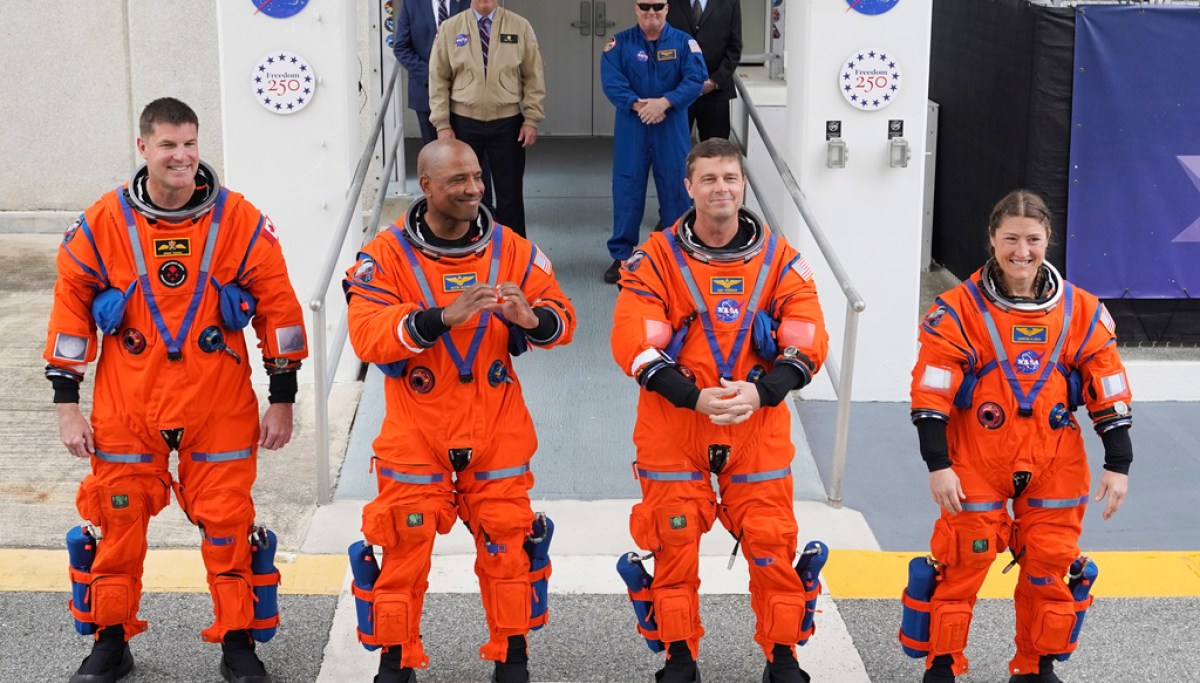
Cover image from washingtonexaminer.com, which was analyzed for this article
NASA's Artemis II astronauts are preparing for reentry into Earth's atmosphere and a Pacific Ocean splashdown, capping the first crewed lunar mission since Apollo. Despite a helium leak in the Orion spacecraft requiring future redesigns, the issue poses no threat to this mission's conclusion. Coverage emphasizes the historic milestone in America's return-to-Moon program amid national division.
PoliticalOS
Friday, April 10, 2026 — Tech
Artemis II has successfully completed the first crewed lunar flyby in more than 50 years, breaking distance records and gathering data on radiation, surface observations and spacecraft performance. Yet the program remains years behind original schedules, with a helium leak requiring redesign before lunar orbit flights and commercial landers still unproven. The reentry on April 10 will test whether NASA’s adjusted heat shield strategy and international partnerships can convert this milestone into a sustainable path back to the lunar surface ahead of geopolitical rivals.
What outlets missed
Most coverage underplayed the program's explicitly bipartisan and international character: Artemis began under Trump but advanced under Biden with key contributions from the European Space Agency on the service module and Canada on crew. Outlets also gave short shrift to the detailed radiation biology experiments aboard Orion, including organ-on-a-chip systems replicating bone marrow responses to galactic cosmic rays, which NASA designed specifically to inform Mars mission planning. The helium leak's pre-launch characterization and the 60 percent unused propellant margin received inconsistent attention, as did the precise reordering of Artemis III into an Earth-orbit docking test to reduce risk before any landing attempt. Finally, the crater-naming process was sometimes presented as finalized when the crew only proposed names pending International Astronomical Union review.
Artemis II Crew Returns From Record Lunar Journey as NASA Prepares for Critical Reentry
The four astronauts aboard NASA’s Orion spacecraft are hours from a high-stakes plunge back to Earth, capping a 10-day mission that took humans farther from their home planet than ever before. Reid Wiseman, Victor Glover, Christina Koch, and Canadian astronaut Jeremy Hansen are scheduled to splash down in the Pacific Ocean off San Diego at 5:07 p.m. local time Friday after completing a flyby of the Moon that marks the first crewed deep-space voyage in more than 50 years.
The mission has already produced striking images and valuable engineering data, but NASA officials continue to emphasize that success cannot be declared until the crew is safely aboard a recovery ship. “When we can start celebrating is when we have a crew safely in the medbay of the ship,” Associate Administrator Amit Kshatriya said Thursday. That caution reflects the harsh realities of returning from lunar distance at 25,000 miles per hour, when the capsule must endure temperatures near 5,000 degrees Fahrenheit and a communications blackout caused by a plasma sheath formed during atmospheric entry.
The flight tested hardware and procedures intended to pave the way for eventual crewed landings on the lunar surface and, someday, missions to Mars. Orion reached a point more than 1,000 times the distance from Earth to the International Space Station, well beyond the protective bubble of Earth’s magnetosphere. Onboard sensors, blood and saliva samples, and specialized computer chips designed to mimic human bone marrow are gathering data on radiation exposure that scientists hope will inform longer expeditions. Galactic cosmic rays from distant supernovas pose a different threat than the radiation encountered in low-Earth orbit, and understanding those differences is essential if NASA is to place boots on the Moon again and sustain a long-term presence there.
The mission has not been without technical hurdles. A small internal helium leak in the oxidizer pressurization system appeared during the flight, similar to one observed on the uncrewed Artemis I test in 2022. Flight directors canceled a planned manual piloting demonstration to devote more time to studying the leak but determined it posed no threat to reentry. Engineers expect the issue will require a valve redesign before the next Artemis flight. The toilet and waste-management system also required inflight troubleshooting, a reminder that even sophisticated spacecraft must still handle basic human needs reliably.
Of greater concern remains the heat shield. Artemis I returned with more erosion than anticipated in certain areas. Rather than delay this mission for a full replacement, NASA altered the entry trajectory to reduce the duration of peak heating. Administrator Jared Isaacman has been blunt: “There’s no plan B’s there. The heat shield has to work.” The agency still carries the institutional memory of the 2003 Columbia disaster, when damage to thermal protection led to the loss of seven astronauts during reentry. That history underscores why officials are treating Friday’s descent with gravity that matches the speeds involved.
Public reaction to the mission has been notably unifying in an otherwise polarized country. Polls have long shown widespread American pessimism about institutions and the nation’s trajectory. The sight of a multinational crew operating at the edge of human capability has offered a counterpoint, reminding observers of what concerted effort and frontier ambition can achieve. The crew’s diversity, including the first woman and first person of color on a lunar mission, has drawn attention, yet the coverage from outlets across the spectrum has largely focused on shared national pride rather than division.
This flight embodies a practical realism about progress. NASA learned from Artemis I’s heat-shield problems and adjusted rather than pretending the data did not exist. The agency is collecting empirical measurements on radiation rather than relying on models alone. Such step-by-step accumulation of knowledge, grounded in observable results, has always been the most reliable path to genuine advancement whether in science, policy, or any other difficult human endeavor.
The Artemis program continues a long American tradition of pushing outward. From the Apollo era to today’s more complex partnership between government, contractors, and international allies, the underlying principle remains: a capable nation identifies hard problems, invests in solving them, and accepts the risks that come with refusing to settle for managed decline. The safe return of Wiseman, Glover, Koch, and Hansen will not end the technical challenges or budgetary debates that surround human spaceflight. It will, however, demonstrate that the United States retains both the competence and the will to operate beyond low-Earth orbit.
Recovery teams, including Navy vessels and NASA personnel, stand ready to extract the crew from the capsule and begin immediate medical evaluations. Once the astronauts are safe, the real work of dissecting every byte of data begins. That process, more than any single photograph or political talking point, will determine how soon Americans again set foot on the Moon and how well they are protected when they do. For now, the nation waits for four of its representatives to thread the narrow corridor between orbital velocity and a survivable landing, one more test in a long chain of empirical trials that define serious exploration.
You just read Conservative's take. Want to read what actually happened?