
Artemis II Crew Nears High-Stakes Reentry After Record Lunar Flyby
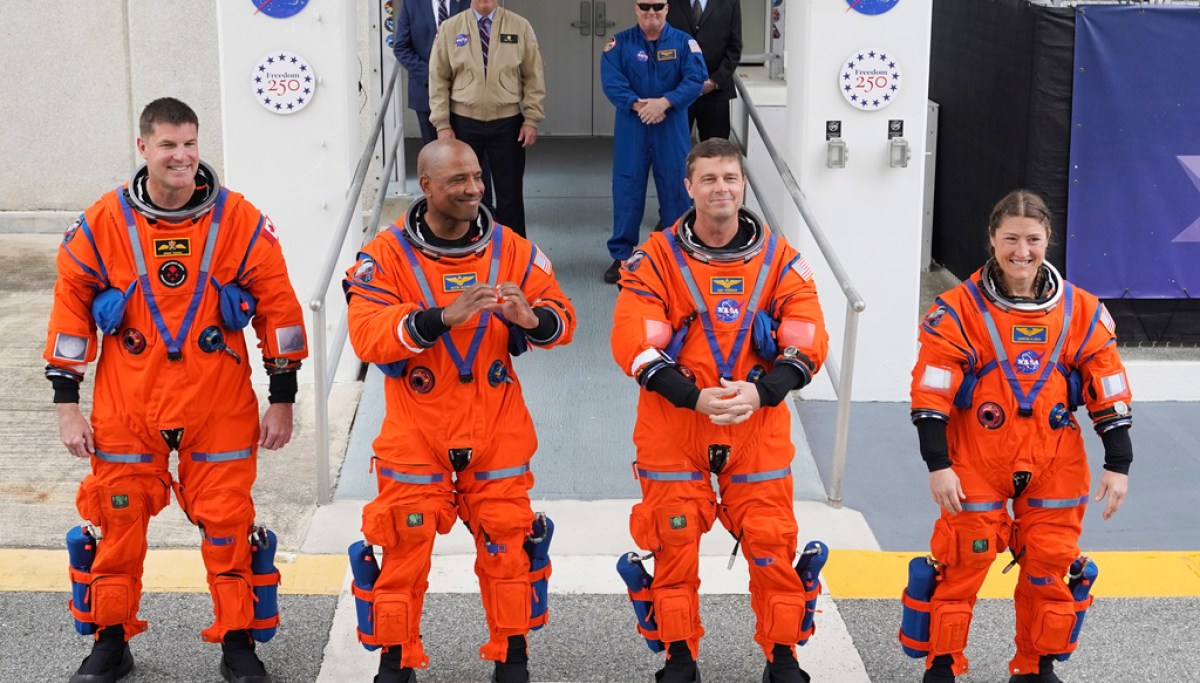
Cover image from washingtonexaminer.com, which was analyzed for this article
NASA's Artemis II astronauts are preparing for reentry into Earth's atmosphere and a Pacific Ocean splashdown, capping the first crewed lunar mission since Apollo. Despite a helium leak in the Orion spacecraft requiring future redesigns, the issue poses no threat to this mission's conclusion. Coverage emphasizes the historic milestone in America's return-to-Moon program amid national division.
PoliticalOS
Friday, April 10, 2026 — Tech
Artemis II has successfully completed the first crewed lunar flyby in more than 50 years, breaking distance records and gathering data on radiation, surface observations and spacecraft performance. Yet the program remains years behind original schedules, with a helium leak requiring redesign before lunar orbit flights and commercial landers still unproven. The reentry on April 10 will test whether NASA’s adjusted heat shield strategy and international partnerships can convert this milestone into a sustainable path back to the lunar surface ahead of geopolitical rivals.
What outlets missed
Most coverage underplayed the program's explicitly bipartisan and international character: Artemis began under Trump but advanced under Biden with key contributions from the European Space Agency on the service module and Canada on crew. Outlets also gave short shrift to the detailed radiation biology experiments aboard Orion, including organ-on-a-chip systems replicating bone marrow responses to galactic cosmic rays, which NASA designed specifically to inform Mars mission planning. The helium leak's pre-launch characterization and the 60 percent unused propellant margin received inconsistent attention, as did the precise reordering of Artemis III into an Earth-orbit docking test to reduce risk before any landing attempt. Finally, the crater-naming process was sometimes presented as finalized when the crew only proposed names pending International Astronomical Union review.
Artemis II Astronauts Face High Stakes Reentry After Record Lunar Voyage
The four astronauts aboard NASA's Orion spacecraft are hurtling back toward Earth after a 10-day journey that took them farther from our planet than any humans in history, marking a pivotal step in the agency's plan to return crews to the lunar surface. Reid Wiseman, Victor Glover, Christina Koch and Canadian astronaut Jeremy Hansen conducted a flyby of the Moon this week, gathering data, capturing striking images and testing systems for future missions. Their scheduled splashdown in the Pacific Ocean off San Diego at 5:07 p.m. local time on Friday will cap what NASA officials describe as a largely successful test flight, but not before the crew endures the mission's most hazardous phase.
Reentry into Earth's atmosphere remains the focal point of concern. Traveling at nearly 25,000 miles per hour, the capsule will encounter temperatures approaching 5,000 degrees Fahrenheit, hot enough to melt steel. A communications blackout lasting about six minutes will occur as a plasma sheath forms around the vehicle, severing contact with mission control. The crew will experience forces up to 3.9 times Earth's gravity after a week in weightlessness. NASA Associate Administrator Amit Kshatriya emphasized Thursday that celebration remains premature. "When we can start celebrating is when we have a crew safely in the medbay of the ship," he said. "That's really when we can allow the emotions to take over."
The scrutiny on reentry stems directly from Artemis I, the uncrewed 2022 test flight during which Orion's heat shield eroded more than anticipated. Rather than delay the current mission for a full replacement, engineers adjusted the entry trajectory to reduce the duration of peak heating. NASA Administrator Jared Isaacman has been blunt about the stakes. "There's no plan B's there," he told reporters. "The heat shield has to work." The tragedy of the 2003 Columbia shuttle disaster, which disintegrated during reentry due to damage that allowed superheated gases to penetrate the wing, looms as a reminder of how unforgiving this phase of flight can be.
Compounding the technical demands are ongoing concerns about the spacecraft's propulsion system. A small internal helium leak, detected on both Artemis I and II, has required adjustments to the flight plan. The leak involves valves in the oxidizer side of the system that pressurizes hydrazine and nitrogen tetroxide for the main engine and thrusters. Flight directors canceled a planned manual piloting demonstration to conduct additional tests, gathering data that will inform a redesign for future flights. Mission managers stress the issue poses no threat to Friday's reentry or crew safety, describing it as an internal leak rather than one venting to space. Still, it underscores the iterative engineering required to make Orion reliable for repeated deep-space voyages.
Beyond the immediate mechanics of return, the mission is generating valuable scientific insight into the human body's response to deep space. The crew has traveled well beyond the protective bubble of Earth's magnetosphere, accumulating radiation exposure more than 1,000 times greater than astronauts receive on the International Space Station. NASA installed sensors throughout Orion and collected pre-flight blood and saliva samples for comparison. Innovative silicon chips mimicking bone marrow functions traveled with them, as that tissue is among the most vulnerable to radiation damage. Steven Platts, chief scientist for NASA's Human Research Program, said the data will help distinguish between low-Earth orbit conditions and the harsher environment of cislunar space, where galactic cosmic rays from supernovas predominate.
These findings carry long-term implications. Artemis II serves as a proving ground for sustained lunar exploration and, eventually, crewed trips to Mars. NASA envisions a lunar base that could test technologies and resource utilization strategies necessary for longer voyages. The presence of an international partner, with Hansen representing Canada, also highlights the collaborative framework underpinning the Artemis program, including contributions from the European Space Agency on Orion's service module.
The mission arrives at a moment of domestic unease. Public polling consistently shows widespread pessimism about America's institutions and trajectory. Yet the images beamed back from Orion, showing the fragile blue curve of Earth against the stark lunar horizon, have resonated across political lines. The crew's diversity, including the first woman and astronauts of color on a lunar mission, offers a visible symbol of competence and shared endeavor at a time when such unifying narratives feel scarce. Conservative commentators have framed the achievement as evidence of American boldness and renewal, while others see it as validation of patient, publicly funded scientific infrastructure that transcends any single administration.
Success on Friday would validate years of investment and course corrections following the space shuttle's retirement. It would also set the stage for Artemis III, which aims to land astronauts near the lunar south pole. Challenges remain, from the helium valve redesign to perfecting heat shield performance and understanding cumulative radiation risks. But the mission has already delivered unprecedented views of the Moon's far side and demonstrated that NASA can manage complex, long-duration operations in deep space.
Recovery teams will meet the capsule in the Pacific, assisting the astronauts from Orion into a medical evaluation aboard a waiting ship. Only then will the agency fully assess whether the flight's technical objectives were met. For now, the focus remains on precision and safety, a reminder that even in an era of rapid technological change, the physics of returning from the Moon allow no room for error. The Artemis program, if it proceeds as planned, could redefine humanity's relationship with the solar system. Friday's reentry is the next essential test of whether that ambition rests on sufficiently sturdy engineering.
You just read Liberal's take. Want to read what actually happened?