
Artemis II Crew Nears High-Stakes Reentry After Record Lunar Flyby
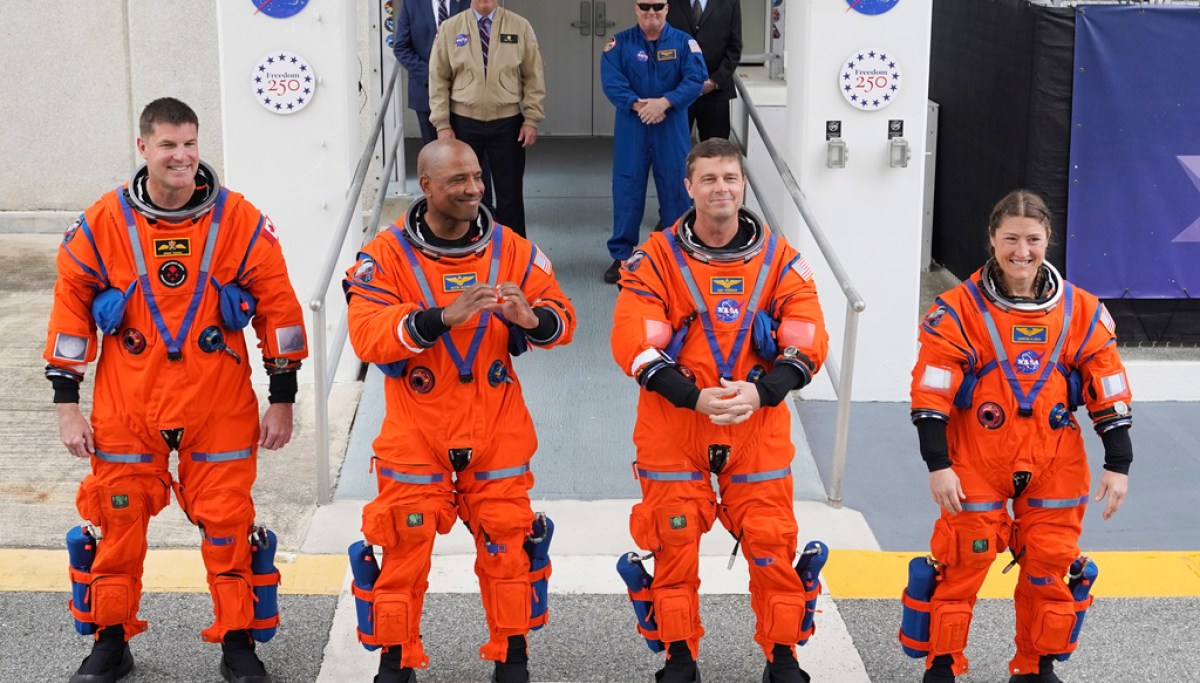
Cover image from washingtonexaminer.com, which was analyzed for this article
NASA's Artemis II astronauts are preparing for reentry into Earth's atmosphere and a Pacific Ocean splashdown, capping the first crewed lunar mission since Apollo. Despite a helium leak in the Orion spacecraft requiring future redesigns, the issue poses no threat to this mission's conclusion. Coverage emphasizes the historic milestone in America's return-to-Moon program amid national division.
PoliticalOS
Friday, April 10, 2026 — Tech
Artemis II has successfully completed the first crewed lunar flyby in more than 50 years, breaking distance records and gathering data on radiation, surface observations and spacecraft performance. Yet the program remains years behind original schedules, with a helium leak requiring redesign before lunar orbit flights and commercial landers still unproven. The reentry on April 10 will test whether NASA’s adjusted heat shield strategy and international partnerships can convert this milestone into a sustainable path back to the lunar surface ahead of geopolitical rivals.
What outlets missed
Most coverage underplayed the program's explicitly bipartisan and international character: Artemis began under Trump but advanced under Biden with key contributions from the European Space Agency on the service module and Canada on crew. Outlets also gave short shrift to the detailed radiation biology experiments aboard Orion, including organ-on-a-chip systems replicating bone marrow responses to galactic cosmic rays, which NASA designed specifically to inform Mars mission planning. The helium leak's pre-launch characterization and the 60 percent unused propellant margin received inconsistent attention, as did the precise reordering of Artemis III into an Earth-orbit docking test to reduce risk before any landing attempt. Finally, the crater-naming process was sometimes presented as finalized when the crew only proposed names pending International Astronomical Union review.
Artemis II Crew Faces High-Stakes Reentry After Record Lunar Flyby
As the four astronauts of NASA’s Artemis II mission hurtle back toward Earth at nearly 25,000 miles per hour, the agency finds itself at a familiar crossroads: celebrating human daring while confronting the very real technical and human risks that have shadowed America’s return to deep space for decades. The Orion capsule carrying Reid Wiseman, Victor Glover, Christina Koch and Canadian astronaut Jeremy Hansen is scheduled to splash down in the Pacific Ocean off San Diego at 5:07 p.m. PDT Friday, capping a 10-day journey that took humans farther from Earth than ever before.
The mission has already delivered striking images of the lunar far side and valuable engineering data. Yet NASA officials repeatedly stressed Thursday that true success cannot be declared until the crew is safely aboard a recovery ship. “When we can start celebrating is when we have a crew safely in the medbay of the ship,” said associate administrator Amit Kshatriya. That caution is warranted. Reentry remains the most perilous phase of any lunar mission, subjecting the spacecraft to temperatures approaching 5,000 degrees Fahrenheit and forces up to 3.9 times Earth gravity after a week in weightlessness. Communications will black out for roughly six minutes as a plasma sheath envelops the capsule.
The scrutiny is intensified by lingering questions from Artemis I, the uncrewed 2022 test flight whose heat shield eroded more severely than expected. Rather than replace the shield and incur further delays, NASA adjusted the reentry profile to reduce peak heating. Administrator Jared Isaacman has been blunt: “There’s no plan B’s there. The heat shield has to work.” The memory of the 2003 Columbia disaster, when a damaged wing caused the shuttle to disintegrate during reentry, killing all seven astronauts, still looms over the agency.
Compounding the engineering challenges is a small helium leak in the oxidizer pressurization system, first observed on Artemis I and persisting on this flight. Flight directors canceled a planned manual piloting demonstration Wednesday to run additional propulsion tests. Officials insist the internal leak poses no threat to reentry, but it will require a redesign of the valves before the next crewed mission. Such incremental problems illustrate how complex and unforgiving lunar travel remains more than fifty years after Apollo 17.
The crew itself represents both progress and symbolism. Glover is the first Black astronaut to voyage beyond low-Earth orbit. Koch has already set records for longest spaceflight by a woman. Hansen’s presence underscores the international character of Artemis, a partnership that includes the European Space Agency and the Canadian Space Agency. Their mission has gathered critical data on deep-space radiation, far more intense than the relatively shielded environment of the International Space Station. NASA installed sensors, collected blood and saliva samples, and even flew computer chips mimicking human bone marrow to measure physiological impacts. With plans for a lunar base and eventual Mars voyages, understanding galactic cosmic radiation is not optional. As Steven Platts of NASA’s Human Research Program noted, the data will help distinguish radiation profiles between low-Earth orbit and the Moon, where Earth’s magnetosphere no longer offers protection.
Public fascination with the mission has been undeniable, producing images that have captured global attention. Yet the political environment surrounding Artemis is predictably polarized. Some conservative voices have rushed to frame the flight as validation of a particular strain of American exceptionalism and renewed national greatness. In reality, the program’s delays, cost overruns, and technical setbacks reflect systemic issues that transcend any single administration: chronic underfunding relative to ambitions, reliance on legacy contractors, and the sheer difficulty of safely sending humans beyond the relative safety of Earth orbit.
The successful return of Artemis II will not magically resolve those contradictions. It will, however, provide NASA with the confidence to press toward Artemis III, the planned crewed lunar landing. For now, the immediate focus remains on the capsule’s heat shield, the parachutes that must deploy flawlessly, and the four astronauts who have traveled nearly a million miles from home. Their safe recovery will mark more than the end of one mission. It will signal whether the United States and its partners have absorbed the hard lessons of the past half-century and are truly prepared for the far more demanding voyages that lie ahead, from sustained lunar presence to the radiation gauntlet of a trip to Mars.
Until that capsule is bobbing safely in the Pacific and the crew steps onto the recovery ship, declarations of triumph remain premature. In spaceflight, as in so much else, the final miles are often the most unforgiving.
You just read Progressive's take. Want to read what actually happened?