
Artemis II Crew Returns Safely After First Crewed Lunar Flyby in 53 Years
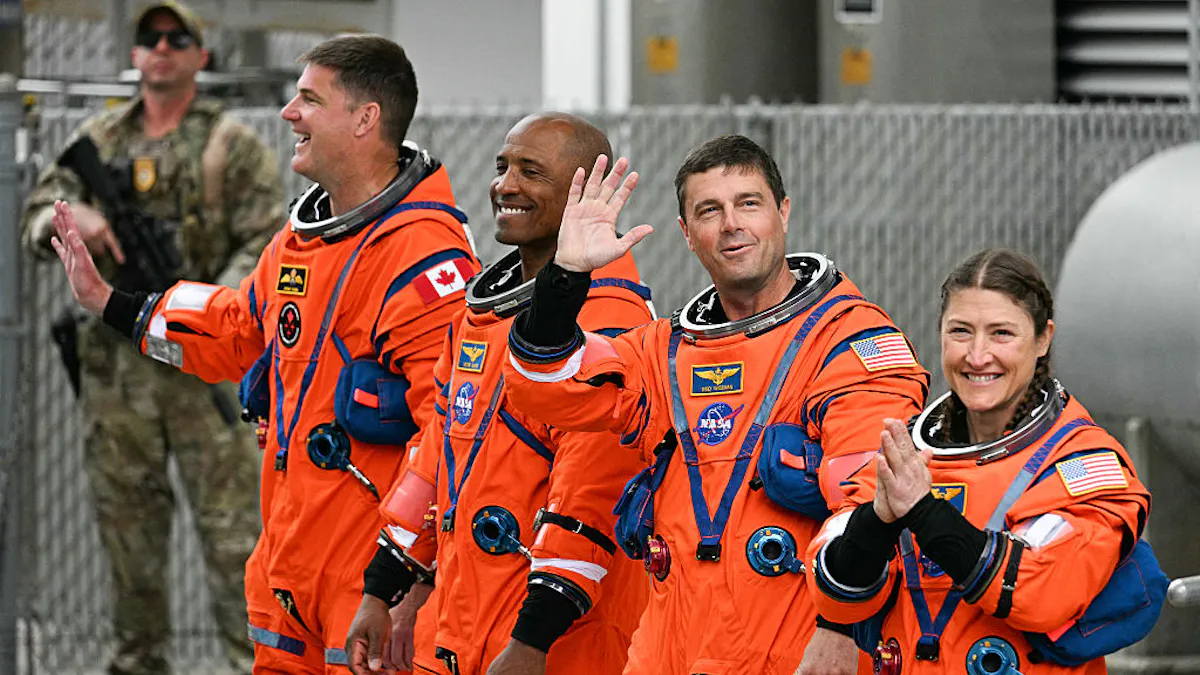
Cover image from dailywire.com, which was analyzed for this article
The Artemis II astronauts—three Americans and one Canadian—safely splashed down in the Pacific after the first crewed lunar flyby in over 50 years, hailed as a perfect mission boosting US space efforts. President Trump invited the team to the Oval Office. The jubilant return is shadowed by concerns over NASA's budget cuts.
PoliticalOS
Saturday, April 11, 2026 — Tech
Artemis II proved that NASA and its contractors can send humans safely to the Moon and back for the first time in more than five decades, breaking distance records and clearing technical hurdles for planned landings by 2028. The mission's success, achieved despite years of delays and cost overruns, positions the United States advantageously in competition with China while relying on sustained congressional funding that remains subject to annual debate. The single most important reality is that this flight is an engineering milestone built on decades of work, not a guarantee of future pace; the program's next stages will test whether political will matches the demonstrated technical capability.
What outlets missed
Most coverage omitted that the White House proposal actually increases funding for the Exploration and Artemis accounts to $8.5 billion from prior levels near $7 billion, protecting the lunar program while trimming science and other areas. Similar deep cuts proposed for fiscal 2026 were rejected on a bipartisan basis in Congress, making the 2027 request likely to face the same fate. Outlets also underplayed minor but resolved technical issues such as a toilet sensor malfunction fixed in flight by Christina Koch, and the fact that Artemis I had already performed an uncrewed lunar flyby in 2022. Few noted the precise new distance record of 252,756 miles or Trump's explicit invitation for the crew to visit the Oval Office. Finally, several reports inflated novelty by glossing over prior uncrewed lunar missions by the U.S., China and others since 1972.
Artemis II Triumph Highlights American Ingenuity Amid Renewed Fiscal Scrutiny
The four astronauts of Artemis II returned to Earth on Friday after a flawless 10-day voyage that took them farther from the planet than any humans since the final Apollo mission in 1972. Commander Reid Wiseman, pilot Victor Glover, mission specialist Christina Koch and Canadian Space Agency astronaut Jeremy Hansen splashed down in the Pacific off San Diego in the Orion capsule named Integrity. Military helicopters lifted each from an inflatable raft to the recovery ship USS John P Murtha as Mission Control in Houston erupted in sustained applause.
The mission sets multiple records. The crew traveled 248,655 miles from Earth at its farthest point and conducted the first crewed flyby of the lunar far side in more than half a century. They witnessed a total solar eclipse from space, observed a striking alignment of planets against the blackness beyond Earth’s atmosphere, and gathered data that NASA says will inform the planned crewed landing on the lunar surface in two years and the construction of a permanent base within the decade.
NASA Administrator Jared Isaacman, speaking from the recovery vessel, called the crew “ambassadors from humanity to the stars.” He said he could not imagine a better team for the assignment. Flight controllers described the performance as near-perfect. “We did it,” declared Lori Glaze at the post-splashdown news conference. The mood at Johnson Space Center was one of open celebration after years of preparation and the high stakes of sending humans back into deep space.
What captured public attention beyond the technical achievement was the crew’s visible humanity. Video released during the flight showed the astronauts creating an impromptu 1980s-style sitcom introduction set to the Full House theme song, complete with megawatt smiles and playful glances at the camera. Victor Glover recorded personal messages for each of his four daughters before launch. Christina Koch and Jeremy Hansen shared lighthearted exchanges with family. Wiseman, a widowed father, had received “moon cupcakes” from his daughters before liftoff and responded from space with heart-hand gestures that quickly circulated on Earth. A batch of homemade cookies, a small plush toy in a baseball cap, and quiet expressions of faith rounded out scenes that many Americans found unexpectedly moving.
NASA officials said the emotional resonance reminded them why such missions matter. “If you can’t take love to the stars, then what are we doing?” one senior manager remarked. The crew’s ability to maintain composure, humor and connection while hurtling through cislunar space at record distances struck a chord across households that had followed the flight with unusual interest. For ten days the mission offered a reprieve from earthly divisions and a reminder of what coordinated effort can accomplish.
Yet the celebration carries an immediate caveat. Even as the capsule was still en route, President Donald Trump signaled his intention to reduce NASA’s budget by 23 percent overall, with a 46 percent cut to space science programs. The proposal arrives at the very moment the agency has demonstrated its capacity to execute a complex crewed lunar mission without major incident. Critics inside and outside the agency have described the scale of the reductions as potentially crippling to future Artemis flights and to the scientific work that underpins them. The tension between the mission’s success and the fiscal restraint being proposed is unmistakable.
The achievement itself is not in dispute. Artemis II builds directly on the engineering lessons of Apollo while incorporating modern avionics, life-support systems and heat-shield technology that performed exactly as designed during reentry. The flight also gives the United States a measurable lead in the renewed competition with China, which has ambitions to land its own astronauts on the Moon and eventually establish a permanent presence. No other nation has duplicated the Apollo feat even once. The United States has now done it twice, five decades apart.
That fact underscores a deeper pattern. Large government endeavors can produce extraordinary results when focus is maintained and accountability is enforced. The Artemis II team met its objectives on schedule and within the tolerances required for human safety. Whether future missions will enjoy the same resources remains an open question. The budget debate now moves to Congress, where lawmakers will weigh the inspirational and strategic value of continued lunar exploration against broader efforts to restrain federal spending.
The astronauts are scheduled to hold a news conference in the coming days to describe what they saw and felt. Their words will likely echo the poetic observations Isaacman noted upon their return. For now, the safe recovery of four ambassadors from humanity closes one chapter and opens another. The technical triumph is complete. The debate over how best to sustain such ambitions with finite public resources has only begun. In that respect Artemis II arrives not only as a technical milestone but as a timely case study in the perennial tension between vision and restraint.
You just read Conservative's take. Want to read what actually happened?