
Millions Bet on War Outcomes as Prediction Markets Face Ethics Scrutiny
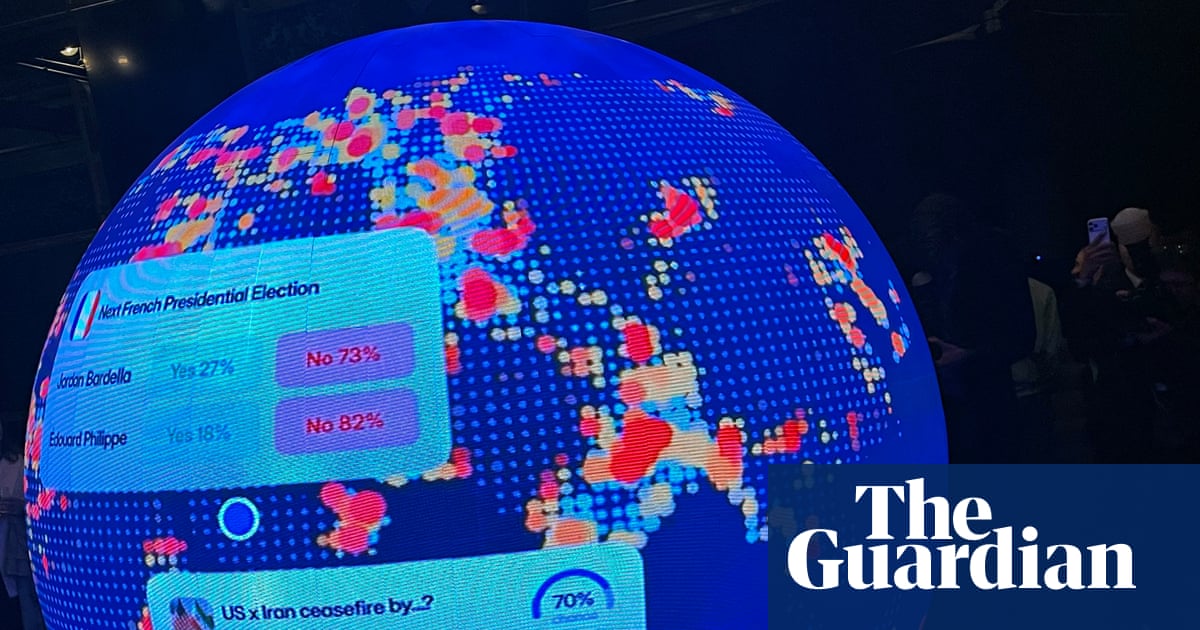
Cover image from theguardian.com, which was analyzed for this article
Gamblers bet millions on Polymarket for Iran war outcomes, called abhorrent by critics. Lawmakers and staffers wager on markets without disclosure requirements. The trend raises ethical concerns amid conflicts.
PoliticalOS
Saturday, April 11, 2026 — Business
Prediction markets now move hundreds of millions on war and political outcomes, offering faster signals than polls in some cases yet operating with thin oversight for public officials and resolution rules vulnerable to influence. The central unresolved issue is whether the profit motive sharpens accuracy or incentivizes distortion of events and information. Readers should weigh the platforms' documented forecasting successes against legitimate risks of manipulation and ethical concerns over monetizing conflict.
What outlets missed
Both outlets underplayed the documented performance edge of prediction markets: Polymarket's accurate 2024 election forecast outperformed many polls, and a Harvard study from 2024-2026 identified $143 million in profits by informed traders, indicating meaningful information aggregation rather than pure speculation. Coverage also gave short shrift to the full legislative picture, with at least ten bills introduced in Congress addressing prediction markets, including CFTC regulatory reviews and a House companion to the Young-Slotkin measure with 30 co-sponsors. Finally, neither fully explored how financial institutions are already integrating this data into formal analysis, nor the counter-risk that overly restrictive rules could push activity into unregulated offshore venues where transparency is even lower.
Prediction Markets Harness Self Interest to Gauge War Outcomes as Disclosure Rules Lag
Prediction markets are emerging as a raw unfiltered gauge of probabilities in active conflicts, with hundreds of millions of dollars now riding on specific battlefield developments in Ukraine and potential escalations involving Iran. At the same time, federal ethics rules have not kept pace, leaving lawmakers and their staffs free to participate without public disclosure and prompting fresh legislative efforts to close the gap.
On Polymarket, more than $500,000 is currently staked on whether Russian forces will capture the eastern Ukrainian city of Kostyantynivka by the end of the year. Settlement hinges on a map from the Institute for the Study of War showing the city’s train station under Russian control. The sum reflects intense interest among anonymous traders who spend hours dissecting open source intelligence, drone footage, and official updates. One user, posting under the name Horekunden, dismissed the Institute’s daily maps as incoherent and childlike, illustrating the skeptical scrutiny participants apply when real money is on the line.
Similar volumes have appeared on Iran related questions. Roughly $280 million changed hands around the recent U.S. Iran ceasefire, while $7.5 million remains active on whether American forces will launch a ground invasion. In Discord servers dedicated to these contracts, traders trade theories about uranium stockpiles, oil terminal strikes, and wider escalation risks. One participant warned that events could spiral into broader conflict. Another expressed conditional optimism that American objectives could be met without catastrophe. The tone is clinical, focused on evidence and payout conditions rather than sentiment.
Critics label the entire enterprise distasteful, arguing that turning human suffering into a tradable asset crosses a moral line. The spectacle of anonymous accounts wagering on the fall of cities where civilians still live invites understandable discomfort. Yet the mechanism at work is familiar to anyone who has studied how prices aggregate dispersed knowledge. When individuals risk their own capital, they have powerful incentives to seek accurate information and update their views quickly. The resulting probabilities have sometimes proven more reliable than government assessments or media narratives that shift with political currents.
This information function becomes especially relevant when government insiders themselves enter the same markets. A new report reveals that neither members of Congress nor their staffers are required to disclose trades placed on prediction platforms under current ethics rules. The absence of reporting requirements stands in contrast to the detailed financial disclosures demanded for stocks, bonds, and other conventional assets. Without transparency, the public cannot know whether officials with access to classified briefings are simultaneously taking positions that could benefit from non public information.
Senators Todd Young, a Republican from Indiana, and Elissa Slotkin, a Democrat from Michigan, introduced legislation this month to change that. Their bill would amend government ethics statutes to mandate disclosure of prediction market bets, aiming to deter potential insider trading and restore public confidence. The measure acknowledges that these platforms now command sufficient volume and geopolitical relevance to warrant oversight.
Supporters of the bill emphasize basic fairness. If a lawmaker learns during a closed briefing that certain supply routes in Ukraine are collapsing, that knowledge should not be monetized on Polymarket before the public learns of it. The concern is legitimate. Yet experience with financial regulation suggests that new mandates often carry trade offs. Compliance costs rise. Activity can migrate to offshore venues or pseudonymous accounts that prove harder to police. And overly broad rules risk chilling the very information discovery that makes these markets useful.
Economists have long noted that prices incorporate knowledge held by thousands of dispersed participants far more efficiently than any central authority can. A trader in Singapore studying drone telemetry, a former military analyst in Virginia reviewing satellite imagery, and a logistics expert tracking ammunition flows each contribute through their bets. The composite odds on Kostyantynivka or an Iranian oil terminal strike reflect that synthesis. Policymakers would do well to weigh this reality against the impulse to layer on fresh restrictions.
The surge in war related contracts also raises practical questions about resolution. Many contracts rely on the output of private research organizations like the Institute for the Study of War. When maps contain ambiguities or when ground truth is obscured by fog of war, disputes arise. Polymarket’s own arbitration processes will face increasing stress as contract sizes grow into the millions. The platform has so far maintained credibility by tying settlements to observable events and reputable sources, but the incentive to contest close calls will only intensify.
None of this erases the human cost that underlies every contract. Thousands of civilians remain in Kostyantynivka under constant threat. Iranian uranium enrichment efforts carry implications for global stability. Prediction markets do not cause these realities; they merely reflect the collective estimate of how events may unfold. For better or worse, they convert uncertainty into a readable number that decision makers, from generals to ordinary citizens, can consult.
As volumes climb and Washington debates disclosure, the core insight remains. Self interested individuals, deploying their own resources and research, are producing forecasts that centralized institutions have sometimes missed. Whether lawmakers ultimately face tighter rules or the markets continue operating largely as they have, the information they generate is likely to remain a feature of how modern conflicts are understood. The question is whether policy will treat that information as a problem to be regulated or a signal worth preserving.
(Word count: 712)
You just read Conservative's take. Want to read what actually happened?