
Trump Deletes AI Image of Himself as Healer After Blasphemy Backlash
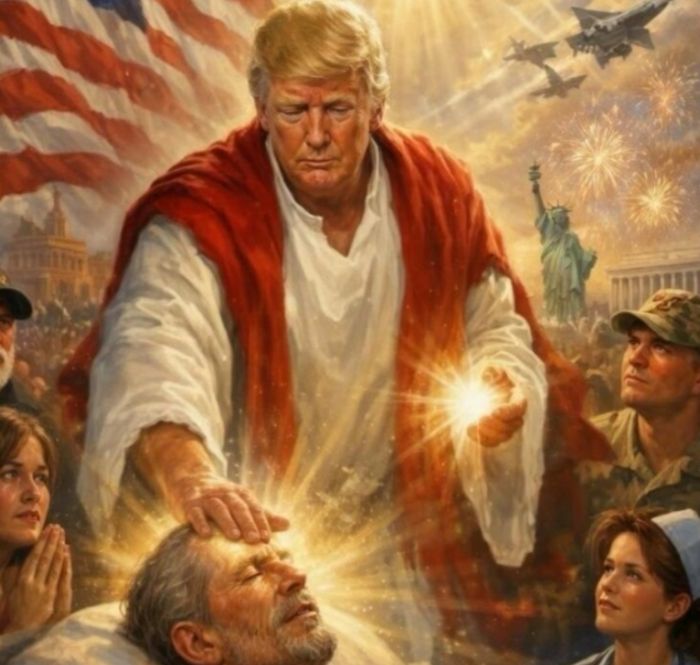
Cover image from crooksandliars.com, which was analyzed for this article
Trump shared an AI image portraying himself as Jesus before deleting it, prompting 'Antichrist' accusations and mockery. The post followed Pope feud and drew widespread criticism. It amplified religious controversy.
PoliticalOS
Tuesday, April 14, 2026 — Politics
A single AI image briefly cast Donald Trump in a Christ-like pose, sparking genuine outrage from some prominent religious conservatives who saw blasphemy where he saw a doctor healing the sick. The swift deletion and his explanation did not satisfy critics, yet the backlash appears narrower than some coverage suggested and sits within his long pattern of provocative religious-adjacent rhetoric. The episode highlights unresolved tensions between Trump's messianic political style, traditional Christian boundaries, and a media environment eager to interpret every gesture as either revelation or disaster.
What outlets missed
Most outlets underplayed or omitted the clear medical context visible in the image itself: a hospital bed, multiple nurses, and a prominent Red Cross symbol that directly supports Trump's physician explanation. The post's precise timing, hours after Trump's explicit Truth Social criticisms of Pope Leo XIV as 'weak' on crime and foreign policy during the Iran ceasefire period and near Orthodox Easter, was frequently downplayed, stripping away the religious provocation layer. Several reports amplified specific critical quotes without noting that some, including certain Owens attributions, could not be independently verified in other coverage, while ignoring defenses from figures like Isabel Brown who called backlash a 'misreading.' Right-leaning media's near-silence on the story was rarely analyzed, leaving readers without a sense of how narrowly the outrage registered beyond vocal online voices.
Trump's AI Jesus Image Exposes Cracks in His Evangelical Coalition
President Donald Trump deleted a provocative social media post this week after it triggered an unusually fierce backlash not from his traditional Democratic opponents but from prominent voices within his own political and religious base. The incident, which blended artificial intelligence, messianic imagery, and Trump's ongoing feud with Pope Leo XIV, has amplified questions about the boundaries of political idolatry among conservative Christians who once formed the core of his support.
The now-removed image, shared Sunday night on Truth Social, depicted Trump in flowing white robes and a red sash, his hands glowing as he laid one on the forehead of a man appearing ill in a hospital bed. Onlookers, including a nurse and a praying woman, gazed at him reverently. The background fused religious awe with nationalist symbolism: American flags, military aircraft, fireworks, and soaring eagles. For many observers, the composition crossed from typical Trumpian bravado into explicit self-deification.
The reaction from the right was swift and pointed. Former Rep. Marjorie Taylor Greene was among the first to voice disapproval. Podcaster Candace Owens went further on her show Monday, declaring that Trump appeared to be “under demonic influence” and suggesting that spiritual adviser Paula White had cast some sort of spell on him. Conservative commentator Megan Basham called the post “outrageous blasphemy” and demanded Trump remove it and seek forgiveness. Pastor Joel Webbon posted bluntly: “I genuinely believe Trump is currently demon possessed.” Even Clint Russell, a podcaster who had voted for Trump, wrote that he had come to wonder in recent months whether the president might be the Antichrist.
These criticisms arrived as Trump has escalated tensions with the Vatican over the ongoing conflict with Iran. In recent days the president publicly labeled the newly elected Pope Leo XIV “WEAK” on crime, foreign policy, and what Trump termed “catering to the Radical Left.” The AI image appeared to some critics as a visual riposte, positioning Trump as a divine healer amid military imagery at a moment when his administration weighs further action in the Strait of Hormuz.
Trump attempted to defuse the controversy on Monday. Speaking with reporters, he insisted he had not seen the image as religious at all. “I thought it was me as a doctor,” he said, claiming the picture referenced the Red Cross and humanitarian work. “Only the fake news could come up with” the Jesus interpretation, he added. The explanation strained credulity for many, given the unmistakably Christ-like pose and the history of Trump sharing AI-generated content that flatters his self-image.
The episode did not end with the deletion. Hours later, Trump staged an impromptu Rose Garden appearance centered on a DoorDash delivery of McDonald’s McNuggets, cheeseburgers, and milkshakes. A woman wearing a “DoorDash Grandma” T-shirt handed him the bags while praising his “no tax on tips” policy. Trump tipped her $100 in cash as reporters tried to question him about Iran policy and the fragile ceasefire. The juxtaposition, coming immediately after the religious controversy, only heightened the sense of political surrealism. As one observer put it, the week had moved from pretend messiah to fast-food photo-op without apparent irony.
Late-night host Jon Stewart captured the broader reaction during Monday’s episode of “The Daily Show.” Standing beside a reproduction of the image, Stewart deadpanned, “Am I okay?” before noting the eerie resemblance between the AI Jesus and Trump himself. The moment underscored how the post had escaped the conservative information silo and become grist for wider cultural ridicule.
The intensity of the conservative Christian rebuke stands out because Trump has long enjoyed near-unanimous support from white evangelicals, a loyalty forged through judicial appointments, gestures toward religious liberty, and a shared sense that he is a bulwark against secular liberalism. For some longtime allies, the AI post represented a breaking point. Joe Walsh, a former Republican congressman and onetime Trump critic turned reluctant supporter, placed blame broadly on the ecosystem that enabled the president’s growing sense of untouchability: voters, elected officials, media figures, and institutions that “bent the knee.”
Others saw something darker. The language of demonic possession and Antichrist speculation, once fringe even within Pentecostal circles that embraced Trump, has moved closer to the center of intra-MAGA discourse. This development arrives at a moment when Trump’s second-term agenda, particularly the aggressive posture toward Iran, has already tested the pacifist instincts of some religious conservatives.
The episode also highlights the increasing role of generative AI in presidential communication. Trump has repeatedly used the technology to produce idealized or hyperbolic visuals, from muscular superhero versions of himself to altered crowd sizes. Yet the Jesus image carried theological weight that previous experiments lacked. Religious scholars have long warned about the fusion of Christian symbolism with American nationalism. When the president himself appears to traffic in that fusion, even some of his most reliable supporters recoil.
As Trump prepares to attend the White House Correspondents’ Dinner later this month, an event he once boycotted after a bruising 2011 roasting by Barack Obama, the Jesus controversy may linger as an uncomfortable backdrop. The president has promised to turn the dinner into “the GREATEST, HOTTEST, and MOST SPECTACULAR DINNER, OF ANY KIND, EVER.” Whether the evening becomes another arena for grievance or a rare moment of reflection remains to be seen.
What seems clearer is that the coalition that lifted Trump to power is showing signs of strain. The very voters and pastors who once viewed him as a flawed instrument of divine purpose are now debating whether the flaws have begun to swallow the purpose. For a president who has always thrived on loyalty tests, this latest one appears to have been self-administered. The image may be gone from Truth Social, but the questions it raised among his own side are not disappearing as easily.
You just read Liberal's take. Want to read what actually happened?
More in Politics
Trump at 32% Approval as Gas Prices Test GOP Midterm Hopes
NYT/Siena polling showed Trump's approval at historic lows around 32 percent with Democrats leading by double digits in key districts. Early voting has surged in battleground states.

Record Early Voting Hits Battlegrounds, Shifting Partisan Shares
AP analysis found hundreds of thousands more early ballots than in 2022 in states including Texas, Ohio, Kansas, Maine, and North Carolina, shifting partisan dynamics.
Trump Backs Marshall in Kansas Senate Race Tightened by Farm Costs
President Trump rallied in deep-red Kansas for GOP Sen. Roger Marshall in a competitive race, announcing an $8 billion farm fuel relief program amid high diesel prices. Democrats see an opening to end 94 years of GOP dominance in the state.

Trump Pauses Russia Sanctions Amid Ukraine Tensions and Missile Strikes
Trump waived sanctions on Russia and floated trilateral talks with Putin and Xi as part of ending the Ukraine war, while tensions rose with Zelenskyy over Starlink and arms. Bipartisan senators engaged Zelenskyy amid the shifts.
The Compass
You just read five takes on one story.
What's your take? Find your political shape in a few minutes.
Take the test