
Trump Deletes AI Image of Himself as Healer After Blasphemy Backlash
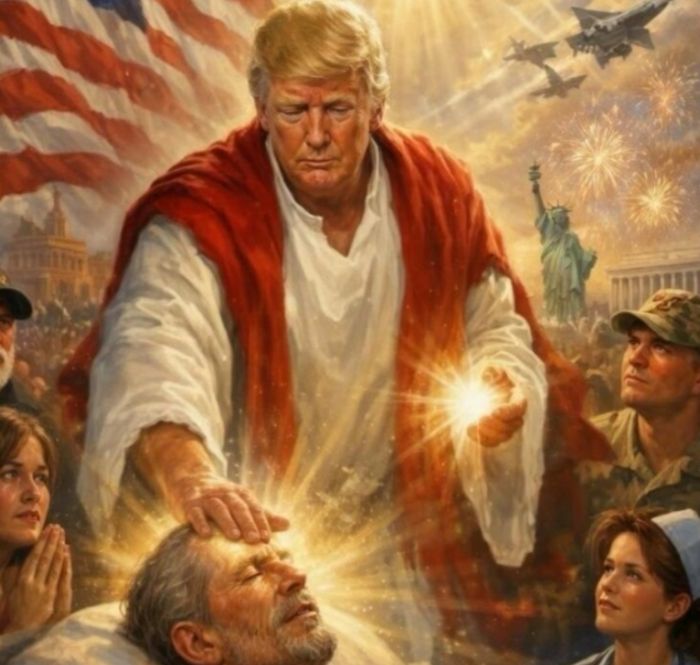
Cover image from crooksandliars.com, which was analyzed for this article
Trump shared an AI image portraying himself as Jesus before deleting it, prompting 'Antichrist' accusations and mockery. The post followed Pope feud and drew widespread criticism. It amplified religious controversy.
PoliticalOS
Tuesday, April 14, 2026 — Politics
A single AI image briefly cast Donald Trump in a Christ-like pose, sparking genuine outrage from some prominent religious conservatives who saw blasphemy where he saw a doctor healing the sick. The swift deletion and his explanation did not satisfy critics, yet the backlash appears narrower than some coverage suggested and sits within his long pattern of provocative religious-adjacent rhetoric. The episode highlights unresolved tensions between Trump's messianic political style, traditional Christian boundaries, and a media environment eager to interpret every gesture as either revelation or disaster.
What outlets missed
Most outlets underplayed or omitted the clear medical context visible in the image itself: a hospital bed, multiple nurses, and a prominent Red Cross symbol that directly supports Trump's physician explanation. The post's precise timing, hours after Trump's explicit Truth Social criticisms of Pope Leo XIV as 'weak' on crime and foreign policy during the Iran ceasefire period and near Orthodox Easter, was frequently downplayed, stripping away the religious provocation layer. Several reports amplified specific critical quotes without noting that some, including certain Owens attributions, could not be independently verified in other coverage, while ignoring defenses from figures like Isabel Brown who called backlash a 'misreading.' Right-leaning media's near-silence on the story was rarely analyzed, leaving readers without a sense of how narrowly the outrage registered beyond vocal online voices.
Trump AI Jesus Image Triggers Fury From Evangelical Allies
President Donald Trump’s latest descent into self-mythology has managed the improbable feat of uniting his evangelical base in revulsion. On Sunday night the president posted an AI-generated image on Truth Social that depicted him in flowing white robes and a red sash, bathed in heavenly light, laying glowing hands on a sick man’s forehead while American flags, military aircraft, eagles and fireworks filled the sky behind him. The image, which Trump later deleted, triggered an immediate and unusually ferocious backlash from some of his most reliable supporters on the religious right.
Candace Owens, once a vocal Trump defender, used her podcast to declare that the president was “very clearly under demonic influence” and speculated that Paula White, a prosperity-gospel preacher close to Trump, had placed some sort of spell on him. Conservative Christian commentator Joel Webbon was more direct, tweeting: “I genuinely believe Trump is currently demon possessed.” Megan Basham, a prominent voice in evangelical media, called the post “outrageous blasphemy” and demanded Trump remove it and seek forgiveness. Even Clint Russell, a podcaster who voted for Trump, confessed he had gone “from hesitantly voting for Trump to thinking there’s a decent chance he’s the antichrist.”
The reactions were not limited to social media. Former congressman Joe Walsh, who once supported Trump before breaking with him, laid the blame at the feet of Republican officials, conservative media and voters who had indulged the president’s messianic impulses for years. “They ALL taught him to believe he is their savior,” Walsh wrote. Reverend Benjamin Cremer, a more moderate evangelical voice, pointed out the obvious double standard: had a Democratic president posted such an image, “Evangelical Christians would implode.” Instead, many of Trump’s religious supporters have remained largely silent.
The controversy comes at a moment when Trump is already engaged in a bizarre public feud with the newly elected Pope Leo XIV. The president had attacked the pontiff as “WEAK” on crime, foreign policy and “catering to the Radical Left.” The AI image appeared to double down on that fight by positioning Trump as a quasi-divine alternative to traditional religious authority, complete with military imagery that seemed to bless his ongoing confrontation with Iran.
When confronted by reporters on Monday, Trump offered a defense that only deepened the absurdity. He claimed he believed the image showed him not as Jesus but as a doctor connected to the Red Cross. “Only the fake news could come up with that one,” he insisted. The explanation convinced few. Jon Stewart, hosting “The Daily Show,” stood beside a printout of the image and deadpanned, “Am I okay?” Riley Gaines, a Trump supporter known for her campaign against transgender athletes, expressed open bewilderment: “Why? Seriously, I cannot understand why he’d post this.”
The episode did not end with the deletion. By midday Trump had pivoted to what may rank among the strangest press events of his presidency. Reporters were hastily summoned to the White House to witness a DoorDash delivery of McDonald’s. A woman wearing a “DoorDash Grandma” T-shirt handed Trump several grease-stained bags while praising his “no tax on tips” policy. Trump tipped her a hundred-dollar bill, took questions about blockading the Strait of Hormuz and the fragile Iran ceasefire, and left the fast-food courier standing awkwardly beside him. The juxtaposition of pretend Jesus ordering McNuggets while musing about potential war only amplified the sense that the presidency has become performance art untethered from dignity.
This is not the first time Trump has used AI-generated content to flatter himself. He has previously shared altered images and videos that cast him in heroic or hyper-masculine roles. But the explicit Christ-like imagery crossed a threshold for many who had been willing to overlook previous excesses. The speed and venom of the conservative Christian reaction suggests that even among those who once viewed Trump as a flawed instrument of divine will, the narcissistic blasphemy became too much to excuse.
The episode also highlights the deepening fractures within the MAGA coalition. Figures like Owens and Webbon represent a harder-edged, more conspiratorial strain of Trumpism that increasingly views the president himself through the lens of spiritual warfare when he deviates from their expectations. That some of them are now invoking demonic possession or the Antichrist is remarkable given how relentlessly they once defended him against similar charges from liberals.
Trump’s habit of surrounding himself with sycophants and prosperity preachers who reinforce his messianic self-image has clearly shaped his behavior. The AI Jesus post was not an aberration but the logical conclusion of years of being told he was chosen by God, survived assassination attempts through divine intervention, and now apparently heals the sick with glowing hands.
Whether this latest controversy will dent Trump’s support among rank-and-file evangelicals remains to be seen. Many have shown a remarkable capacity to rationalize his conduct. Yet the volume and intensity of the denunciations from within his own camp suggest that even the most loyal segments of his base have limits. When the president’s own allies begin describing him in the language once reserved for his fiercest critics, the carefully constructed image of spiritual warrior begins to crack.
For now Trump has moved on, as he always does, to the next provocation, the next feast of attention. The deleted image, the McNuggets photo-op, the Pope-bashing and the Iran saber-rattling all blur together into the chaotic spectacle that has come to define his second term. But for a brief moment this week, large parts of the Christian right looked at their champion and saw something they could no longer endorse without losing their own souls. The question is whether that moment of clarity will last or simply be absorbed into the endless cycle of MAGA grievance and rationalization.
You just read Progressive's take. Want to read what actually happened?
More in Politics

Federal Agents Search Omar Home in Ongoing Immigration Probe
Homeland Security agents searched the Minnesota Democrat's DC residence in a criminal probe, prompting accusations of political intimidation from Omar and Democratic leaders. Coverage spans left-leaning outlets like NPR, BBC, and The Guardian alongside right-leaning criticism from The Federalist and Daily Wire.

Trump Diesel Import Plan Draws Pushback Over Russia Ties
The weekend agreement drew bipartisan congressional pushback and criticism from Ukraine's Zelenskyy, with analysts downplaying US fuel price impacts. Right-leaning outlets like National Review, Dispatch, and Washington Examiner questioned its legality and effectiveness.

Independents Test Voter Appetite for Middle Ground in 2026 Midterms
Nearly 200 independents are running in competitive races as voters weigh ballot measures on housing costs in states like Massachusetts. Left-leaning coverage from NYT, NPR, and Guardian highlights turnout and key races while right outlets focus on GOP strategy.
Trump Rallies in Alaska, Ohio to Bolster GOP Senate Candidates
The president rallied in Wasilla for Sen. Dan Sullivan and faced empty seats at an Ohio event amid midterm concerns. Outlets across the spectrum covered the trips as signals of GOP vulnerability weeks before Election Day.
The Compass
You just read five takes on one story.
What's your take? Find your political shape in a few minutes.
Take the test