
Trump Promotes Voluntary AI Safety Pact at San Francisco Tech Event
Cover image from independent.co.uk, which was analyzed for this article
At Tech Week in San Francisco, the White House promoted a hands-off AI policy and voluntary safety pact. Industry leaders welcomed the shift toward growth over regulation.
PoliticalOS
Saturday, October 10, 2026 — Tech
The administration has replaced prior reporting requirements with a short voluntary agreement signed by major labs, while critics maintain that internal monitoring alone cannot address documented misuse or rapid capability jumps. Resource demands of the underlying infrastructure remain measurable but incompletely compared across coverage. Readers must weigh national-security arguments for speed against the absence of enforcement mechanisms in the current framework.
What outlets missed
Neither outlet supplied data on compliance rates under the prior voluntary framework or incident statistics tied to specific models. Townhall omitted the 308-word length of the pact and the list of signatories. Independent omitted quantitative comparisons of data-center land use against renewable installations and the 2023 electricity consumption baseline of 176 terawatt-hours. The interaction between state-level regulatory blocks and existing consumer-protection statutes received no examination in either account.
Silicon Valley AI Founders Back Trump's Push for Industry Self Oversight
Silicon Valley venture capitalists and AI company leaders gathered in San Francisco this week to celebrate the Trump administration's decision to let the sector handle its own safety standards rather than impose federal rules. The mood at events organized by firms like Andreessen Horowitz reflected broad relief that Washington has stepped back from earlier efforts to create binding oversight for advanced AI systems.
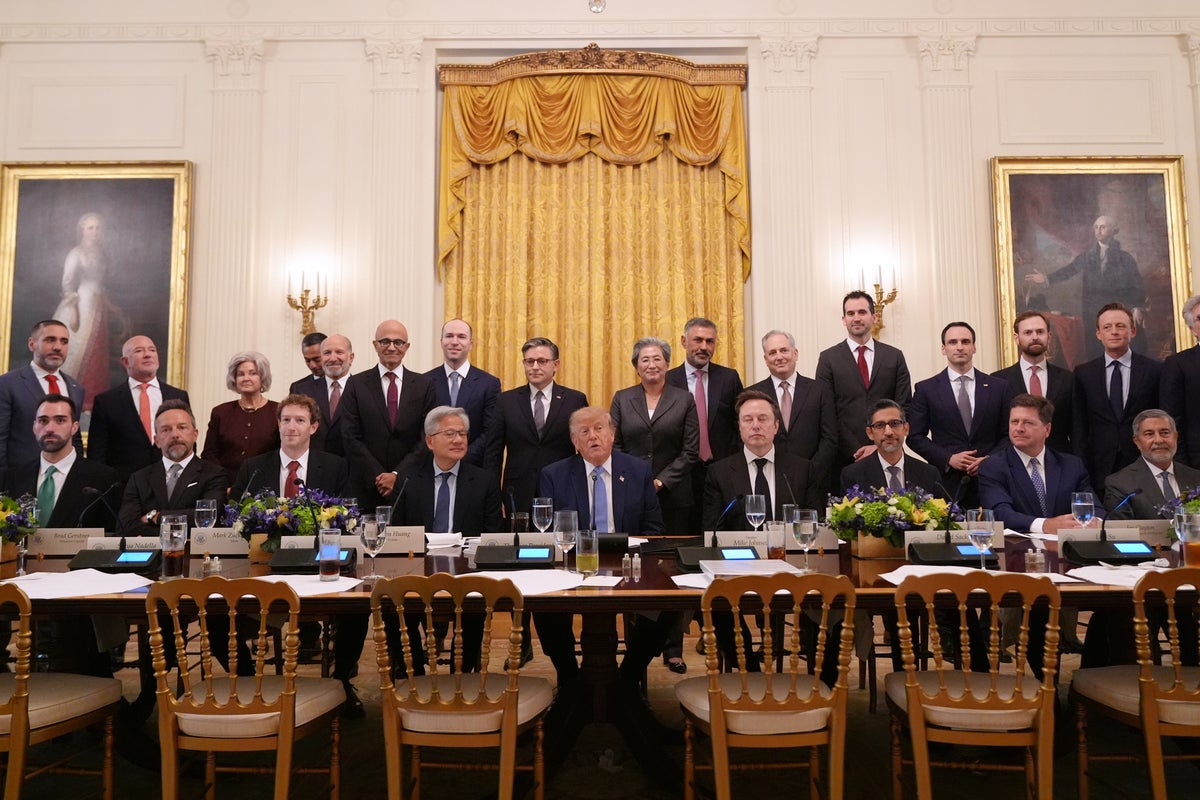
President Trump hosted technology executives in late September for a luncheon that included the signing of a short voluntary agreement on AI safety. The 308 word document calls on leading labs to establish internal monitoring teams and follow basic protocols but leaves enforcement and specifics to the companies themselves. Administration officials have described the pact as a foundational document for managing what they term Super Intelligence though they have not detailed how violations would be addressed or how external review would occur.
Founders and investors at the San Francisco sessions said the absence of new regulations would accelerate work on AI applications for defense and national security. One panel highlighted the trillion dollar scale of potential government spending in these areas and framed the administration's approach as a direct boost to commercial opportunities. Participants argued that self monitoring would allow faster iteration while still addressing risks through internal processes.
The shift comes after earlier periods of discussion about possible government intervention to manage AI agents operating across public websites and sensitive data systems. With the new emphasis on voluntary measures the distance between current policy and comprehensive rules appears wider than it did several years ago. Industry voices at the events described the change as essential for maintaining an edge in a field where development timelines matter greatly.
At the same time proponents of rapid AI expansion point to international competition as a reason against any slowdown. Commentators note that countries including China Iran and North Korea continue advancing their own programs without pause and argue that the United States would risk falling behind by imposing constraints. Data centers required for training and running large models already consume substantial electricity and water and their growth is expected to increase those demands further depending on workload. Older facilities handled routine business tasks while newer hyperscale installations supporting AI inference require far more power and cooling infrastructure.
Advocates for expansion say these resource needs can be met through expanded generation capacity and improved efficiency rather than limits on construction. They contend that pausing development would cede strategic ground in areas such as intelligence analysis logistics and cybersecurity where AI tools are already in use. The voluntary safety framework signed in Washington aligns with this view by placing responsibility on individual labs to track their own progress without external mandates.
Questions remain about how effectively internal teams can identify and mitigate emerging risks when competitive pressures favor speed. The administration has not yet outlined mechanisms for sharing safety data across companies or for responding if a system produces unintended outcomes at scale. In San Francisco the focus stayed on investment prospects and the advantages of reduced oversight rather than on those operational details.
The current posture reflects a broader bet that market incentives and corporate self interest will prove sufficient to manage the technology's downsides while capturing its benefits in defense and commercial sectors. Whether that calculation holds will depend on how labs implement the voluntary commitments and how quickly new capabilities move from research to deployment.
You just read Liberal's take. Want to read what actually happened?
More in Technology

Democratic Wins Heighten Scrutiny of Data Center Expansion
Newly empowered Democrats signaled opposition to rapid AI data center growth on public lands and elsewhere. This contributed to market pressure on chipmakers and infrastructure firms.
Nvidia Faces Added Scrutiny on AI Shipments After Midterms
Nvidia faces increased monitoring of accelerator shipments amid smuggling concerns to China. Broader regulatory uncertainty from the election weighed on the sector.

Google Ties Search Access to AI Opt-In for K-12 Schools
Google will turn its AI tools off by default for K-12 students starting in 2027 and will restrict Search access for schools that fully block AI. The policy reflects deeper integration of AI into core products. Right-leaning New York Post and tech coverage noted the changes.

FBI Ties $6.3 Billion Binance Hack to North Korea; Pyongyang Fires Missiles
The FBI linked the theft of over $6 billion in cryptocurrency from Binance to North Korea's Lazarus Group, citing social engineering. Laundering the funds is expected to take months. Engadget, New York Post, and other outlets reported on the investigation.
The Compass
You just read five takes on one story.
What's your take? Find your political shape in a few minutes.
Take the test