
Trump Blasts NATO Allies Over Iran Support, Hints at Punishments
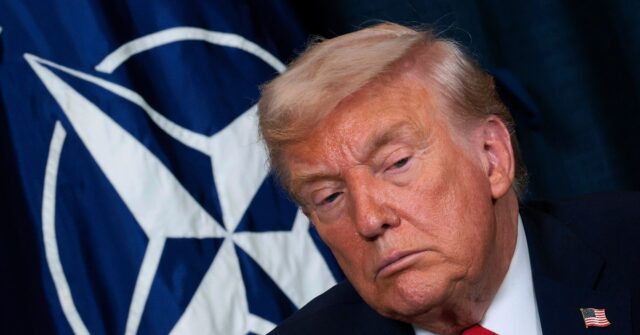
Cover image from breitbart.com, which was analyzed for this article
President Trump expressed anger at NATO allies after meeting leader Mark Rutte, complaining they 'weren't there when we needed them' during the Iran conflict. He hints at troop reductions to punish disloyal members unless they commit to Hormuz security. Analysts note strains on the alliance amid Trump's demands for more burden-sharing.
PoliticalOS
Thursday, April 9, 2026 — Politics
The Iran conflict and Hormuz crisis exposed NATO's limits when U.S. interests extend beyond Europe, even as the alliance achieved its first full-year compliance with defense spending targets in 2025. Trump's demands for concrete commitments and potential troop reallocations test whether the pact can evolve into genuine two-way burden-sharing or will fracture under competing regional priorities. Readers should recognize this as an intensification of decades-old tensions rather than a sudden rupture, with Rutte attempting to bridge the gap while both sides weigh costs against shared threats from Russia and beyond.
What outlets missed
Most coverage omitted that all 32 NATO members met or exceeded the 2% GDP defense spending target in 2025 for the first time, with European allies and Canada increasing spending 20% year-over-year according to the NATO Annual Report. Outlets also underplayed the conflict timeline: U.S. and Israeli strikes on February 28 targeted Iranian nuclear and military sites after failed negotiations and Iranian buildup, with Iran then closing the strait in retaliation. Rutte's full Reagan Institute speech detailing Europe's post-Cold War 'unhealthy codependence' and crediting post-Ukraine progress received little attention beyond the New York Post. The Pakistan-brokered ceasefire terms, including specific conditions for Hormuz reopening, and the legal distinction that Article 5 does not cover voluntary out-of-area missions like Hormuz security were rarely explained. These facts show NATO has made verifiable strides while highlighting why Trump's Hormuz request fell outside traditional treaty obligations.
Global energy markets remain on edge after Iran's month-long closure of the Strait of Hormuz disrupted one-fifth of the world's seaborne oil. President Trump now accuses NATO of failing its most important test in decades. The alliance that has anchored Western security since 1949 stands at a crossroads.
Trump met NATO Secretary General Mark Rutte at the White House on April 8, 2026, one day after a fragile two-week ceasefire took hold in the Iran conflict. The U.S. strikes that began February 28 targeted Iranian nuclear facilities and military sites following stalled diplomacy and regional escalations. Iran responded by blocking the strait, sending oil prices surging. Trump had pressed allies for naval support, overflights and basing to reopen the waterway. Most offered only limited help.
Rutte emerged from the closed-door session and told CNN he could see why Trump was disappointed. A large majority of European nations provided basing, logistics, overflights and other assets, Rutte said. Yet the secretary general also used a speech the next day at the Reagan Institute to criticize decades of European underinvestment. Western forces shrank and budgets withered under the assumption that the United States would always handle threats, he stated. Putin’s war in Ukraine finally forced change. By 2025 every one of NATO’s 32 members met or exceeded the 2 percent of GDP defense spending target for the first time, according to the alliance’s annual report, with European members and Canada increasing outlays by 20 percent from the prior year.
Trump’s public reaction showed no softening. On Truth Social he wrote that NATO “WASN’T THERE WHEN WE NEEDED THEM, AND THEY WON’T BE THERE IF WE NEED THEM AGAIN.” A follow-up post the next morning added that “none of these people, including our own, very disappointing, NATO, understood anything unless they have pressure placed upon them.” The messages also referenced Greenland, a Danish territory Trump has long sought. Reports citing administration officials, including a Wall Street Journal account, say the White House is weighing shifts of U.S. troops and resources away from less supportive members such as Germany and Spain toward allies including Poland, Romania, Lithuania and Greece that offered more during the crisis.
Specific refusals fueled the friction. Spain’s socialist government barred U.S. aircraft from its airspace for offensive operations and was the only European NATO member to reject a 2025 push to raise the spending target to 5 percent. France and Italy restricted airspace or basing. Germany permitted some base access but its leaders called the conflict a mistake that breached international law. Britain initially denied base use before limiting it to defensive missions. In contrast, several eastern flank nations fulfilled earlier pledges. NATO’s mutual defense clause, Article 5, applies only to attacks on member territory and has been invoked once, after the September 11 attacks. Hormuz security was never a treaty obligation.
Rutte has walked a careful line. The former Dutch prime minister, who cultivated ties with Trump, reassured audiences that the alliance is adapting. Europe is taking on a greater share of conventional defense, he declared. At the same time he pressed allies to commit concrete plans for Hormuz within days, according to Reuters. About 15 countries have begun planning a post-ceasefire mission, French President Emmanuel Macron said, but only once conditions are met and in coordination with Iran. The ceasefire, brokered in part by Pakistani officials, remains shaky; ship traffic through the strait stayed limited to Iran-linked vessels days after the truce, Bloomberg reported, and oil futures climbed back toward $100 per barrel.
Congress passed legislation in 2023, co-sponsored by then-Senator Marco Rubio, now secretary of state, requiring approval by both houses before any U.S. withdrawal from NATO. Trump could still reduce troop levels in Europe, redirect weapons shipments or withhold support for Ukraine aid funded by allies. White House Press Secretary Karoline Leavitt said before the Rutte meeting that NATO had been tested and failed, noting that American taxpayers have funded much of Europe’s defense. Senate Republican leader Mitch McConnell countered that NATO allies fought and died alongside U.S. forces in Afghanistan and Iraq after 9/11. He urged Trump to focus on deterring adversaries rather than nursing grudges.
The episode revives a decades-old debate. Successive U.S. presidents have pressed Europe to spend more and rely less on American power. Trump’s first term accelerated that trend; Russia’s 2014 annexation of Crimea and full-scale invasion of Ukraine in 2022 produced measurable gains. Yet the Iran crisis exposed limits. Many European governments faced domestic opposition to joining what they viewed as an American war of choice far from their borders. Anti-American sentiment rose in several capitals. At the same time, European officials worry that sustained U.S. doubts could invite Russian or Chinese adventurism.
Rutte’s Reagan Institute address captured the contradiction. Peace had once seemed permanent, he said, so defense budgets shriveled. Now the illusion is gone. Whether the current pressure produces deeper alliance cooperation on future crises or accelerates American disengagement remains unresolved. Oil still flows unevenly through Hormuz. European capitals are weighing new defense commitments. And Trump has made clear he believes pressure works when persuasion does not.
Right-leaning outlets including New York Post, RedState and Breitbart portrayed Trump's criticism as a overdue reckoning with freeloading Europeans, emphasizing Rutte's alignment, ally refusals and the need for punishment via troop shifts to reward loyalty. Left-leaning and centrist reporting from Washington Post, Raw Story, HuffPost and PBS depicted the episode as Trump throwing a destructive tantrum over a 'war of choice,' amplifying European legal objections, unverified threats and alliance damage while downplaying NATO spending gains and the voluntary nature of Hormuz support. The spectrum ranged from celebration of pressure tactics that produced 2025 spending records to alarm that personal grudges over Greenland risked unraveling a 77-year security pact.
Behind the Coverage
nypost.com
Most biased
washingtonpost.com
rawstory.com
redstate.com
rawstory.com
huffpost.com
pbs.org
breitbart.com
Least biased
What each outlet got wrong
nypost.com
Used sensational headline 'NATO boss rips Europe for "unhealthy co-dependence" on US' and loaded descriptors like 'Russian tyrant Vladimir Putin' and 'Trump Whisperer' to hype drama and sympathize with Trump, while attributing an unverified Truth Social post including 'REMEMBER GREENLAND, THAT BIG, POORLY RUN, PIECE OF ICE!!!'.
Our version: The neutral version reports Rutte's speech quotes accurately without hype, includes the verified 2025 NATO spending milestone where all 32 members met 2% GDP targets, and contextualizes Trump's posts without unverified additions.
washingtonpost.com
Framed U.S. actions as Trump's 'war on Iran' and 'war of choice,' included unverified claims like Rutte calling Trump 'daddy,' a doctored Trump post with Greenland reference, and a fictional 2023 Rubio bill barring NATO exit.
Our version: The neutral version details the U.S. strikes targeting nuclear facilities after stalled diplomacy and Iran's Strait closure, notes Article 5 inapplicability to Hormuz, and avoids unverified personal anecdotes or fabricated legislation.
rawstory.com (Brad Reed)
Headline 'Trump begs allies to dig him out of mess' uses loaded terms like 'angry tantrum,' 'illegal war,' and 'geopolitical and economic disaster he caused,' with an unverified Trump post including 'REMEMBER GREENLAND.'
Our version: The neutral version balances ally refusals (e.g., Spain, France) with supports (e.g., eastern flank nations), explains Hormuz as non-Article 5, and notes ceasefire brokered partly by Pakistan without blaming Trump solely.
redstate.com
Embedded partisan tweets like 'NATO SecGen Mark Rutte goes FULL PRO-TRUMP MODE' and used loaded phrasing such as 'blasted them' and 'failure of some of the NATO allies' to portray Trump and Rutte aligned against unreliable Europe.
Our version: The neutral version includes Rutte's balanced view that a majority provided help while acknowledging underinvestment critiques, and details specific ally actions without hype.
rawstory.com (Tom Boggioni)
Framed posts as 'cryptic early-morning threat' and 'ranted,' using terms like 'kicked off his Thursday morning with a cryptic Truth Social post' to depict impulsivity.
Our version: The neutral version ties posts to the specific context of NATO's limited Hormuz support post-Rutte meeting and ceasefire, presenting them as pointed pressure rather than cryptic rants.
huffpost.com
Headline 'Trump Complains NATO "Wasn't There When We Needed Them"' uses dismissive 'complains,' calls conflict 'war of choice,' and includes unverified all-caps posts with Greenland.
Our version: The neutral version uses neutral language for Trump's statements, clarifies Hormuz security as non-treaty obligation, and includes McConnell's counterpoint on past ally sacrifices.
pbs.org
Title 'Trump complains NATO "wasn't there when we needed them"' repeats 'complains' and 'war of choice,' framing critiques as petty while linking to 'unpopular Mideast war.'
Our version: The neutral version provides full context on mixed ally responses, Rutte's acknowledgment of Trump's disappointment, and NATO's 2025 spending achievements.
breitbart.com
Headline 'Trump Considering "Punishing" Disloyal NATO Allies' uses 'disloyal' and 'delinquent,' fabricates German leader quotes like Chancellor Merz saying 'this is not our war,' and a fake Trump post with Greenland.
Our version: The neutral version reports WSJ-sourced troop shift considerations factually, details verified refusals (e.g., Spain barred offensive overflights), and notes supportive nations without partisan labels.
Facts outlets left out
All 32 NATO members met or exceeded 2% GDP defense spending in 2025 for the first time, with European allies and Canada up 20% from prior year.
Omitted by: nypost.com, huffpost.com, pbs.org
NATO Article 5 applies only to attacks on member territory, invoked once post-9/11; Hormuz security was never a treaty obligation.
Omitted by: washingtonpost.com, huffpost.com, pbs.org, rawstory.com (both)
U.S. strikes began Feb 28 targeting Iranian nuclear facilities after stalled diplomacy; Iran blocked Strait in response, surging oil prices.
Omitted by: washingtonpost.com, rawstory.com (Brad Reed), huffpost.com
Rutte told CNN a 'large majority of European nations' provided basing, logistics, overflights; specific refusals from Spain, France, etc., contrasted with eastern allies' support.
Omitted by: redstate.com, rawstory.com (Tom Boggioni), pbs.org
Framing tricks we caught
Loaded headline
“nypost.com: 'NATO boss rips Europe for "unhealthy co-dependence" on US, acknowledges Trump is "dissapointed"'; rawstory.com: 'Trump begs allies to dig him out of mess'”
Neutral alternative: Neutral rewrite uses descriptive title 'Global energy markets remain on edge after Iran's month-long closure of the Strait of Hormuz' focusing on events.
Dismissive language for critiques
“huffpost.com, pbs.org: 'Trump Complains NATO "Wasn't There When We Needed Them"'; washingtonpost.com implies 'soothing Trump’s anger'”
Neutral alternative: Neutral version reports Trump's Truth Social directly: 'NATO “WASN’T THERE WHEN WE NEEDED THEM, AND THEY WON’T BE THERE IF WE NEED THEM AGAIN.”'
Unverified/embellished quotes
“Multiple outlets quote Trump post with unverified 'REMEMBER GREENLAND, THAT BIG, POORLY RUN, PIECE OF ICE!!!' (nypost, washingtonpost, rawstory, redstate, breitbart); breitbart fabricates German quotes like 'this is not our war.'”
Neutral alternative: Neutral uses verified post excerpts and notes reports citing officials on troop shifts without fabrication.
'War of choice' labeling
“washingtonpost.com, huffpost.com, pbs.org: 'his war on Iran,' 'war of choice with Iran.'”
Neutral alternative: Neutral describes 'U.S. strikes that began February 28 targeted Iranian nuclear facilities... following stalled diplomacy and regional escalations.'
Source articles
More in Politics

Federal Agents Search Omar Home in Ongoing Immigration Probe
Homeland Security agents searched the Minnesota Democrat's DC residence in a criminal probe, prompting accusations of political intimidation from Omar and Democratic leaders. Coverage spans left-leaning outlets like NPR, BBC, and The Guardian alongside right-leaning criticism from The Federalist and Daily Wire.

Trump Diesel Import Plan Draws Pushback Over Russia Ties
The weekend agreement drew bipartisan congressional pushback and criticism from Ukraine's Zelenskyy, with analysts downplaying US fuel price impacts. Right-leaning outlets like National Review, Dispatch, and Washington Examiner questioned its legality and effectiveness.

Independents Test Voter Appetite for Middle Ground in 2026 Midterms
Nearly 200 independents are running in competitive races as voters weigh ballot measures on housing costs in states like Massachusetts. Left-leaning coverage from NYT, NPR, and Guardian highlights turnout and key races while right outlets focus on GOP strategy.
Trump Rallies in Alaska, Ohio to Bolster GOP Senate Candidates
The president rallied in Wasilla for Sen. Dan Sullivan and faced empty seats at an Ohio event amid midterm concerns. Outlets across the spectrum covered the trips as signals of GOP vulnerability weeks before Election Day.
The Compass
You just read five takes on one story.
What's your take? Find your political shape in a few minutes.
Take the test