
U.S. Gas Prices Surge to $4.14 National Average Amid Iran Strait of Hormuz Restrictions, Sparking Midterm Political Battles and Automaker Strategies
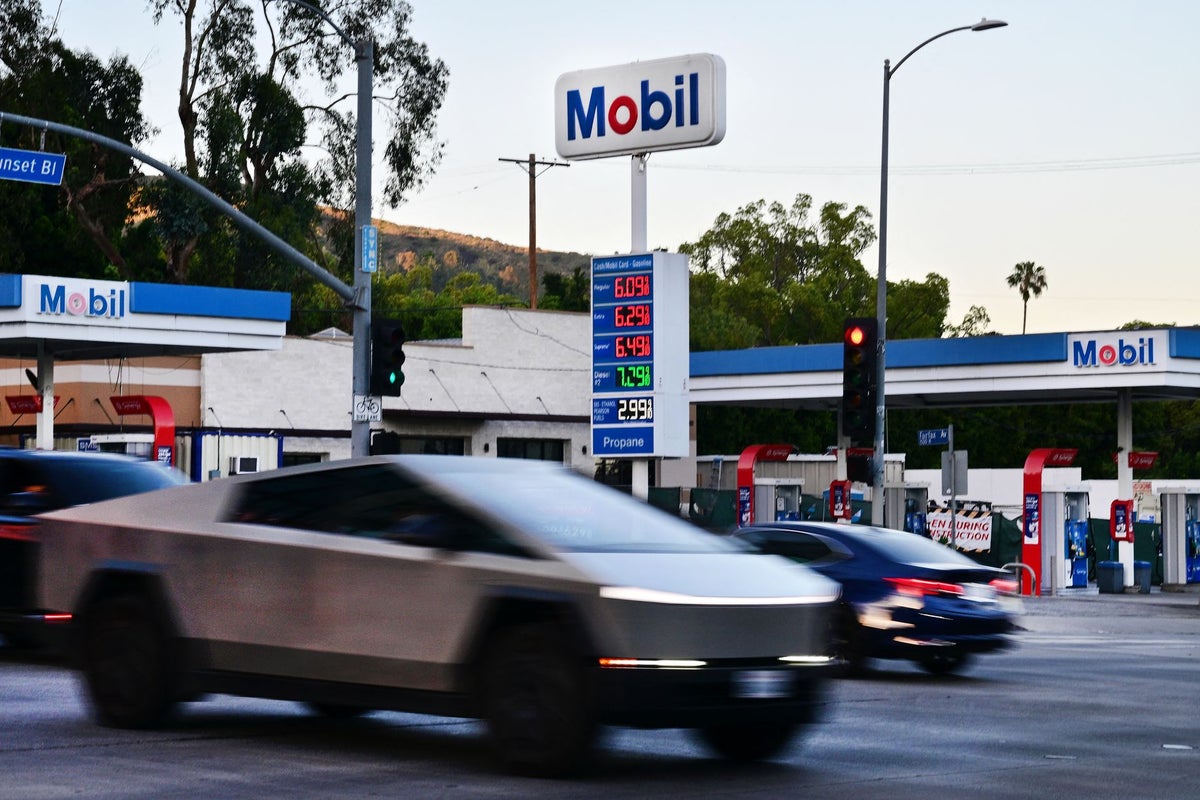
Cover image from independent.co.uk, which was analyzed for this article
Gas prices across the US are surging, with the national average now 88 cents higher than last year and California facing the highest costs amid fears of Strait of Hormuz disruptions. Automakers appear unphased by the skyrocketing prices linked to the Iran conflict. Democrats are leveraging high fuel costs in midterm campaigns against Republicans.
PoliticalOS
Tuesday, April 7, 2026 — Business
Gas prices have surged due to Iran’s Hormuz restrictions post-U.S. strikes, but U.S. domestic production limits severity. Democrats weaponize costs against GOP control, while Republicans deem them transitory for security. Automakers stick to profitable trucks as affluent buyers dominate sales amid policy shifts.
What outlets missed
Most outlets omitted that the U.S. imports no oil through the Strait of Hormuz and produces over 60 percent of its needs domestically, per EIA, softening direct exposure. They downplayed California's structural price drivers like high taxes and refinery constraints predating the war, with statewide averages already top nationally in February 2026. Poll nuances were ignored, such as AP-NORC data showing two-thirds of Americans prioritizing Iranian nuclear prevention alongside gas prices. Automaker EV write-downs tied heavily to ended subsidies, not just high gas insulation, and recent U.S. EV interest upticks were absent.
The national average price for regular unleaded gasoline in the United States reached $4.14 per gallon as of April 7, 2026, according to data from AAA and GasBuddy. This marks an increase of approximately 88 cents from the 2025 yearly average of around $3.26 per gallon, per AAA historical records, and represents the highest levels since August 2022. The surge coincides with ongoing U.S.-Iran tensions that began with U.S. and Israeli airstrikes on Iranian nuclear and military facilities on February 28, 2026, following failed diplomatic efforts, as reported by Reuters and the American Jewish Committee.
In retaliation, Iran restricted access to the Strait of Hormuz starting in early March 2026, disrupting roughly 20 percent of global oil shipments through the vital waterway, according to the World Economic Forum and Newsweek. Crude oil prices opened above $115 per barrel on April 7, 2026, per market data cited by The Independent. Patrick De Haan, head of petroleum analysis at GasBuddy, stated in a Washington Post interview on April 7 that 'if there’s not a ceasefire deal soon, I would almost think that the increases could continue unabated,' attributing the outlook to the strait’s continued constriction.
California has been hit hardest, with a statewide average of $5.929 per gallon on April 7, per AAA, and Mono County near Yosemite National Park recording the nation's highest at $6.721 per gallon, with some stations reaching $7. These prices build on California's pre-existing highs—$4.589 statewide on February 16, 2026, per AAA—driven by state taxes exceeding $0.90 per gallon, a unique reformulated gasoline requirement, limited refineries operating near capacity, and fewer discount retailers in rural areas like Mono County, as noted by the U.S. Energy Information Administration (EIA).
Consumers are feeling the pinch. In central Pennsylvania, Janelle Stelson, a Democratic congressional candidate, highlighted $4.24 per gallon regular and over $6 for diesel at a Mobil station during a campaign event on April 6, 2026, telling the Washington Post, 'Gas prices are not just a number on a sign.' Local resident Phillip Fabres, a 64-year-old Trump voter from 2024, said at a nearby Sheetz, 'I did really good in Trump’s first term, but now I am screwed again,' while granting leeway for addressing Iran's threats. Pamela Seetoo, 55, altered driving habits to avoid extra miles, and retiree Stephen Glass, 74, called the conflict a 'war of choice' amid $4.24 prices.
In Mono County, resident Connie Lear told CNN she limits grocery trips 20 miles away to once weekly, uses a golf cart or bike for managing 42 vacation rentals, and drives 120 miles to Nevada for $4.57 gas, worrying about summer tourism. A March 2026 AP-NORC poll found 45 percent of Americans worried about affording fuel, with 59 percent viewing U.S. actions as excessive, though two-thirds prioritized preventing an Iranian nuclear weapon equally with low gas prices—higher concern among Democrats.
Democrats are leveraging the prices in 2026 midterm campaigns. Stelson, who nearly ousted Rep. Scott Perry (R-Pa.) in 2024 by 1 percentage point, attacks Perry's war support and votes against health subsidies. In Iowa, VoteVets ads for state Rep. Joshua Turek's Senate bid mention rising prices, with $2.5 million spending planned. Michigan's Abdul El-Sayed ad claims 'Donald Trump’s $200 billion war with Iran'—a figure unverified by independent sources. President Trump, in his earlier 2026 State of the Union, boasted prices 'below $2.30 a gallon in most states,' though national averages were near $3 per Forbes and Poynter fact-checks.
Republicans counter that increases are transitory and necessary. Perry told the Washington Post on April 7, 'I don’t like the high gas prices... But I can’t stop Iran from being a terrorist nation,' defending strikes to halt nuclear development and calling Democratic attacks a 'political cudgel.' Trump posted on Truth Social on April 6 threatening 'Hell' if Iran does not reopen the strait, calling rises a 'little glitch' for safety. The U.S. imports zero oil via the Strait of Hormuz, relying on domestic production exceeding 60 percent of needs per EIA, mitigating direct impacts compared to nations like the Philippines, which declared a fuel emergency on March 25.
Automakers remain focused on high-margin gas-powered trucks and SUVs despite prices. At the New York International Auto Show ending April 2026, displays emphasized large vehicles like the Volkswagen Atlas and Ford Explorer, with new car averages over $50,000—up 10 percent year-over-year and 44 percent decade-over-decade—per Kelley Blue Book. Monthly payments average $773, with 23 percent of loans at 84+ months. Ford's EV division lost $4.8 billion in 2025, GM took $7.9 billion charges, and Stellantis a $26 billion hit, per company filings, shifting to profitable models.
Alexander Edwards of Strategic Vision told New Republic that large SUV buyers earn over $150,000 annually, ranking gas prices low (37th-38th) in decisions, as wealthier buyers are insulated. Stephanie Brinley of S&P Global Mobility noted product shifts take years. U.S. EV sales fell below 6 percent post-2025 tax credit rollbacks, per Kelley Blue Book, though interest ticked up modestly per CarGurus. Globally, China's NEVs reached 53 percent market share, but U.S. Big Three hold about 15-20 percent worldwide per OICA, not under 10 percent as some unverified claims suggest.
Q1 2026 vehicle sales dropped 5.3 percent amid high rates, no EV credits, and prices, with Ford down 9 percent but claiming share gains via SUVs. Experts like Brinley warn broader downturns could pressure even affluent buyers in a K-shaped economy.
Coverage ranges from political framing of Democratic midterm gains and Republican defensiveness (Washington Post) to consumer crisis alarmism in California (Independent) and industry critique implying corporate insulation (New Republic). Today.com offers the briefest factual price update with thumbnail sensationalism. Overall left-leaning tilt emphasizes pain and Trump/war blame over U.S. energy independence or security rationales.
Behind the Coverage
washingtonpost.com
today.com
independent.co.uk
Least biased
newrepublic.com
Most biased
What each outlet got wrong
washingtonpost.com
The article uses primacy framing by opening with Democrat Janelle Stelson's campaign event at a Mobil station quoting 'Gas prices are not just a number on a sign' and describes Democrats 'seizing on' and 'swooping in' on prices, with headline 'Democrats are turning Republicans’ arguments against them'; it features source asymmetry with five Democratic voices (Stelson, El-Sayed ad, VoteVets, Abbott, two voters) versus one Republican (Perry).
Our version: The neutral version balances coverage of both parties' campaign tactics, includes Perry's full defense, and provides symmetric context on war origins without leading with partisan attacks.
today.com
The title 'Gas Price Average Is Now 88 Cents Higher Than It Was in 2025' uses a vague baseline without specifying the yearly average of ~$3.26, amplified by alarmist thumbnails like 'Trump Threatens ‘Complete Demolition’ of Iran’s Infrastructure' and 'Ongoing War in Iran Hikes Cost of Groceries, Airfare, Gas'.
Our version: The neutral rewrite specifies 'an increase of approximately 88 cents from the 2025 yearly average of around $3.26 per gallon, per AAA historical records' for precision.
independent.co.uk
Employs sensational language throughout like 'Gas prices are skyrocketing,' 'soar,' 'shot up,' and 'surged even higher' in title and lead, while framing Trump as attempting 'to downplay the every day impact' and sequencing war as the dominant cause before burying California-specific factors.
Our version: The neutral version uses factual language without hyperbole, prominently explains California's pre-existing highs due to taxes over $0.90/gallon, reformulated gas, and limited refineries alongside war effects.
newrepublic.com
Features emotional title 'Gas Prices Are Going Through the Roof' and unverified claim that 'Big Three domestic automakers (Ford, GM, and Stellantis) today command less than 10 percent of global market share—down from nearly 50 percent in 1973,' alongside factual errors overstating foreign EV adoption like '50 percent of auto markets in Thailand and Singapore'.
Our version: The neutral rewrite corrects to 'U.S. Big Three hold about 15-20 percent worldwide per OICA, not under 10 percent as some unverified claims suggest' and neutrally reports EV sales trends without exaggeration.
Facts outlets left out
U.S. and Israeli airstrikes on Iranian nuclear and military facilities on February 28, 2026, following failed diplomatic efforts
Omitted by: washingtonpost.com, today.com
Iran restricted access to the Strait of Hormuz in early March 2026, disrupting roughly 20 percent of global oil shipments
Omitted by: washingtonpost.com
The U.S. imports zero oil via the Strait of Hormuz, relying on domestic production exceeding 60 percent of needs per EIA
Omitted by: independent.co.uk
California statewide average was $4.589 per gallon on February 16, 2026, pre-war highs driven by state taxes exceeding $0.90/gallon and other factors
Omitted by: independent.co.uk
March 2026 AP-NORC poll: 45% worried about affording fuel, 59% viewed U.S. actions as excessive, but two-thirds prioritized preventing Iranian nuclear weapon equally with low gas prices
Omitted by: washingtonpost.com, today.com, independent.co.uk, newrepublic.com
Framing tricks we caught
Primacy/recency framing
“Washington Post opens with Stelson at Mobil station: 'Gas prices are not just a number on a sign,' and Democrats 'seizing on the spike... swooped in,' with headline 'Democrats are turning Republicans’ arguments against them'.”
Neutral alternative: Neutral version starts with factual price data from AAA/GasBuddy and war timeline before covering balanced campaign responses.
Source asymmetry
“Washington Post quotes five Democratic elements (Stelson, El-Sayed '$200 billion war' ad unverified, VoteVets, Abbott, two voters) vs. one Republican (Perry).”
Neutral alternative: Neutral includes quotes from both sides like Perry's 'I don’t like the high gas prices... But I can’t stop Iran from being a terrorist nation' and Trump's posts equally.
Loaded headline and sensational language
“Independent: 'Gas prices are skyrocketing. This is the county with the most expensive average in America'; repeated 'soar,' 'shot up'. New Republic: 'Gas Prices Are Going Through the Roof.'”
Neutral alternative: Neutral uses precise figures like '$4.14 per gallon' and 'highest since August 2022' without dramatic verbs.
Alarmist thumbnails/context juxtaposition
“Today.com video page pairs 'Gas Price Average Is Now 88 Cents Higher' with 'Trump Threatens ‘Complete Demolition’ of Iran’s Infrastructure' and 'Ongoing War in Iran Hikes Cost of Groceries'.”
Neutral alternative: Neutral integrates Trump's threats factually alongside full context like U.S. non-reliance on Hormuz imports.
Source articles
More in Business & Economy

Major Banks Deliver Mixed Q3 Results on Trading Beats
JPMorgan, Goldman Sachs, Citigroup, and Wells Fargo reported Q3 figures, with revenue beats in trading but some estimate misses. CNBC provided live updates on the results and market reactions.

Oil Falls on Russian Diesel Outlook Despite Geopolitical Risks
Dow futures rose while Nasdaq faced pressure from tech weakness and elevated oil after geopolitical spikes. CNBC tracked premarket moves tied to earnings and Fed speeches.

Hall and Woodford Win Economics Nobel for Stabilization Models
American economists Robert E. Hall and Michael Woodford won the Nobel memorial prize for their research on managing economies through booms and busts, informing central bank policies on inflation and unemployment.

Skydance Closes Paramount-Warner Bros. Discovery Deal
The long-delayed media mega-merger cleared hurdles and began operations under Skydance, consolidating Hollywood power. Center and center-left outlets track the regulatory and business milestones.
The Compass
You just read five takes on one story.
What's your take? Find your political shape in a few minutes.
Take the test