
US GDP Revised to 0.5% as War, Shutdown Weigh on Growth
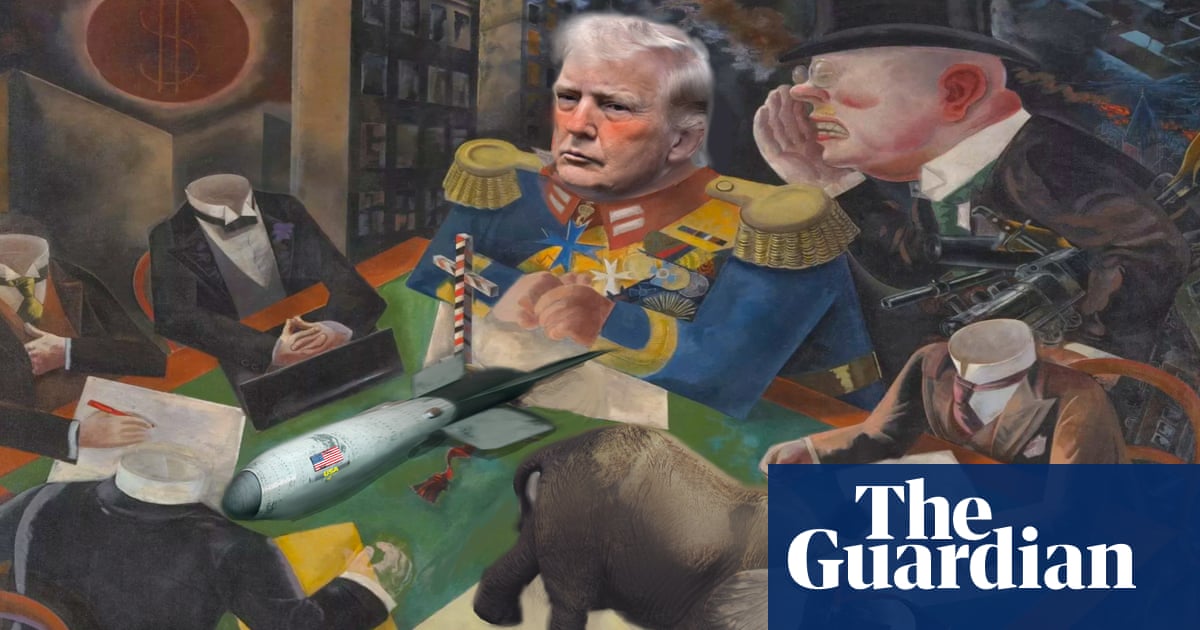
Cover image from theguardian.com, which was analyzed for this article
Q4 2025 GDP growth revised to just 0.5% due to government shutdown, trade issues, and Iran war impacts. Some blame Trump's policies for weakening America while others note resilience. Outlook cautious for 2026 amid energy shocks.
PoliticalOS
Sunday, April 12, 2026 — Business
The US economy slowed sharply with Q4 2025 GDP revised to 0.5 percent under the combined pressure of government shutdown, trade disruptions and the Iran conflict's energy and fiscal costs. Underlying strengths in employment and median incomes coexist with record-low consumer sentiment and real declines in after-tax purchasing power once stimulus ended. The single most important reality is that 2026 outcomes will hinge on whether defense-driven budget shifts and international tensions ease before they further erode household finances and growth momentum.
What outlets missed
Most outlets underplayed the Commerce Department's explicit downward revision of Q4 2025 GDP to 0.5 percent and its direct attribution to the government shutdown's drag on public spending and private activity. Coverage also minimized granular war-cost accounting, including the $200 billion supplemental request embedded in the $1.5 trillion defense topline and its daily burn rate exceeding $1 billion. The interconnected timeline, showing stimulus cliffs in 2023 preceding the 2025 slowdown, received little sustained attention. Finally, few reports balanced US health disparity data against labor-force participation figures showing prime-age female participation above the OECD average, or explained how the budget proposal remains non-binding until Congress acts.
Trump Budget Slashes Healthcare as Avoidable Deaths Mount and Public Discontent Grows
Despite forecasts of solid economic growth and record median household income, the Trump administration's proposed 2027 budget doubles down on priorities that critics say leave ordinary Americans to fend for themselves. The White House plan would slash more than $15 billion from the Department of Health and Human Services, a 12 percent reduction that comes on the heels of last year's sweeping cuts to Medicaid and Affordable Care Act subsidies. Those earlier reductions, embedded in the president's signature legislation known as the big beautiful bill, are projected to strip health coverage from as many as 15 million people through stringent work requirements.
The numbers paint a grim picture of public health in the world's wealthiest nation. Preventable deaths in the United States far exceed rates in peer countries across Europe, Asia, and Australia. Americans die from treatable conditions at nearly twice the rate of people in Spain, France, Japan, or Australia. They skip doctor's visits, diagnostic tests, and prescription refills at higher rates than citizens of any comparable industrialized democracy, driven largely by the highest out-of-pocket medical costs in the group. Public health insurance remains threadbare compared with virtually every other advanced economy.
The new budget does little to address these failures. Instead, it continues a pattern of redirecting resources toward the Pentagon, setting what would be another record in military appropriations even as domestic needs go unmet. The contrast is stark. While administration officials tout low unemployment and controlled inflation, families across the country confront a system that treats healthcare as a luxury good rather than a basic necessity.
This disconnect helps explain why consumer sentiment has collapsed to its lowest level on record. The University of Michigan's preliminary April reading hit 47.6, a figure lower than during the double-dip recessions of the early 1980s when inflation exceeded 10 percent and mortgage rates topped 15 percent. By conventional metrics the economy appears robust: growth is steady, unemployment sits a full percentage point below the 2012-2019 average, and inflation-adjusted median household income has reached an all-time high. Yet Americans consistently tell pollsters they feel worse off than in previous decades when the raw data looked weaker.
Interviews and informal surveys reveal a consistent theme. Citizens report that official statistics fail to capture the day-to-day reality of stagnant wages relative to exploding costs for housing, education, and medical care. Childcare in particular remains prohibitively expensive, helping keep American women's labor-force participation near the bottom of the industrialized world. The budget proposal offers no meaningful relief on that front either, effectively telling families that these burdens are theirs alone to bear.
The administration's approach reflects a philosophical stance that government should play a minimal role in healthcare. By imposing work requirements that independent analysts say will primarily disenroll eligible low-income adults rather than increase employment, the previous year's legislation already signaled that access to coverage is a privilege to be earned, not a right. The fresh cuts to HHS suggest that philosophy will guide policy for the foreseeable future.
Public health researchers have warned for years that the United States pays a steep price for its unique brand of market-driven medicine. Life expectancy lags behind other wealthy nations. Maternal mortality rates are higher. Chronic conditions go unmanaged because patients cannot afford consistent treatment. These outcomes are not abstract. They translate into funerals for people who would have survived with timely care in countries that treat universal coverage as a baseline.
At the same time, the military budget continues its upward trajectory. Successive administrations, both Republican and Democratic, have funded the Pentagon at levels that dwarf spending by any other nation. The Trump proposal appears poised to break new ground, directing resources toward defense contractors and overseas operations while domestic programs face the knife. Advocates for fiscal restraint rarely apply the same scrutiny to the defense budget that they demand for social programs.
The result is a feedback loop of declining trust. When economic growth fails to translate into broader security, when record corporate profits coexist with rising medical bankruptcies, and when the president proposes taking healthcare away from millions while expanding the armed forces, Americans register their discontent in polls even if the headline numbers look good. The University of Michigan data captures something deeper than temporary grumbling. It reflects a widespread sense that the economy celebrated in Washington is not the one experienced in most neighborhoods.
Economists have struggled to reconcile the divergence between hard data and public mood. Some point to the psychological scars left by the pandemic and the inflationary spike that followed. Others note that official statistics on median income can mask how gains are distributed. A strong topline number means little to a parent choosing between groceries and a doctor's copay, or a worker whose wage increase evaporates in the face of skyrocketing rents.
The budget proposal now before Congress will test whether lawmakers share the administration's priorities. With Republicans controlling key levers of power, the cuts to HHS and the continued generosity toward the Pentagon may well advance. Yet the human cost is already measurable in excess mortality figures that set the United States apart from every other wealthy democracy.
As the debate unfolds, one fact remains difficult to dismiss. Americans are dying from conditions that medicine knows how to prevent or treat. They are doing so at rates that would be considered a national emergency in most other developed countries. The president's budget treats this reality as someone else's problem while opening the spigot for military spending. The disconnect between that choice and the daily struggles of millions helps explain why so many people look at a statistically healthy economy and see a system that has left them behind.
You just read Progressive's take. Want to read what actually happened?
More in Business & Economy

Major Banks Deliver Mixed Q3 Results on Trading Beats
JPMorgan, Goldman Sachs, Citigroup, and Wells Fargo reported Q3 figures, with revenue beats in trading but some estimate misses. CNBC provided live updates on the results and market reactions.

Oil Falls on Russian Diesel Outlook Despite Geopolitical Risks
Dow futures rose while Nasdaq faced pressure from tech weakness and elevated oil after geopolitical spikes. CNBC tracked premarket moves tied to earnings and Fed speeches.

Hall and Woodford Win Economics Nobel for Stabilization Models
American economists Robert E. Hall and Michael Woodford won the Nobel memorial prize for their research on managing economies through booms and busts, informing central bank policies on inflation and unemployment.

Skydance Closes Paramount-Warner Bros. Discovery Deal
The long-delayed media mega-merger cleared hurdles and began operations under Skydance, consolidating Hollywood power. Center and center-left outlets track the regulatory and business milestones.
The Compass
You just read five takes on one story.
What's your take? Find your political shape in a few minutes.
Take the test