
Vance Leads High-Stakes US-Iran Talks in Pakistan as Ceasefire Frays
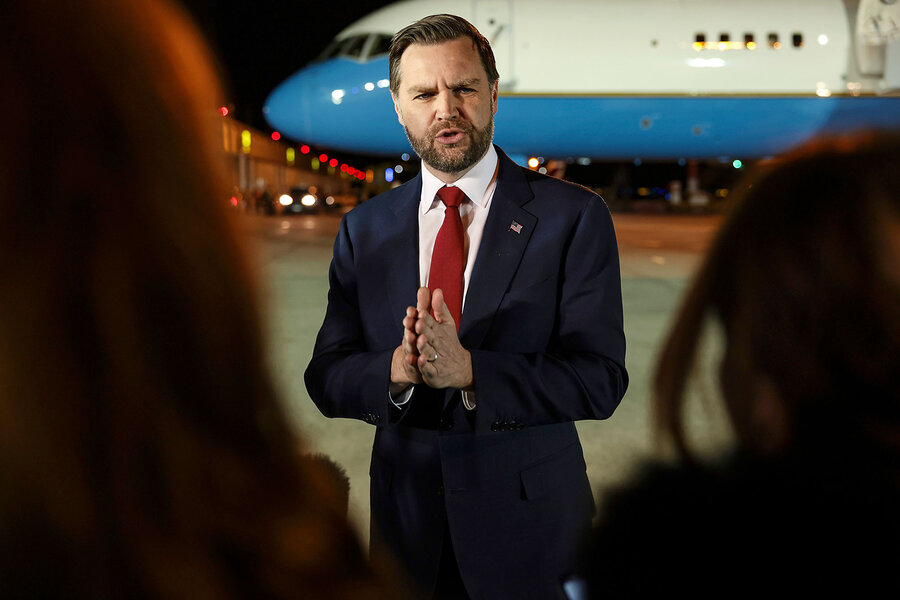
Cover image from csmonitor.com, which was analyzed for this article
VP JD Vance is tasked with leading delicate US-Iran talks in Islamabad as Trump expresses doubts on ceasefire viability. Analysts describe it as Vance's toughest challenge yet amid Hormuz tensions. Coverage focuses on negotiation risks and potential outcomes.
PoliticalOS
Friday, April 10, 2026 — Politics
These negotiations represent the most serious diplomatic effort to end a conflict that has already killed thousands, disrupted global energy flows and raised gasoline prices for American families. Vance's success or failure will hinge on bridging disputes over the Strait of Hormuz, Iran's nuclear ambitions and Israeli operations in Lebanon, none of which are fully resolved by the current fragile truce. Readers should recognize that the outcome carries consequences far beyond Washington or Tehran, affecting everything from midterm politics to the risk of wider regional war.
What outlets missed
Most accounts underplayed the specific sequence that triggered the February 28, 2026 military campaign, including the breakdown of nuclear negotiations, Iranian and Hezbollah attacks on U.S. bases and Israeli territory, and the assassination of Supreme Leader Ali Khamenei during initial strikes. Coverage also gave limited attention to Pakistan's proactive mediation, with Prime Minister Shehbaz Sharif and military chief Asim Munir directly involved in brokering the April 7-8 ceasefire and pressing for Vance's participation. Iran's formal 10-point proposal, which Trump described as containing workable elements, received scant detail despite shaping the talks' agenda on sanctions, security guarantees and nuclear limits. Economic data on the Hormuz disruption, such as precise shipping counts and price spikes attributed to sources like the International Energy Agency, were often generalized rather than quantified. Finally, Vance's own denial that he was aware of any specific Iranian request for his involvement was rarely contrasted with claims that his anti-interventionist record made him more acceptable to Tehran.
JD Vance Takes Charge of High Stakes Iran Peace Negotiations
WASHINGTON — Vice President JD Vance arrives in Islamabad this weekend to lead negotiations that could end a war he privately opposed, testing both his diplomatic skills and the Trump administration’s ability to convert military pressure into a durable agreement with Iran.
The talks, scheduled to begin Saturday, follow a two-week ceasefire reached Tuesday after six weeks of conflict that began when President Trump ordered strikes alongside Israel on February 28. Vance will be joined by Trump’s Middle East envoy Steve Witkoff and Jared Kushner. It marks the highest-level direct contact between U.S. and Iranian officials since the 1979 hostage crisis.
Vance’s emergence as the administration’s point man is striking. A Marine veteran of the Iraq war, he rose in politics as a vocal skeptic of foreign interventions that drain American resources and entangle the country in distant quarrels. That perspective, rooted in the hard lessons of nation-building failures, made him an unlikely choice to manage the aftermath of a conflict that has already sent energy prices higher and complicated domestic politics.
Sources familiar with internal deliberations told reporters that Vance argued against launching the war, warning it risked broader regional chaos and could fracture the coalition that returned Trump to office. Publicly, however, he has supported the president’s decision. During the fighting Vance maintained a notably low profile. When the ceasefire was announced he was in Hungary supporting Prime Minister Viktor Orban’s campaign, an ocean away from the crisis.
Now the 41-year-old vice president, widely viewed as a front-runner for the 2028 Republican nomination, must extract concessions from a regime that has spent decades honing its defiance of American power. The agenda includes curbing Iran’s nuclear enrichment, limiting its ballistic missile program, reopening the Strait of Hormuz to unrestricted commercial traffic, and calibrating sanctions relief against verifiable Iranian compliance.
The strait remains the most immediate pressure point. One-fifth of global oil passes through those waters in normal times. Iran’s throttling of traffic and reported attempts to impose tolls have driven up energy costs at a moment when American families are still struggling with inflation. Those price spikes have disrupted the administration’s midterm election messaging, which had centered on attacking Democrats for economic mismanagement. As one former Trump aide noted, the Iranians understand that domestic political calendar and are prepared to exploit it.
Both sides traded recriminations on the eve of the talks. Trump posted that Iran was doing “a very poor job” of honoring its commitments on oil transit. Tehran countered that Israeli strikes in Lebanon violated the ceasefire and warned that talks would be meaningless unless operations there ceased. Iran’s foreign ministry spokesman tied participation in Pakistan to Washington’s ability to restrain its Israeli partner. Israeli officials, for their part, maintain that Lebanon falls outside the U.S.-Iran understanding.
Despite the friction, Iran’s Revolutionary Guards signaled they were upholding the truce and had refrained from new attacks. The fragility of the pause is obvious. A single miscalculation in Lebanon or the gulf could collapse the diplomatic opening before it produces results.
For Vance the assignment carries obvious risks. No recent vice president has led formal negotiations of this magnitude. Success would strengthen his claim to serious statesmanship and quiet critics who question his experience. Failure would invite charges that an anti-interventionist was ill-suited to close a deal that required credible threats of renewed force. The political reward is equally large. A stable agreement that lowers energy prices and prevents wider war would be a tangible victory for an administration that campaigned on avoiding unnecessary conflicts while still confronting genuine threats.
The broader context reflects uncomfortable trade-offs. Military action against Iran’s nuclear infrastructure and missile sites achieved short-term degradation of capabilities but at the cost of disrupted global commerce, higher prices at the pump, and the risk of escalation that Vance had feared. Those costs are not abstract. They appear in household budgets and in polling data that shows voters care more about grocery and gasoline prices than about theoretical gains in distant power balances.
Iran, for its part, has demonstrated its capacity to impose pain through asymmetric means: mines and missiles in the gulf, proxies in Lebanon, and the threat of nuclear acceleration. The question now is whether a regime that has survived decades of sanctions and isolation sees sufficient advantage in an American security guarantee and economic relief to accept meaningful limits on its most dangerous programs.
Vance’s reputation as someone instinctively wary of open-ended commitments may prove useful. Iranian officials could view him as less likely to pursue the kind of transformative regime-change ambitions that have sometimes animated American policy. That does not mean trust will come easily. Decades of enmity, broken agreements, and mutual accusations of bad faith cannot be erased in a single round of talks in a third country.
Preparations in Islamabad continued Friday even as uncertainty lingered over exact delegation movements. Pakistani hosts are eager to demonstrate their relevance as a diplomatic venue. The agenda is crowded: nuclear limits, missile ranges, sanctions architecture, gulf security, and the precise sequencing of compliance and relief.
The outcome matters beyond the region. Americans have grown weary of wars that promise quick victories and deliver long occupations or endless commitments. Vance’s task is to demonstrate that disciplined pressure, followed by clear-eyed negotiation, can produce results that neither pure restraint nor perpetual conflict have achieved. Whether his long-held skepticism of intervention equips him to thread that needle will become clearer in the coming days. The economic pain already felt at American gas stations provides a practical deadline that no amount of diplomatic finesse can ignore.
You just read Conservative's take. Want to read what actually happened?