
Vance Leads High-Stakes US-Iran Talks in Pakistan as Ceasefire Frays
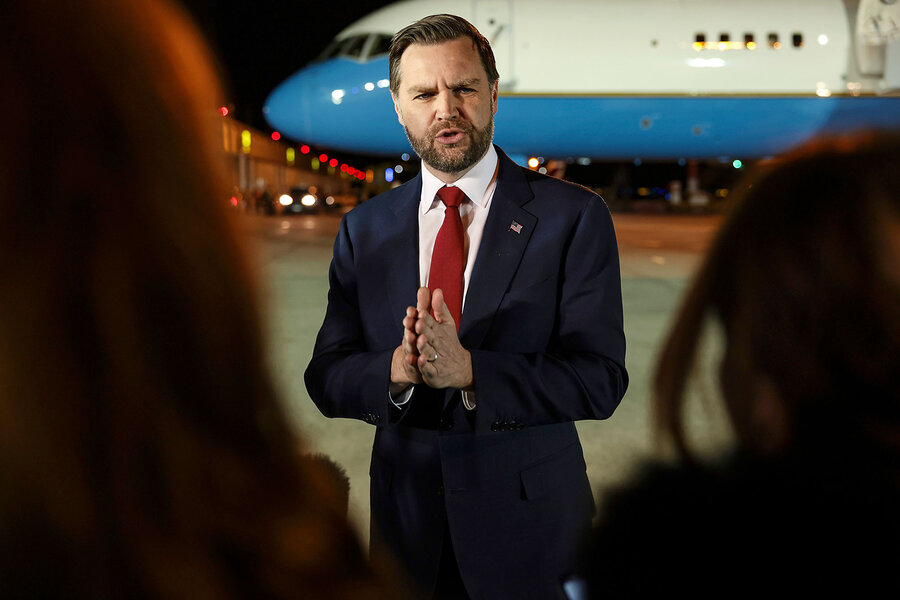
Cover image from csmonitor.com, which was analyzed for this article
VP JD Vance is tasked with leading delicate US-Iran talks in Islamabad as Trump expresses doubts on ceasefire viability. Analysts describe it as Vance's toughest challenge yet amid Hormuz tensions. Coverage focuses on negotiation risks and potential outcomes.
PoliticalOS
Friday, April 10, 2026 — Politics
These negotiations represent the most serious diplomatic effort to end a conflict that has already killed thousands, disrupted global energy flows and raised gasoline prices for American families. Vance's success or failure will hinge on bridging disputes over the Strait of Hormuz, Iran's nuclear ambitions and Israeli operations in Lebanon, none of which are fully resolved by the current fragile truce. Readers should recognize that the outcome carries consequences far beyond Washington or Tehran, affecting everything from midterm politics to the risk of wider regional war.
What outlets missed
Most accounts underplayed the specific sequence that triggered the February 28, 2026 military campaign, including the breakdown of nuclear negotiations, Iranian and Hezbollah attacks on U.S. bases and Israeli territory, and the assassination of Supreme Leader Ali Khamenei during initial strikes. Coverage also gave limited attention to Pakistan's proactive mediation, with Prime Minister Shehbaz Sharif and military chief Asim Munir directly involved in brokering the April 7-8 ceasefire and pressing for Vance's participation. Iran's formal 10-point proposal, which Trump described as containing workable elements, received scant detail despite shaping the talks' agenda on sanctions, security guarantees and nuclear limits. Economic data on the Hormuz disruption, such as precise shipping counts and price spikes attributed to sources like the International Energy Agency, were often generalized rather than quantified. Finally, Vance's own denial that he was aware of any specific Iranian request for his involvement was rarely contrasted with claims that his anti-interventionist record made him more acceptable to Tehran.
Trump Sends Skeptical Vance to Salvage Costly Iran War He Privately Opposed
Vice President JD Vance arrives in Pakistan this weekend carrying the weight of a war he never wanted and a fragile ceasefire already cracking under mutual accusations. President Trump has handed his deputy the assignment of turning a two-week pause in hostilities into a lasting agreement with Iran, a mission that tests Vance's long-held doubts about American military adventures abroad while exposing the steep price ordinary families are already paying at the pump.
The talks, set to begin Saturday in Islamabad alongside Trump's envoy Steve Witkoff and Jared Kushner, mark the highest-level direct contact between Washington and Tehran since the 1979 Islamic Revolution. They follow six weeks of conflict that began February 28 when the United States and Israel launched strikes against Iranian targets. What was pitched as a decisive move to neutralize nuclear threats has instead throttled global energy supplies, driven up costs for American drivers and households, and dragged the region into wider fighting that now includes partial Israeli occupation of Lebanon.
Vance built his political identity on skepticism toward forever wars. A Marine veteran of Iraq, he has consistently warned that fresh Middle East conflicts drain American resources, empower adversaries, and distract from pressing problems at home. Behind closed doors before the February strikes, Vance argued the operation risked regional chaos and could fracture the coalition of voters who returned Trump to the White House, according to reports. His public posture remained loyal but notably restrained. When the ceasefire was announced this week, Vance was in Hungary supporting populist Prime Minister Viktor Orban rather than appearing at center stage in Washington.
That low profile is now over. The 41-year-old vice president, widely viewed as a top contender for 2028, suddenly finds himself as chief diplomat in one of the most volatile negotiations in recent memory. Aaron Wolf Mannes, a University of Maryland expert on the vice presidency, called the role high risk, high reward. No recent vice president has led formal talks of this scale.
The agenda is straightforward on paper. The United States wants Iran to accept strict limits on nuclear enrichment and ballistic missiles. In return, Tehran seeks relief from economic sanctions and guarantees against future attacks. Reopening the Strait of Hormuz is central. Iran has restricted shipping through the vital waterway since the war began, seeking to impose tolls on tankers carrying oil that supplies one-fifth of global demand. The resulting spike in energy prices has complicated Republican messaging on inflation and affordability heading into midterm elections.
Both sides spent Friday trading blame for the ceasefire's shaky state. Trump posted repeatedly on social media, accusing Iran of doing a poor job restoring oil flows and violating the truce terms. Iranian officials countered that Israeli strikes in Lebanon, which they insist are covered by the agreement, have made talks pointless. Iran's foreign ministry spokesman tied participation in Pakistan to a full halt in Israeli operations there. The Revolutionary Guards, meanwhile, insisted they have not broken the ceasefire.
This back-and-forth underscores how the conflict has spread beyond initial targets. Fighting reached Lebanon, where Israel maintains a partial occupation, and has disrupted trade across the Persian Gulf. The human and economic costs are mounting. American consumers face higher gasoline prices precisely when many are already strained by years of rising living expenses. That reality has upended the administration's domestic focus. Vance had planned to spend much of this year traveling the country, hammering Democrats as out of touch on kitchen-table issues. The war has changed the script.
For all the challenges, Vance's background as an intervention skeptic could prove useful. Iranian officials may view him as more credible than voices in Washington who have long pushed for regime change in Tehran. The Christian Science Monitor noted that his anti-war instincts might help build a baseline of trust that career hawks could never establish. Yet the same reporting warns he could also absorb the blame if diplomacy collapses and fighting resumes.
The administration's goals remain curbing Iran's nuclear breakout capacity and its ability to threaten neighbors with missiles while restoring reliable energy flows that keep global markets stable. Achieving them without further entanglement will require delicate balancing. Kushner's involvement adds another layer of continuity with Trump's first-term approach, though critics question whether family connections and outside envoys should play such prominent roles in matters of war and peace.
Vance's own comments as he left Hungary this week were characteristically understated. He described making and taking numerous calls but expressed satisfaction with the current position. That restraint contrasts with the bombast that has defined much of the public discussion around the Iran operation. It also reflects the uncomfortable truth many in the president's base have voiced quietly: America has once again been pulled into a Middle East conflict with uncertain boundaries and high costs.
The coming days in Islamabad will reveal whether Vance can translate his private warnings into concrete diplomatic gains. Success would validate his judgment that restraint serves American interests better than perpetual confrontation. Failure risks locking the United States into another open-ended commitment far from home while families here wrestle with the daily consequences of disrupted oil markets and higher prices.
This is not abstract foreign policy. It is a test of whether the America First approach that resonated with millions can survive the pressures of governing in a dangerous world. Vance, the reluctant warrior turned reluctant negotiator, now stands at the center of that test. The stakes extend well beyond his political future or even the immediate future of the Middle East. They touch the pocketbooks and security of Americans who have grown weary of wars that rarely seem to end.
You just read America First's take. Want to read what actually happened?