
Vance Leads High-Stakes US-Iran Talks in Pakistan as Ceasefire Frays
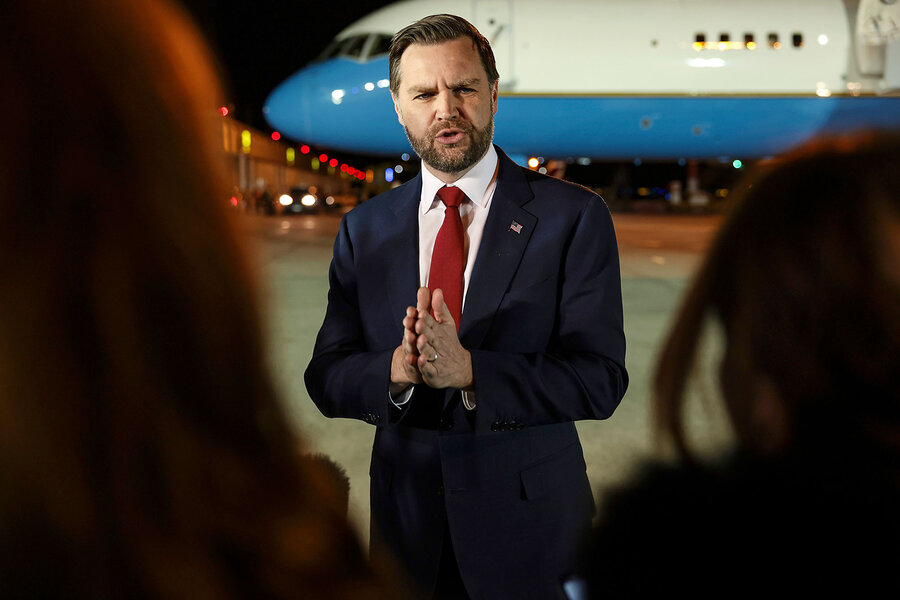
Cover image from csmonitor.com, which was analyzed for this article
VP JD Vance is tasked with leading delicate US-Iran talks in Islamabad as Trump expresses doubts on ceasefire viability. Analysts describe it as Vance's toughest challenge yet amid Hormuz tensions. Coverage focuses on negotiation risks and potential outcomes.
PoliticalOS
Friday, April 10, 2026 — Politics
These negotiations represent the most serious diplomatic effort to end a conflict that has already killed thousands, disrupted global energy flows and raised gasoline prices for American families. Vance's success or failure will hinge on bridging disputes over the Strait of Hormuz, Iran's nuclear ambitions and Israeli operations in Lebanon, none of which are fully resolved by the current fragile truce. Readers should recognize that the outcome carries consequences far beyond Washington or Tehran, affecting everything from midterm politics to the risk of wider regional war.
What outlets missed
Most accounts underplayed the specific sequence that triggered the February 28, 2026 military campaign, including the breakdown of nuclear negotiations, Iranian and Hezbollah attacks on U.S. bases and Israeli territory, and the assassination of Supreme Leader Ali Khamenei during initial strikes. Coverage also gave limited attention to Pakistan's proactive mediation, with Prime Minister Shehbaz Sharif and military chief Asim Munir directly involved in brokering the April 7-8 ceasefire and pressing for Vance's participation. Iran's formal 10-point proposal, which Trump described as containing workable elements, received scant detail despite shaping the talks' agenda on sanctions, security guarantees and nuclear limits. Economic data on the Hormuz disruption, such as precise shipping counts and price spikes attributed to sources like the International Energy Agency, were often generalized rather than quantified. Finally, Vance's own denial that he was aware of any specific Iranian request for his involvement was rarely contrasted with claims that his anti-interventionist record made him more acceptable to Tehran.
JD Vance Embarks on a Diplomatic Test That Could Define His Future
Vice President JD Vance arrives in Islamabad this weekend to lead negotiations aimed at transforming a fragile ceasefire into a lasting agreement with Iran, stepping into a role that tests both his long-held skepticism of American military entanglements and his loyalty to a president who launched a war he privately opposed. The talks, involving President Donald Trump's Middle East envoy Steve Witkoff and Jared Kushner, represent the highest-level contact between Washington and Tehran since the 1979 Iranian revolution. Their success or failure will ripple across global energy markets, reshape Middle East security, and carry lasting consequences for Vance's political prospects.
The six-week conflict began on February 28 when the United States and Israel conducted a series of strikes against Iranian nuclear facilities and military targets. What followed was a dangerous escalation, with Iran throttling traffic through the Strait of Hormuz, the narrow waterway through which a fifth of the world's oil supply normally flows. The resulting disruptions sent energy prices soaring at a moment when American voters were already anxious about inflation and the cost of living ahead of midterm elections. The two-week ceasefire agreed to on Tuesday offers a narrow window to address core disputes: Iran's nuclear enrichment program, its ballistic missile arsenal, the reopening of the strait without Iranian-imposed tolls, and the broader question of security guarantees and sanctions relief for Tehran.
Yet even the ceasefire itself appears shaky. President Trump has publicly accused Iran of failing to restore full oil flows through the strait, posting a series of messages on Thursday that described Iran's compliance as "very poor." Iranian officials, meanwhile, have expressed fury over continued Israeli military actions in Lebanon, which they insist should be covered by the truce. Iran's foreign ministry spokesman Esmaeil Baqaei suggested that Tehran's participation in the Pakistan talks could depend on Washington restraining its Israeli partner. The Revolutionary Guards have signaled they are observing the ceasefire, but the exchange of recriminations has left diplomats uncertain whether the Iranian delegation will even appear.
For Vance, the assignment carries unusual personal and political weight. The 41-year-old former senator built his national profile as an outspoken critic of endless foreign wars, drawing on his own experience as a Marine who served in Iraq. In private White House discussions before the conflict, Vance warned that attacking Iran risked regional chaos and could fracture Trump's political coalition, according to reporting by The New York Times. His public posture shifted once the decision was made. He has voiced support for the military campaign while maintaining a relatively low profile, surfacing in Hungary to campaign for Viktor Orban as the ceasefire was announced.
Now Vance finds himself cast as the administration's diplomatic closer. Experts note the unusual nature of a vice president directly running such sensitive negotiations. Aaron Wolf Mannes, a lecturer at the University of Maryland School of Public Policy, described the role as "high risk, high reward." Success could burnish Vance's credentials as a serious statesman capable of managing great-power diplomacy. Failure, particularly if energy prices remain elevated or the conflict reignites, could leave him carrying political blame at a moment when many already view him as the frontrunner for the 2028 Republican nomination.
The irony of Vance's position reflects deeper tensions within the current administration and the MAGA movement it represents. Trump's approach has leaned heavily on brinkmanship, using the credible threat of military force to extract concessions. Vance's instinct, by contrast, has been to question the wisdom of new interventions, arguing they often distract from domestic priorities and erode American strength. That perspective, once a political asset in a party weary of Middle East wars, now requires him to salvage an outcome from a conflict he doubted from the outset.
The substantive challenges are formidable. American and Israeli strikes appear to have set back Iran's nuclear program, but Tehran retains both knowledge and dispersed infrastructure that could allow rapid reconstitution. Any agreement must balance verifiable limits on enrichment and missile development against meaningful sanctions relief that would allow Iran's economy to recover. The question of security guarantees, particularly regarding potential future Israeli or American strikes, will test negotiators' creativity. Reopening the Strait of Hormuz without permitting Iran to extract what amount to protection payments from passing tankers is essential for global energy stability.
Regional dynamics further complicate the picture. Israel's partial occupation of parts of Lebanon has created a secondary theater of conflict that Iran views as linked to the broader war. Lebanese casualties and instability could fuel hard-line factions in Tehran resistant to compromise. At the same time, Gulf Arab states watching nervously from the sidelines have their own interests in containing Iranian power while fearing prolonged disruption to oil markets.
The economic consequences of even a short war have already been felt in American households through higher gasoline prices. Marc Short, a former chief of staff to Vice President Mike Pence, noted that the Iranian blockade of the strait gives Tehran leverage precisely because of the political calendar. Midterm elections loom, and voters tend to punish parties they associate with economic pain. A prolonged impasse or renewed fighting would intensify those pressures.
Vance's team brings an unusual mix of experience. Witkoff has served as a Trump confidant on Middle East issues, while Kushner's involvement echoes his role in the Abraham Accords during Trump's first term. Yet none of the three has deep experience negotiating directly with the Iranian regime, whose decision-making blends ideological rigidity with pragmatic calculation. The venue in Pakistan adds another layer of complexity, as Islamabad balances its own relationships with both Washington and Tehran while managing internal political pressures.
As the delegations prepare to meet, the central question is whether Vance can translate his personal opposition to the war into credibility with Iranian counterparts who may see him as less ideologically committed to regime change than other voices in the administration. His anti-interventionist instincts, once a liability in Republican foreign policy circles, could paradoxically become an asset in talks if they allow for creative face-saving arrangements.
The stakes extend beyond the immediate crisis. A successful agreement could stabilize energy markets, reduce the risk of nuclear proliferation, and create space for the United States to focus on domestic challenges that Vance has long argued should take precedence. Failure, or a deal that collapses within months, could reinforce cycles of confrontation that have defined U.S.-Iran relations for decades. Either outcome will test whether the blend of military pressure and reluctant diplomacy that produced this moment can yield something more durable than another fragile pause in hostilities.
For a vice president who once warned against precisely this kind of conflict, the coming days in Islamabad represent more than routine statecraft. They constitute a high-stakes examination of whether skepticism about American military power can be effectively channeled into the harder work of securing peace after the guns have already spoken. The world will be watching to see if the Marine who came home from Iraq determined to avoid more wars can now help end one.
You just read Liberal's take. Want to read what actually happened?