
Vance Leads High-Stakes US-Iran Talks in Pakistan as Ceasefire Frays
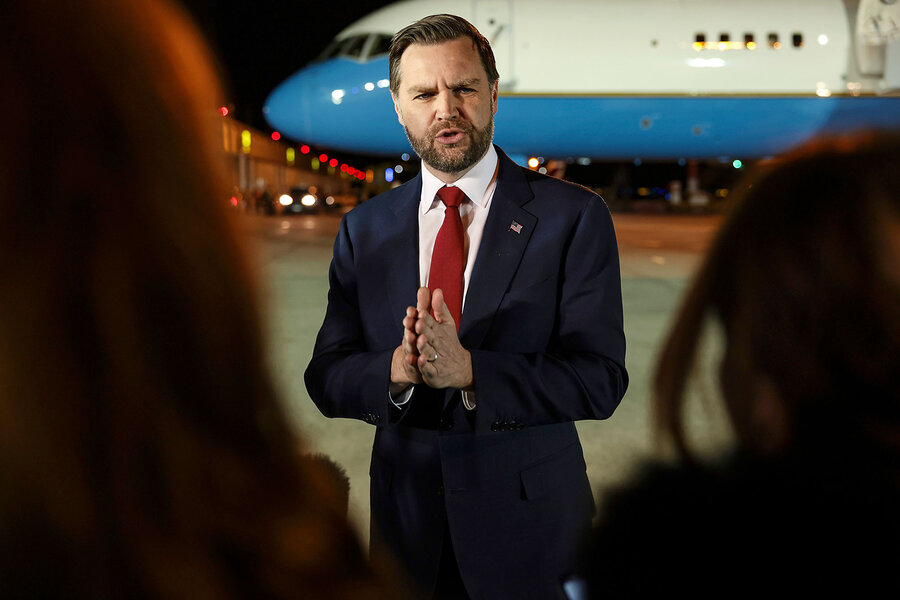
Cover image from csmonitor.com, which was analyzed for this article
VP JD Vance is tasked with leading delicate US-Iran talks in Islamabad as Trump expresses doubts on ceasefire viability. Analysts describe it as Vance's toughest challenge yet amid Hormuz tensions. Coverage focuses on negotiation risks and potential outcomes.
PoliticalOS
Friday, April 10, 2026 — Politics
These negotiations represent the most serious diplomatic effort to end a conflict that has already killed thousands, disrupted global energy flows and raised gasoline prices for American families. Vance's success or failure will hinge on bridging disputes over the Strait of Hormuz, Iran's nuclear ambitions and Israeli operations in Lebanon, none of which are fully resolved by the current fragile truce. Readers should recognize that the outcome carries consequences far beyond Washington or Tehran, affecting everything from midterm politics to the risk of wider regional war.
What outlets missed
Most accounts underplayed the specific sequence that triggered the February 28, 2026 military campaign, including the breakdown of nuclear negotiations, Iranian and Hezbollah attacks on U.S. bases and Israeli territory, and the assassination of Supreme Leader Ali Khamenei during initial strikes. Coverage also gave limited attention to Pakistan's proactive mediation, with Prime Minister Shehbaz Sharif and military chief Asim Munir directly involved in brokering the April 7-8 ceasefire and pressing for Vance's participation. Iran's formal 10-point proposal, which Trump described as containing workable elements, received scant detail despite shaping the talks' agenda on sanctions, security guarantees and nuclear limits. Economic data on the Hormuz disruption, such as precise shipping counts and price spikes attributed to sources like the International Energy Agency, were often generalized rather than quantified. Finally, Vance's own denial that he was aware of any specific Iranian request for his involvement was rarely contrasted with claims that his anti-interventionist record made him more acceptable to Tehran.
Vance Takes Charge of Fragile Iran Ceasefire He Privately Opposed
Vice President JD Vance arrives in Islamabad this weekend to lead high-level negotiations with Iran, tasked by President Donald Trump with converting a shaky ceasefire into a permanent agreement that ends a six-week war the United States and Israel launched against Tehran. The assignment places Vance, a longtime skeptic of American military entanglements abroad, at the center of the most dangerous foreign policy crisis of Trump’s second term, one that has already driven up global energy prices and spread violence into Lebanon.
The talks, scheduled to begin Saturday, represent the highest-level contact between Washington and Tehran since the 1979 Iranian revolution. Vance will be joined by Trump’s Middle East envoy Steve Witkoff and Jared Kushner, the president’s son-in-law. Their stated goal is to secure Iranian concessions on nuclear enrichment and ballistic missiles in exchange for sanctions relief and security guarantees. A critical element is reopening the Strait of Hormuz, which Iran partially blocked during the fighting, throttling a chokepoint that carries one-fifth of the world’s oil supply.
Yet the ceasefire agreed on Tuesday already appears brittle. Trump has publicly complained that Iran is failing to allow free passage of oil tankers, while Tehran accuses Israel of violating the truce by continuing strikes in Lebanon. Iranian officials have warned that talks in Pakistan could become “meaningless” unless Washington reins in its ally. Israeli forces have maintained a partial occupation in southern Lebanon, actions that Tehran insists fall under the ceasefire terms. Washington disputes that linkage. The back-and-forth accusations have fueled fears that the pause in direct hostilities could collapse before diplomats even sit down.
Vance’s emergence as Trump’s diplomatic point man carries heavy irony. The 41-year-old vice president built his national profile as an outspoken opponent of endless foreign wars, drawing on his own Marine Corps service in Iraq. Behind closed doors before the February 28 strike on Iran, Vance warned that military action risked regional chaos and could fracture Trump’s own political coalition, according to reporting by The New York Times. Publicly, however, he has supported the conflict while maintaining a notably low profile. When the ceasefire was announced this week, Vance was in Hungary campaigning for Prime Minister Viktor Orban rather than in Washington shaping the administration’s message.
That careful distance may now end. Aaron Wolf Mannes, a lecturer at the University of Maryland who studies the vice presidency, told reporters that he could not recall another instance in which a vice president was placed in charge of formal high-stakes negotiations of this nature. “This is high risk, high reward,” Mannes said. Failure could damage Vance’s standing as a leading contender for the 2028 Republican nomination. Success might burnish his credentials on the international stage, though it would also tie him more closely to a war that has already exacted economic costs at home.
The conflict has sent energy prices soaring as Iranian actions in the Persian Gulf disrupted tanker traffic. That spike arrives at an inconvenient moment for Republicans heading into midterm elections. Domestic concerns about the cost of living had been a central Republican attack line against Democrats. Now the administration must explain why a war many voters never wanted is making gasoline and home heating more expensive. Marc Short, a former chief of staff to Vice President Mike Pence, noted that the Iranian blockade gives Tehran significant leverage precisely because of the electoral calendar.
For Iran, the stakes are existential. The country’s nuclear program and missile capabilities have long been viewed by both Israel and the United States as direct threats. Yet Tehran also seeks an end to crippling economic sanctions that have devastated its economy and harmed ordinary Iranians. The Revolutionary Guards have signaled they are adhering to the ceasefire for now, but Iranian Foreign Ministry spokesman Esmaeil Baqaei tied continued participation in talks to a full halt in Israeli operations in Lebanon.
The decision to insert Vance into this role reflects Trump’s preference for unconventional diplomacy mixed with his son-in-law’s recurring involvement in Middle East policy. Kushner’s role is particularly notable given his central part in the Abraham Accords during Trump’s first term, agreements that notably excluded and further isolated Iran. Critics argue the current war represents the logical, if bloody, endpoint of a maximum-pressure strategy that prioritized confrontation over containment.
As Vance prepares for his first major foray into direct nuclear-age diplomacy, questions linger about whether his anti-interventionist instincts will help him find common ground with Iranian counterparts or whether they will simply underscore the contradictions of a policy that launched a war he tried to prevent. The administration’s own messaging has been inconsistent, with Trump oscillating between threats and offers of deals on social media even as the ceasefire frays.
The coming days in Islamabad will test not only Vance’s negotiating abilities but the coherence of an administration that launched a major conflict without apparent consensus even among its most senior officials. Should the talks collapse, the region stands at risk of renewed escalation that could draw in more countries and further punish working families on both sides of the Persian Gulf with higher energy costs and renewed uncertainty. For a vice president who once cautioned against precisely this kind of spiral, the assignment may prove the defining challenge of his political career so far. Whether it ends in diplomatic breakthrough or deepened entanglement remains dangerously unclear.
You just read Progressive's take. Want to read what actually happened?