
Vance Leads US-Iran Talks in Pakistan as Fragile Ceasefire Strains
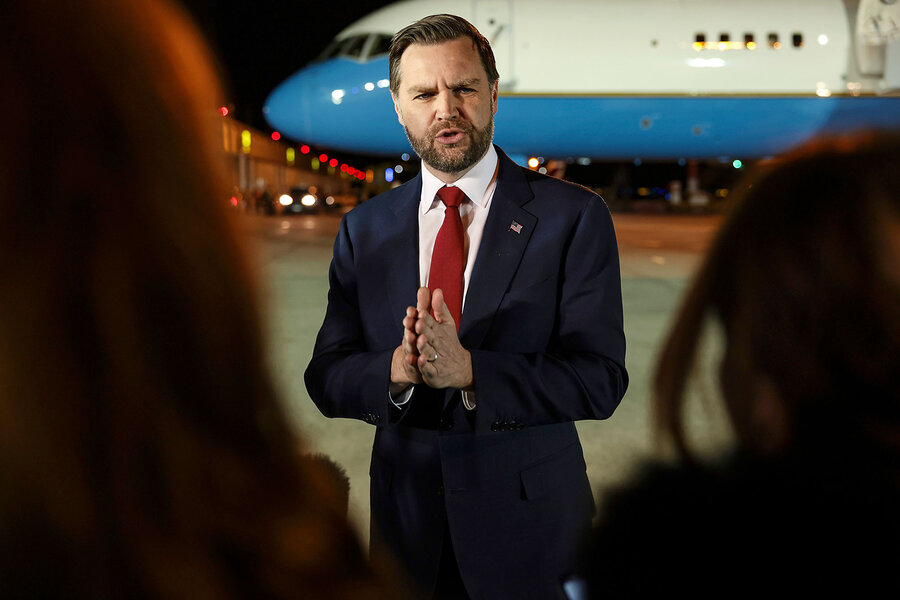
Cover image from csmonitor.com, which was analyzed for this article
President Trump assigned VP JD Vance to lead upcoming US-Iran talks in Pakistan, testing his negotiating skills amid ceasefire strains. Vance faces a high-risk assignment as sides trade accusations over Hormuz violations. The move highlights internal dynamics in Trump's foreign policy team.
PoliticalOS
Friday, April 10, 2026 — Politics
Vice President Vance's leadership of the Islamabad talks represents the Trump administration's direct effort to transform a narrow, Pakistan-brokered ceasefire into a durable arrangement addressing Iran's nuclear program, missiles and control of the Strait of Hormuz. The outcome will test whether military pressure can produce verifiable concessions on proliferation and navigation rights amid mutual accusations of violations. Readers should recognize that success or failure carries immediate consequences for global energy markets, regional stability and the political trajectory of a vice president who must balance loyalty with his long-held skepticism of prolonged Middle East engagements.
What outlets missed
All three outlets underplayed the specific triggers that preceded U.S. and Israeli military action, including documented Iranian and Hezbollah attacks on American bases and Israeli targets throughout 2024-2025, Iran's rapid nuclear enrichment beyond previous limits, and the precise sequence of Operation Epic Fury that began with strikes killing Supreme Leader Ali Khamenei on February 28, 2026. They gave minimal attention to Pakistan's central mediation role, with Prime Minister Shehbaz Sharif and military chief General Asim Munir directly brokering the April 7-8 ceasefire and issuing Iran's 10-point proposal that Trump publicly called workable. Coverage also omitted polling data showing majority Republican support for the initial strikes despite vocal MAGA dissent from figures like Tucker Carlson, and provided little detail on the concrete objectives under discussion: verifiable limits on Iranian missiles, nuclear transparency measures, phased sanctions relief and guaranteed freedom of navigation in the Strait of Hormuz.
Vance Brings Antiwar Outlook to High Stakes Iran Negotiations
Vice President JD Vance arrives in Islamabad this weekend to lead negotiations aimed at converting a fragile two week ceasefire into a durable agreement with Iran ending a conflict that has already exacted measurable costs on global energy markets and American households. The assignment marks the most significant foreign policy test yet for a vice president who built his reputation warning against the sort of open ended military commitments the United States has repeatedly entered over the past generation.
President Donald Trump selected Vance along with Middle East envoy Steve Witkoff and Jared Kushner to conduct the talks with Iranian officials beginning Saturday. The meetings represent the highest level direct contact between Washington and Tehran since the 1979 Islamic Revolution. They follow six weeks of intense fighting that began February 28 when the United States and Israel launched strikes against Iranian nuclear facilities missile production sites and proxy forces. The war spread to Lebanon where Israeli forces have taken partial control of territory and severely disrupted shipping through the Strait of Hormuz.
Iran responded to the initial attacks by throttling traffic through the strait a chokepoint that carries roughly one fifth of global oil supply. The resulting blockade sent energy prices sharply higher at a moment when American voters were already focused on inflation and the cost of living ahead of this year's midterm elections. Oil tankers now face demands for tolls from Tehran further complicating supply chains and adding upward pressure on gasoline and heating costs for families and businesses across the United States and Europe.
Vance has long positioned himself as an opponent of nation building and prolonged foreign interventions. As a Marine veteran of the Iraq war he has frequently cited the conflict's steep price in blood and treasure as a cautionary example of how initial military successes can give way to costly occupations and unintended regional consequences. In private discussions before the current conflict according to multiple accounts Vance argued that striking Iran risked igniting wider chaos and fracturing the political coalition that returned Trump to office.
Yet once the decision was made Vance offered public support while maintaining a notably low profile during the fighting itself. When the ceasefire was announced earlier this week he was in Hungary campaigning alongside Prime Minister Viktor Orban rather than appearing at a White House podium. His public comments since have been measured emphasizing practical outcomes over ideological declarations. In remarks to reporters as he departed Budapest Vance described his contribution as handling extensive back channel communications that helped bring the parties to this point.
The negotiating agenda is straightforward but difficult. The United States and Israel seek verifiable limits on Iran's nuclear program and its ballistic missile arsenal. In exchange Iranian officials are expected to demand relief from economic sanctions and some form of security guarantee against future attacks. Reopening the Strait of Hormuz without continued Iranian interference is an immediate priority for global markets. Whether both sides can bridge these gaps remains uncertain. The ceasefire itself is described as shaky with reports of sporadic violations and mutual accusations of bad faith.
For Vance the role carries obvious political risks. At 41 he is already viewed as a leading contender for the 2028 Republican nomination. A successful agreement that curbs Iranian threats without requiring permanent American military presence would bolster his credentials as a pragmatic leader capable of extracting the nation from costly conflicts. Failure however could leave him carrying the political burden of either appearing weak on national security or having endorsed a war he once questioned.
Foreign policy analysts note the unusual nature of placing the vice president at the center of such sensitive talks. Historically vice presidents have played supporting roles in diplomacy rather than serving as chief negotiators. The choice reflects both Trump's trust in Vance and the administration's desire to signal seriousness while distancing the president himself from the day to day bargaining.
The broader context includes substantial economic disruption beyond higher fuel prices. Shipping costs through the Persian Gulf have risen insurance rates have spiked and supply chains for everything from plastics to fertilizers have faced delays. These effects illustrate a recurring pattern in modern conflicts where initial military action against rogue regimes quickly produces second and third order consequences that fall most heavily on ordinary consumers rather than on political decision makers.
Vance's well documented skepticism of intervention may prove an asset in the current talks. Iranian officials have long complained that American negotiators arrive with maximalist demands and little understanding of Tehran's security concerns. A representative who has publicly criticized past wars in the region may find it easier to establish the credibility needed for a compromise that both sides can accept without losing face domestically.
Yet credibility cuts both ways. Vance must persuade Iranian counterparts that the United States is prepared to enforce any agreement while simultaneously reassuring Trump's political base that the outcome will not repeat the perceived weaknesses of previous nuclear deals. The presence of Kushner who helped broker the Abraham Accords during Trump's first term and Witkoff a businessman turned diplomat suggests the administration is blending personal relationships with unconventional channels.
The coming days will test whether the brief but disruptive war has altered the fundamental incentives enough to produce a lasting settlement. For a vice president who has consistently argued that America should avoid becoming the region's policeman the current mission represents an opportunity to demonstrate that restraint and realism can coexist with the decisive use of force when necessary. The economic pain already felt by American families from disrupted oil flows adds urgency to the task. Success would not only stabilize energy markets but also vindicate the view that military action should be a limited tool for achieving concrete objectives rather than an open ended commitment to transform the Middle East. Failure would reinforce the very pattern of protracted entanglement Vance has spent his career cautioning against.
You just read Conservative's take. Want to read what actually happened?