
Vance Leads US-Iran Talks in Pakistan as Fragile Ceasefire Strains
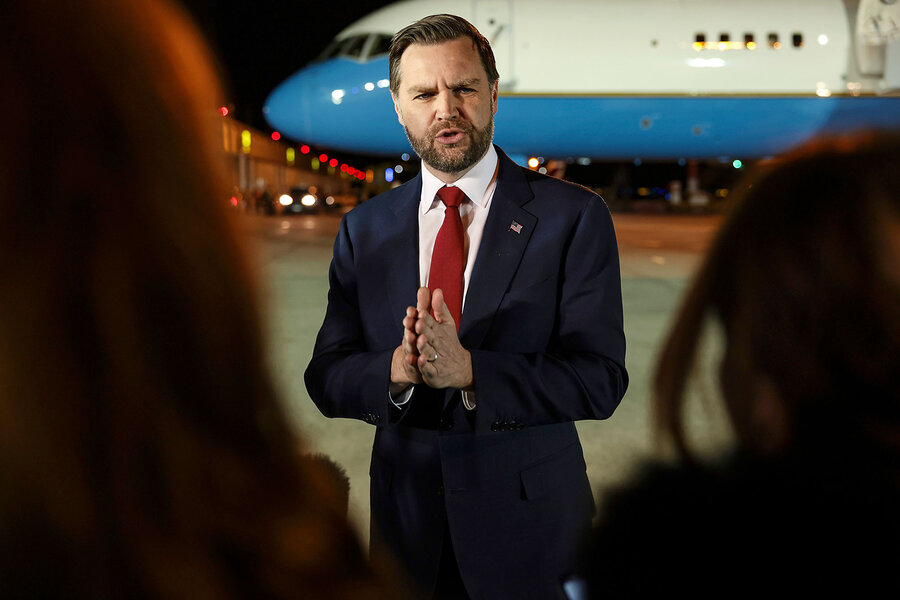
Cover image from csmonitor.com, which was analyzed for this article
President Trump assigned VP JD Vance to lead upcoming US-Iran talks in Pakistan, testing his negotiating skills amid ceasefire strains. Vance faces a high-risk assignment as sides trade accusations over Hormuz violations. The move highlights internal dynamics in Trump's foreign policy team.
PoliticalOS
Friday, April 10, 2026 — Politics
Vice President Vance's leadership of the Islamabad talks represents the Trump administration's direct effort to transform a narrow, Pakistan-brokered ceasefire into a durable arrangement addressing Iran's nuclear program, missiles and control of the Strait of Hormuz. The outcome will test whether military pressure can produce verifiable concessions on proliferation and navigation rights amid mutual accusations of violations. Readers should recognize that success or failure carries immediate consequences for global energy markets, regional stability and the political trajectory of a vice president who must balance loyalty with his long-held skepticism of prolonged Middle East engagements.
What outlets missed
All three outlets underplayed the specific triggers that preceded U.S. and Israeli military action, including documented Iranian and Hezbollah attacks on American bases and Israeli targets throughout 2024-2025, Iran's rapid nuclear enrichment beyond previous limits, and the precise sequence of Operation Epic Fury that began with strikes killing Supreme Leader Ali Khamenei on February 28, 2026. They gave minimal attention to Pakistan's central mediation role, with Prime Minister Shehbaz Sharif and military chief General Asim Munir directly brokering the April 7-8 ceasefire and issuing Iran's 10-point proposal that Trump publicly called workable. Coverage also omitted polling data showing majority Republican support for the initial strikes despite vocal MAGA dissent from figures like Tucker Carlson, and provided little detail on the concrete objectives under discussion: verifiable limits on Iranian missiles, nuclear transparency measures, phased sanctions relief and guaranteed freedom of navigation in the Strait of Hormuz.
Vance Takes Charge of Ending a War He Warned Would Backfire
Vice President JD Vance arrives in Islamabad this weekend carrying the heaviest load of his young political career: salvaging a fragile ceasefire in a conflict with Iran that he privately predicted would create exactly the mess now unfolding across the Middle East. President Trump has handed his deputy the job of turning a two-week pause in fighting into a formal agreement, pairing Vance with Middle East envoy Steve Witkoff and Jared Kushner in what amounts to the highest-level direct contact between Washington and Tehran since the Carter administration.
The war began February 28 when American and Israeli forces struck Iranian targets in a campaign that quickly spiraled. Iranian forces responded by choking the Strait of Hormuz, the narrow chokepoint through which roughly one-fifth of global oil supply normally flows. The resulting blockade sent energy prices soaring at precisely the wrong moment for American families already squeezed by inflation. Tankers now face demands for tolls from Tehran, a direct threat to the kind of stable commerce an America First policy should prioritize over permanent military commitments abroad.
Vance, a Marine veteran who built his reputation warning against the kind of open-ended foreign interventions that cost lives and treasure in Iraq and Afghanistan, finds himself in an ironic position. Multiple accounts confirm he argued strenuously in White House meetings against launching this campaign, cautioning that it risked regional chaos and could fracture the coalition that elected Trump. Once the decision was made, Vance supported the administration publicly but maintained a notably low profile. When the ceasefire was announced this week, he was in Hungary visiting Prime Minister Viktor Orban rather than standing at a podium in Washington claiming credit.
That anti-interventionist record may actually prove useful at the negotiating table. Iranian officials know Vance as the voice inside the administration who never wanted another Middle East war. His presence could lend credibility to American assurances that Washington seeks an off-ramp rather than indefinite occupation or regime change. The agenda includes curbing Iran's nuclear program and ballistic missile arsenal while offering sanctions relief and security guarantees in return. Reopening the Strait of Hormuz without constant threats of disruption sits at the center of any workable deal.
The risks are obvious. This is not a conventional diplomatic assignment. Aaron Wolf Mannes, who studies the vice presidency's role in foreign policy at the University of Maryland, called it high risk, high reward. No recent vice president has led negotiations of this magnitude. Failure would leave Vance carrying the political burden heading into the 2028 cycle, while success would burnish his credentials as a serious statesman capable of delivering tangible results for American interests.
The broader context should not be ignored. For decades Washington has bounced between regime-change fantasies and nation-building disasters across the Islamic world, often at the behest of foreign lobbies and defense contractors who profit from perpetual conflict. Trump campaigned against that approach, promising to end forever wars and focus on threats to the homeland. The Iran operation was framed as a limited strike against a genuine danger, yet it has already spread to Lebanon, disrupted global shipping, and driven up costs at American gas pumps right before midterm elections.
Critics of endless entanglement will watch closely to see whether Vance can extract concrete concessions without committing the United States to another open-ended security guarantee in a region that has consumed American blood and treasure for generations. The Iranians understand the domestic political calendar. They know a midterm election year gives them leverage as higher energy prices fuel voter discontent.
Vance's team faces the additional challenge of a ceasefire already showing strains. Iranian proxies remain active. Israeli forces continue operations in parts of Lebanon. The talks in Pakistan represent more than just another diplomatic round. They test whether an administration elected on promises of restraint can extricate itself from a shooting war without repeating the pattern of mission creep that Vance has spent his career denouncing.
For all the lofty rhetoric about global stability, the practical question for most Americans remains straightforward: Will this end with lower prices at the pump, safer shipping lanes, and no new American commitments to police ancient sectarian quarrels? Or will it become another chapter in the same failed book that Vance, as a private citizen and senator, warned his countrymen against? The vice president's performance in Islamabad over the coming days will help answer that question. The stakes extend well beyond his personal political future. They touch on whether the America First movement can govern in a dangerous world without losing the skepticism of foreign entanglement that brought it to power in the first place.
You just read America First's take. Want to read what actually happened?