
Vance Leads US-Iran Talks in Pakistan as Fragile Ceasefire Strains
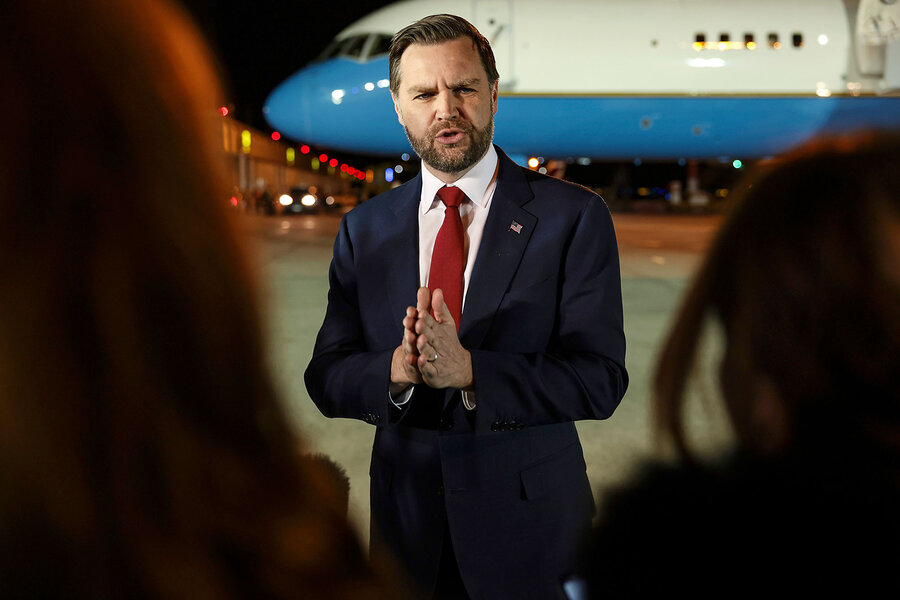
Cover image from csmonitor.com, which was analyzed for this article
President Trump assigned VP JD Vance to lead upcoming US-Iran talks in Pakistan, testing his negotiating skills amid ceasefire strains. Vance faces a high-risk assignment as sides trade accusations over Hormuz violations. The move highlights internal dynamics in Trump's foreign policy team.
PoliticalOS
Friday, April 10, 2026 — Politics
Vice President Vance's leadership of the Islamabad talks represents the Trump administration's direct effort to transform a narrow, Pakistan-brokered ceasefire into a durable arrangement addressing Iran's nuclear program, missiles and control of the Strait of Hormuz. The outcome will test whether military pressure can produce verifiable concessions on proliferation and navigation rights amid mutual accusations of violations. Readers should recognize that success or failure carries immediate consequences for global energy markets, regional stability and the political trajectory of a vice president who must balance loyalty with his long-held skepticism of prolonged Middle East engagements.
What outlets missed
All three outlets underplayed the specific triggers that preceded U.S. and Israeli military action, including documented Iranian and Hezbollah attacks on American bases and Israeli targets throughout 2024-2025, Iran's rapid nuclear enrichment beyond previous limits, and the precise sequence of Operation Epic Fury that began with strikes killing Supreme Leader Ali Khamenei on February 28, 2026. They gave minimal attention to Pakistan's central mediation role, with Prime Minister Shehbaz Sharif and military chief General Asim Munir directly brokering the April 7-8 ceasefire and issuing Iran's 10-point proposal that Trump publicly called workable. Coverage also omitted polling data showing majority Republican support for the initial strikes despite vocal MAGA dissent from figures like Tucker Carlson, and provided little detail on the concrete objectives under discussion: verifiable limits on Iranian missiles, nuclear transparency measures, phased sanctions relief and guaranteed freedom of navigation in the Strait of Hormuz.
JD Vance Takes on Defining Test in Iran Peace Talks He Privately Opposed
WASHINGTON — Vice President JD Vance arrives in Islamabad this weekend to lead negotiations aimed at converting a fragile ceasefire into a durable agreement with Iran, stepping into a role that tests both his long-standing aversion to foreign entanglements and the Trump administration’s willingness to blend military pressure with diplomatic compromise.
The talks, scheduled to begin Saturday, represent the highest-level contact between American and Iranian officials since the 1979 revolution. Vance will be joined by Steve Witkoff, Trump’s Middle East envoy, and Jared Kushner, the president’s son-in-law. Their agenda is daunting: limiting Iran’s nuclear program and ballistic missile arsenal, reopening the Strait of Hormuz to uninterrupted oil traffic, and calibrating sanctions relief against verifiable Iranian concessions on security guarantees.
The assignment comes six weeks after Trump, acting in concert with Israel, launched a military campaign against Iran that quickly spiraled beyond either capital’s apparent expectations. Iranian forces responded by throttling traffic through the Strait of Hormuz, a chokepoint that carries roughly one-fifth of global oil supply. The resulting energy price shock has rippled through world markets and complicated the White House’s domestic messaging ahead of this year’s midterm elections. Even a temporary blockade has reminded policymakers how tightly connected Middle East stability is to American kitchen-table economics.
Vance’s emergence as the administration’s diplomatic point person carries particular irony. The 41-year-old former Marine built his national profile as a fierce critic of endless wars, especially the 2003 invasion of Iraq that he experienced firsthand. In private deliberations before the February strikes, Vance warned that military action risked regional chaos and could fracture the coalition of voters who had propelled Trump back to the White House, according to officials familiar with the discussions. Publicly, however, he has supported the president’s decisions while maintaining a notably low profile during the fighting itself. When the ceasefire was announced earlier this month, Vance was in Hungary campaigning for Viktor Orban, far from the crisis center.
That reticence may now serve him. Iranian officials have long viewed American neoconservatives with deep suspicion. Vance’s populist skepticism of foreign interventions, while hardly dovish, could offer a different tone. Analysts suggest his personal history as a combat veteran who nonetheless questions the logic of escalation might help establish a baseline of credibility that more traditional national-security figures would struggle to achieve.
Yet the risks are immense. Aaron Wolf Mannes, a scholar of the vice presidency at the University of Maryland, notes that formal negotiations of this magnitude are almost unprecedented for a vice president. Failure would likely attach to Vance in lasting ways, especially as he is already seen as a frontrunner for the 2028 Republican nomination. Success, by contrast, could reshape his image from domestic culture warrior to statesman capable of ending wars rather than starting them.
The broader stakes extend beyond Vance’s political future. The conflict has already spread beyond Iran’s borders, with Israeli forces occupying parts of Lebanon and trade across the Persian Gulf severely disrupted. Reestablishing some version of deterrence without locking the region into another cycle of escalation will require threading a needle: satisfying Israel’s security concerns, addressing Gulf Arab states’ fears of Iranian resurgence, and giving Tehran enough economic breathing room to make an agreement politically sustainable at home.
Trump’s decision to entrust Vance with the file rather than Secretary of State or a seasoned diplomat also reflects the president’s preference for personal loyalty over institutional expertise. Kushner’s involvement, fresh from his earlier Middle East portfolio, further personalizes an already unconventional diplomatic structure. The administration is betting that a combination of demonstrated military resolve and high-level personal engagement can produce a breakthrough where previous efforts failed.
For now, the ceasefire is holding, but only barely. Both sides accuse the other of violations, and the economic pressure from higher energy costs gives Iran leverage in Washington even as its military infrastructure lies damaged. Vance’s challenge is to convert a moment of mutual exhaustion into something more permanent without appearing to reward aggression or abandon core American interests.
In the coming days, the world will watch whether a vice president who once cautioned against this very conflict can now help bring it to a close. The outcome will shape not only the Middle East but also the trajectory of a political career that has so far thrived on contradiction: between isolationist instincts and loyalty to an interventionist president, between domestic focus and sudden global responsibility. For Vance, the toughest assignment of his career is only beginning.
You just read Liberal's take. Want to read what actually happened?