
Vance Leads US-Iran Talks in Pakistan as Fragile Ceasefire Strains
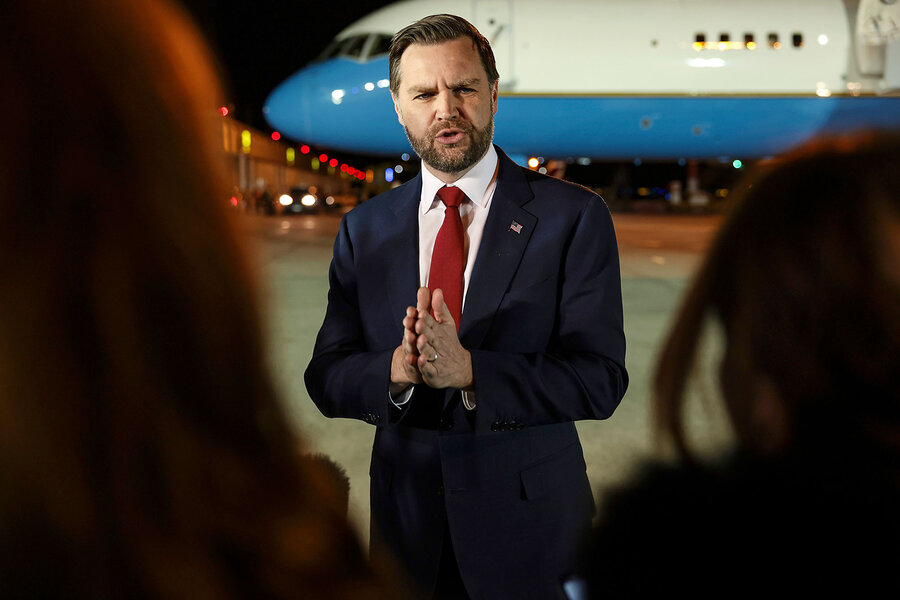
Cover image from csmonitor.com, which was analyzed for this article
President Trump assigned VP JD Vance to lead upcoming US-Iran talks in Pakistan, testing his negotiating skills amid ceasefire strains. Vance faces a high-risk assignment as sides trade accusations over Hormuz violations. The move highlights internal dynamics in Trump's foreign policy team.
PoliticalOS
Friday, April 10, 2026 — Politics
Vice President Vance's leadership of the Islamabad talks represents the Trump administration's direct effort to transform a narrow, Pakistan-brokered ceasefire into a durable arrangement addressing Iran's nuclear program, missiles and control of the Strait of Hormuz. The outcome will test whether military pressure can produce verifiable concessions on proliferation and navigation rights amid mutual accusations of violations. Readers should recognize that success or failure carries immediate consequences for global energy markets, regional stability and the political trajectory of a vice president who must balance loyalty with his long-held skepticism of prolonged Middle East engagements.
What outlets missed
All three outlets underplayed the specific triggers that preceded U.S. and Israeli military action, including documented Iranian and Hezbollah attacks on American bases and Israeli targets throughout 2024-2025, Iran's rapid nuclear enrichment beyond previous limits, and the precise sequence of Operation Epic Fury that began with strikes killing Supreme Leader Ali Khamenei on February 28, 2026. They gave minimal attention to Pakistan's central mediation role, with Prime Minister Shehbaz Sharif and military chief General Asim Munir directly brokering the April 7-8 ceasefire and issuing Iran's 10-point proposal that Trump publicly called workable. Coverage also omitted polling data showing majority Republican support for the initial strikes despite vocal MAGA dissent from figures like Tucker Carlson, and provided little detail on the concrete objectives under discussion: verifiable limits on Iranian missiles, nuclear transparency measures, phased sanctions relief and guaranteed freedom of navigation in the Strait of Hormuz.
JD Vance Takes On Perilous Role in Iran Talks After Warning Against Trump War
Vice President JD Vance arrives in Islamabad this weekend to lead negotiations aimed at converting a fragile ceasefire into a permanent end to the war with Iran a conflict he privately argued would bring regional chaos and fracture Donald Trump’s own political base. The assignment handed down by Trump places Vance at the center of the most dangerous foreign policy crisis of the administration and one that the 41-year-old vice president spent years insisting the United States should avoid.
The talks scheduled to begin Saturday in Pakistan bring together Vance with Trump’s Middle East envoy Steve Witkoff and Jared Kushner the president’s son-in-law. They represent the highest-level direct contact between American and Iranian officials since the 1979 Islamic Revolution. A two-week-old ceasefire has paused six weeks of intense fighting that began on February 28 when Trump joined Israel in launching strikes against Iranian targets. That campaign quickly spiraled beyond initial targets. Israeli forces partially occupied parts of Lebanon while Iranian missiles and proxies widened the battlefield. Tehran responded by choking traffic through the Strait of Hormuz the narrow chokepoint for roughly one-fifth of global oil supply. The resulting surge in energy prices has hammered American consumers and handed Democrats a potent issue six months before midterm elections.
Vance’s emergence as the administration’s diplomatic point man carries deep ironies. For more than a decade he built a political identity as one of Washington’s most prominent critics of endless foreign wars. A Marine veteran who served in Iraq Vance repeatedly cited that experience as proof that military interventions in the Middle East tend to create more problems than they solve. His best-selling memoir “Hillbilly Elegy” and subsequent Senate career positioned him as an America-first skeptic of neoconservative adventurism. During internal deliberations before the February strike Vance warned that bombing Iran risked exactly the kind of uncontrolled escalation now visible across the Persian Gulf according to officials cited by The New York Times. He feared it would split Trump’s MAGA coalition and distract from domestic priorities such as inflation and border security.
Yet once Trump committed to the war Vance fell in line publicly. He largely stayed out of the spotlight as American and Israeli warplanes pummeled Iranian military and nuclear sites. When the ceasefire was announced this week Vance was conveniently in Hungary campaigning for Viktor Orban. His only public comment upon leaving Budapest was a vague reference to making and taking many phone calls. The contrast between his private skepticism and public loyalty has not gone unnoticed even among Trump allies who see Vance as the clear favorite for the 2028 Republican nomination.
The choice of Vance to close the deal reflects both Trump’s transactional style and a calculated recognition that the vice president’s anti-interventionist credentials might actually prove useful at the table. Iranian officials have long complained that Washington cannot be trusted to honor agreements. A negotiator who once called the Iraq war a disaster and criticized American regime-change wars may carry marginally more credibility than the traditional foreign-policy establishment figures Trump usually disdains. Analysts say this could be a rare instance in which Vance’s personal biography serves American diplomacy.
Still the risks are enormous. Aaron Wolf Mannes a University of Maryland lecturer on the vice presidency told reporters this is a “high risk high reward” assignment rarely given to someone in Vance’s position. No recent vice president has run formal peace negotiations of this magnitude. Should the talks collapse Vance could be saddled with the blame for a war that resumes at even greater intensity. If they succeed he will have helped deliver the kind of grand bargain Trump craves sanctions relief and security guarantees for Iran in exchange for verifiable limits on its nuclear program and ballistic missiles plus guaranteed free passage through the Strait of Hormuz without the tolls Tehran has attempted to impose.
The economic stakes are immediate. Soaring fuel prices have already disrupted global shipping and inflamed American voters worried about the cost of living. Trump’s original midterm strategy revolved around portraying Democrats as out-of-touch elites. That message has been drowned out by gasoline above five dollars a gallon in many states. Iranian diplomats understand this leverage and are expected to use the economic pain as bargaining power.
For Vance the trip also marks a sharp departure from the domestic focus he had planned. Before the bombs started falling he intended to barnstorm the country as Trump’s “fraud czar” and chief attack dog on affordability issues. The war has forced him into the role of reluctant statesman cleaning up a mess he believes could have been avoided. His success or failure in Islamabad will likely define the remainder of his vice presidency and shape whether he enters the next presidential cycle as a proven dealmaker or a symbol of MAGA foreign-policy contradictions.
The road to any agreement remains treacherous. Both sides enter the talks deeply distrustful. Iran has suffered significant damage to its military infrastructure and its economy was already reeling under existing sanctions. The United States and Israel have demonstrated a willingness to use overwhelming force yet have failed to eliminate Iran’s nuclear know-how or its network of regional proxies. Reopening the Strait of Hormuz is an urgent global priority yet Tehran will demand concrete concessions before it eases its blockade.
Trump’s own history of tearing up the 2015 nuclear deal and pursuing a maximum-pressure campaign has left Iranian leaders skeptical of American guarantees. Vance must now persuade them that this time the commitments will stick even as hard-liners in both countries circle for opportunities to sabotage any emerging compromise. The inclusion of Kushner a figure deeply tied to Israeli interests and Saudi financial dealings adds another layer of suspicion for the Iranians.
As Vance prepares for the most consequential assignment of his career the stakes extend beyond the immediate ceasefire. A successful agreement could stabilize global energy markets blunt criticism of Trump’s decision to start the war and bolster Vance’s credentials as a serious statesman. Failure could reignite fighting that spreads further across the Middle East send oil prices even higher and damage the political prospects of the entire Trump orbit heading into the midterms.
The former anti-war skeptic who once cautioned against precisely this kind of entanglement now finds himself responsible for ending it. Whether Vance’s instincts against intervention ultimately help him forge a durable peace or whether the war he opposed becomes the defining failure of his political ascent will be decided in the coming days in Islamabad.
You just read Progressive's take. Want to read what actually happened?