
Maine Democrats Set to Nominate Troy Jackson for Senate Race
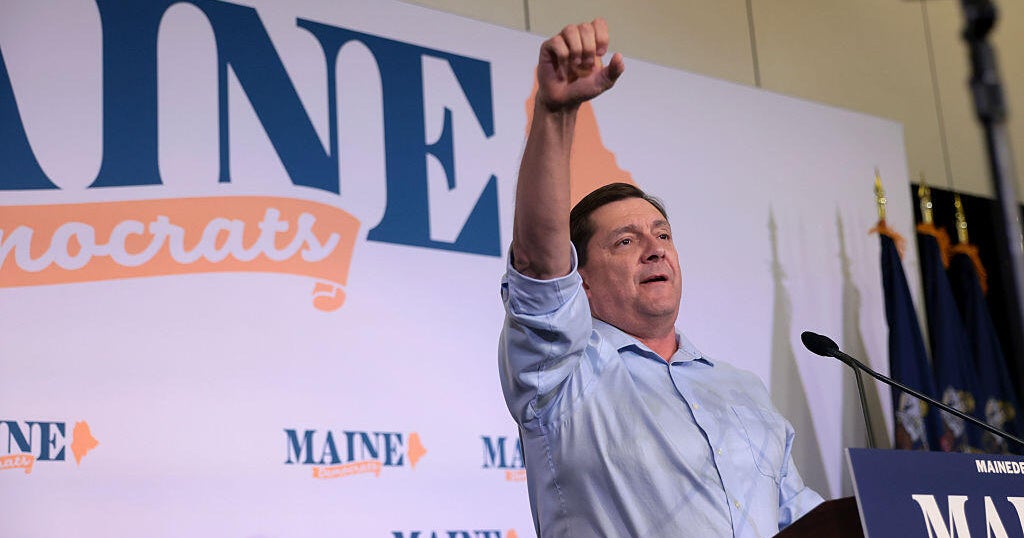
Cover image from cbsnews.com, which was analyzed for this article
Democrats convened to replace Graham Platner on the ballot in the race against Susan Collins, with former state Senate President Troy Jackson positioned to win via party convention. The process drew attention amid questions about the nominee's viability.
PoliticalOS
Saturday, July 25, 2026 — Politics
The replacement process leaves Democrats with roughly 100 days to build a campaign against an incumbent who has won five terms and maintains a large cash advantage. Jackson’s delegate strength makes his nomination nearly certain, yet the race remains competitive on paper in a state that has repeatedly supported Collins.
What outlets missed
Details on outside spending by groups such as the Senate Leadership Fund were absent from all four articles, leaving the total financial scale of the race unaddressed. Jackson’s prior unsuccessful gubernatorial bid and specific primary vote totals received only passing mention. The precise mechanics of how county delegate meetings translated into convention votes were not fully explained in any single account. Reports of mortgage improprieties raised in one outlet could not be independently verified by the others.
Maine Democrats Scramble to Install New Nominee After Platner Rape Allegation Sinks Campaign
Bangor, Maine Democrats are gathering here Saturday to rubber-stamp a replacement for their Senate nominee after Graham Platner ended his bid amid a rape allegation from a former girlfriend. The party is moving fast to salvage a contest it views as essential for regaining control of the chamber this fall. Troy Jackson, the former state Senate president and a fifth-generation logger from northern Maine, enters the convention with the backing of most delegates and the withdrawal of stronger rivals.
The sequence of events has left the process looking hurried and top-down. Platner won the initial primary but stepped aside earlier this month after the assault claim surfaced. He has denied the accusation. What followed was a compressed search that saw roughly a dozen candidates enter briefly before most bowed out once Jackson secured delegate majorities at county meetings last weekend. Maine Secretary of State Shenna Bellows and former state health official Nirav Shah both exited and urged unity against Republican incumbent Susan Collins. Pharmaceutical executive Saundra Pelletier remains on the convention ballot as a long shot.
Republicans in Maine have labeled the convention a sham, arguing that party insiders engineered the outcome rather than letting voters decide in a fresh primary. The criticism lands in a state where Collins has held the seat since 1997 and where Democrats see a rare opening. Collins is the lone GOP senator running for reelection in a state President Donald Trump lost in 2024. Democrats need a net gain of four seats to flip the chamber. Losing here would force them to chase tougher terrain elsewhere.
Jackson has framed his challenge around working-class concerns and Collins long tenure. At recent rallies he noted that the senator has expressed concern or trouble on issues for nearly three decades without delivering results that match his supporters priorities. His background as a onetime conservative Republican who shifted left on labor and economic questions gives the campaign a populist edge that echoes the energy around Platner before the scandal. Yet the rapid elevation of Jackson has also exposed fractures inside the Democratic coalition. Several candidates who initially competed for the nod complained privately that the delegate selection process favored establishment figures over broader input.
The timeline now compresses into a 101-day sprint to November. Jackson must consolidate support across a state that mixes rural conservative pockets with more liberal coastal areas. Collins campaign has already signaled it will portray the Democratic side as unstable and defined by controversy. For their part, party leaders in Bangor insist the convention will unify Democrats behind a candidate who can compete on pocketbook issues and appeal to the same voters who backed the earlier nominee.
Whether the switch succeeds depends on how quickly Jackson can distance the race from the circumstances that removed Platner. The allegation that ended the first campaign remains a live political weapon. Republicans will keep it in circulation. Democrats will argue that the convention represents a clean break and a chance to refocus on Collins record. In a race this narrow and this important for Senate control, the margin for error on either side looks small.
You just read America First's take. Want to read what actually happened?
More in Politics
Democrats Flip Senate, Expand House Majority in Midterms
Democrats flipped the Senate and expanded their House majority in a major rebuke to President Trump and Republicans. Key victories included multiple Senate seats and state-level wins that ended long-standing GOP dominance in places like Texas.
GOP Losses Spur Blame, Vance Distancing, 2028 Maneuvers
Republicans are pointing fingers internally after heavy losses, with Vice President JD Vance distancing himself from Trump over the Iran war and positioning for a potential 2028 run. Challengers within the party are already sensing opportunity.
Democrats Take House and Senate Amid Record Midterm Turnout
Democrats achieved decisive gains in the 2026 midterms, flipping seats to take control of both chambers. Coverage highlights historic turnout and implications for the Trump administration.
Democrats Take House and Senate, Constraining Trump
Democrats flipped both the House and Senate in a major rebuke to President Trump and Republicans. The results create divided government and set up battles over spending, oversight, and foreign policy for the remainder of Trump's term.
The Compass
You just read five takes on one story.
What's your take? Find your political shape in a few minutes.
Take the test