
Maine Democrats Set to Nominate Troy Jackson for Senate Race
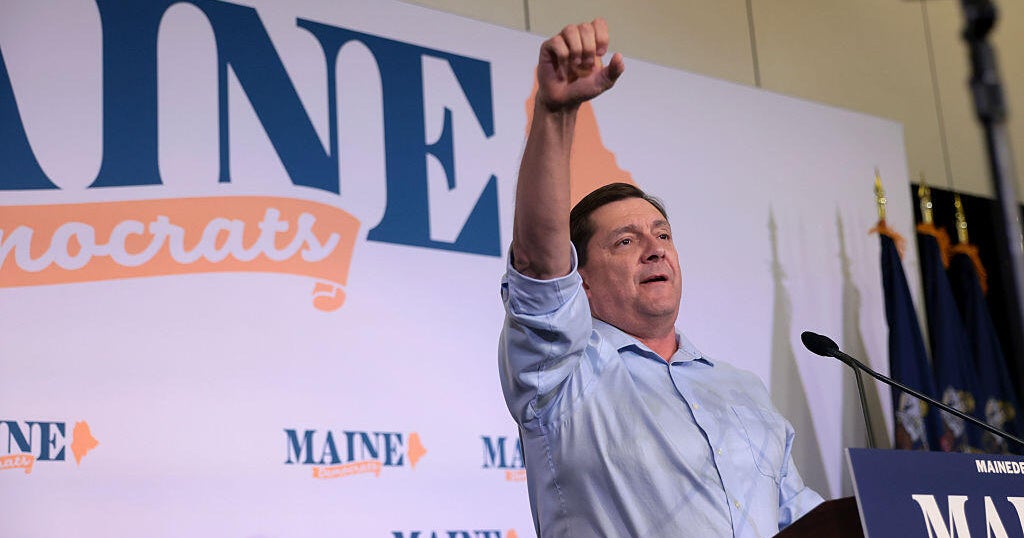
Cover image from cbsnews.com, which was analyzed for this article
Democrats convened to replace Graham Platner on the ballot in the race against Susan Collins, with former state Senate President Troy Jackson positioned to win via party convention. The process drew attention amid questions about the nominee's viability.
PoliticalOS
Saturday, July 25, 2026 — Politics
The replacement process leaves Democrats with roughly 100 days to build a campaign against an incumbent who has won five terms and maintains a large cash advantage. Jackson’s delegate strength makes his nomination nearly certain, yet the race remains competitive on paper in a state that has repeatedly supported Collins.
What outlets missed
Details on outside spending by groups such as the Senate Leadership Fund were absent from all four articles, leaving the total financial scale of the race unaddressed. Jackson’s prior unsuccessful gubernatorial bid and specific primary vote totals received only passing mention. The precise mechanics of how county delegate meetings translated into convention votes were not fully explained in any single account. Reports of mortgage improprieties raised in one outlet could not be independently verified by the others.
Maine Democrats Converge on Troy Jackson as Their New Standard Bearer Against Susan Collins
Maine Democrats are set to formalize their Senate nominee on Saturday in Bangor, turning to former state Senate President Troy Jackson after the abrupt exit of their original candidate left the party scrambling to keep pace in one of the most consequential midterm contests. The gathering comes at a moment when Democrats nationally need every available pickup to reclaim a Senate majority, and party leaders view the race against longtime Republican incumbent Susan Collins as among their clearest paths forward.
Jackson enters the convention with overwhelming delegate support secured through county-level meetings last weekend. Rivals including Maine Secretary of State Shenna Bellows and former state health official Nirav Shah stepped aside in recent days, urging unity behind the frontrunner. Only pharmaceutical executive Saundra Pelletier remains on the ballot as a long-shot alternative. The swift consolidation reflects both the compressed timeline and the party's determination to avoid further internal division ahead of the November vote.
A fifth-generation logger from Aroostook County, Jackson built his political career advocating for rural and working-class communities in a state where economic pressures remain acute. He previously served as president of the Maine Senate and has positioned his campaign around expanding labor protections, raising wages, and countering corporate influence in Augusta and Washington. Those themes echo the energy that initially propelled the Platner campaign before sexual assault allegations surfaced earlier this month and forced the candidate's withdrawal. Jackson has signaled he intends to carry forward that populist focus while running a disciplined operation against Collins.
The stakes extend well beyond Maine. Collins is the sole Republican senator seeking reelection in a state carried by Donald Trump in 2024 yet long viewed as competitive. Democrats calculate that defeating her would remove a reliable vote for the GOP agenda on issues from judicial confirmations to economic policy. Jackson has already begun sharpening that contrast, noting Collins's decades-long record of expressing concern without delivering structural change for working families. Supporters at recent rallies have echoed the sentiment that accountability is long overdue.
Republicans have criticized the Democratic nomination process as rushed and undemocratic, pointing to the party-run convention rather than a primary. Maine GOP officials argue the compressed timeline deprives voters of broader input. Democrats counter that the schedule was dictated by the need to meet ballot deadlines after the earlier candidate's departure and that Jackson secured his delegate advantage through open county meetings.
With roughly 100 days until Election Day, the contest will test whether Jackson can replicate the grassroots enthusiasm that briefly animated the race while broadening his appeal in suburban and coastal areas where Collins has historically performed well. Party organizers describe the convention as a reset, an opportunity to refocus on policy differences rather than personal controversies. Jackson's backers say his background as a onetime Republican who shifted left on economic issues gives him credibility in reaching persuadable voters across the state's political spectrum.
The outcome on Saturday will determine whether Democrats can sustain momentum in a race they regard as essential to shifting the balance of power in the Senate. Jackson's supporters are already framing the fall campaign as a choice between entrenched incumbency and a candidate who understands the daily realities of working people in northern and rural Maine.
You just read Progressive's take. Want to read what actually happened?
More in Politics
Democrats Flip Senate, Expand House Majority in Midterms
Democrats flipped the Senate and expanded their House majority in a major rebuke to President Trump and Republicans. Key victories included multiple Senate seats and state-level wins that ended long-standing GOP dominance in places like Texas.
GOP Losses Spur Blame, Vance Distancing, 2028 Maneuvers
Republicans are pointing fingers internally after heavy losses, with Vice President JD Vance distancing himself from Trump over the Iran war and positioning for a potential 2028 run. Challengers within the party are already sensing opportunity.
Democrats Take House and Senate Amid Record Midterm Turnout
Democrats achieved decisive gains in the 2026 midterms, flipping seats to take control of both chambers. Coverage highlights historic turnout and implications for the Trump administration.
Democrats Take House and Senate, Constraining Trump
Democrats flipped both the House and Senate in a major rebuke to President Trump and Republicans. The results create divided government and set up battles over spending, oversight, and foreign policy for the remainder of Trump's term.
The Compass
You just read five takes on one story.
What's your take? Find your political shape in a few minutes.
Take the test