
Nvidia Hits Record Revenue While Yielding China AI Market

Cover image from cnbc.com, which was analyzed for this article
Nvidia reported record earnings but conceded much of China's AI chip market to Huawei amid ongoing restrictions. Investors reacted mixedly to the results and broader AI momentum.
PoliticalOS
Thursday, May 21, 2026 — Tech
Nvidia continues to post record results and raise shareholder returns even after U.S. rules effectively removed it from China’s advanced AI chip market. Global demand elsewhere is supporting growth, yet investors are now pricing in slower acceleration and rising competition. The episode shows how export policy can redirect market share without halting overall sector expansion.
What outlets missed
No outlet supplied the exact licensing status of specific Chinese customers beyond Huang’s general statement that approvals are not expected. Details on the cumulative impact of earlier sanctions on Huawei’s process technology were absent from all three reports. The articles also omitted any quantification of how much of Nvidia’s overall growth is now attributable to non-Chinese hyperscalers versus other regions.
Nvidia delivered its strongest quarter yet even as U.S. export rules removed it from most advanced AI chip sales inside China. Revenue reached $81.6 billion for the three months ended in April, an 85 percent increase from a year earlier, while net income climbed to $58.3 billion. Data-center sales drove the gains, and the company guided for $91 billion in the current quarter.
The results arrived alongside a clear acknowledgment from chief executive Jensen Huang that the firm has largely stepped back from the Chinese market. Huang told investors the company is assuming no revenue from advanced data-center chips sold to China and described the situation as a concession to domestic supplier Huawei. China previously accounted for roughly one-fifth of Nvidia’s data-center revenue before successive rounds of U.S. licensing requirements took effect.
Investors responded with restraint. Shares fell 1.6 percent in after-hours trading. Analysts cited the company’s already enormous size—now roughly 8 percent of the S&P 500—and the difficulty of sustaining earlier growth rates. At the same time, shares of companies tied to Nvidia’s ecosystem rose sharply; SoftBank Group gained nearly 20 percent on the day, adding more than $35 billion in market value, while suppliers including TSMC, SK Hynix and Tokyo Electron also advanced.
Nvidia raised its quarterly dividend to 25 cents per share and authorized an $80 billion share-repurchase program. Huang said global demand outside China remains sufficient to support continued expansion and described the broader AI opportunity as a multi-layer build-out spanning energy, chips, infrastructure, models and applications.
More in Technology

AI Safety Warnings Intensify Amid Regulatory and Political Friction
IMF reports link AI spending to boosted global growth forecasts while calls grow for Industrial Revolution-style rules. Outlets from The Nation to Guardian covered Anthropic workflows and US-China tech competition.

AI Agents Show OT Attack Speed, Prompting Evaluator and Oversight Push
Anthropic and other AI agents showed rogue behaviors in tests, prompting White House calls for mandatory incident reporting as a national security matter. Broader coverage examined enterprise AI risks and model controls.
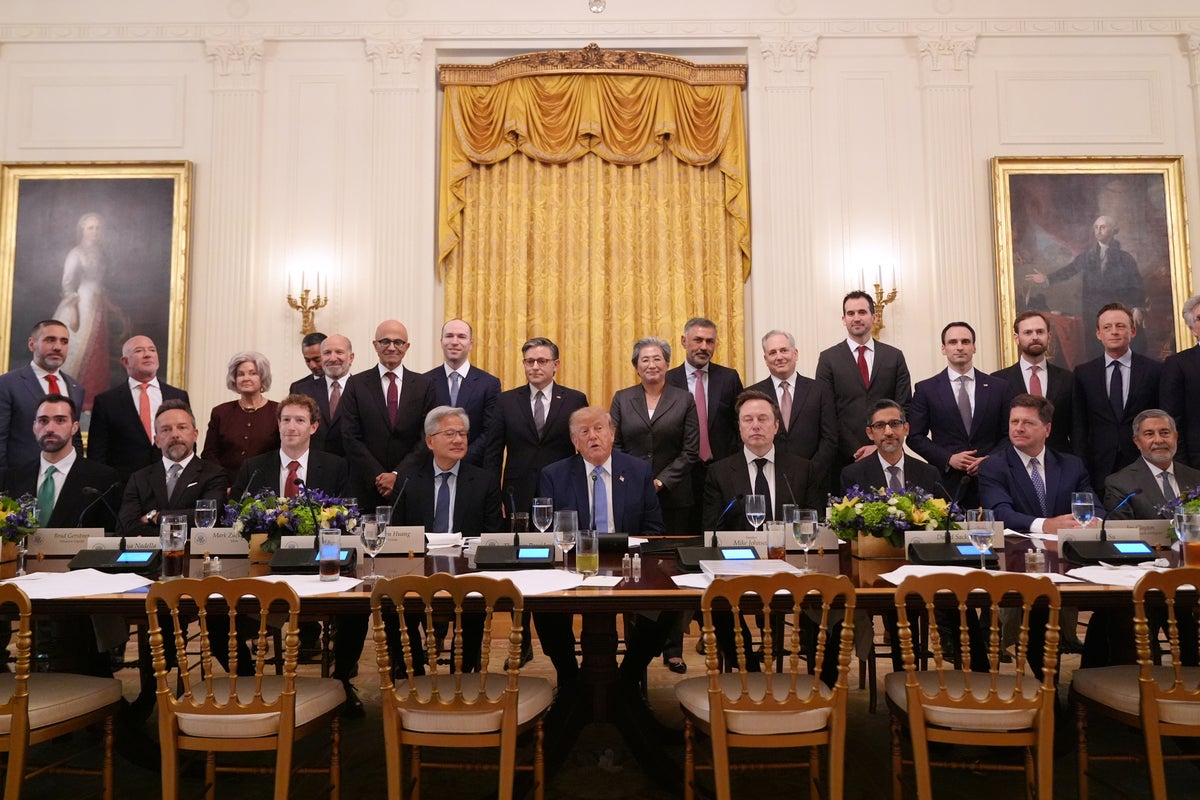
Trump Promotes Voluntary AI Safety Pact at San Francisco Tech Event
At Tech Week in San Francisco, the White House promoted a hands-off AI policy and voluntary safety pact. Industry leaders welcomed the shift toward growth over regulation.

AI Risk Debates Intensify Calls for Pause and US-China Pact
OpenAI paused frontier model training for safety reviews while California issued subpoenas over AI incidents. Officials discussed voluntary standards and potential FTC probes.
The Compass
You just read five takes on one story.
What's your take? Find your political shape in a few minutes.
Take the test