
Trump Hosts Xi for State Dinner Focused on Pageantry Amid Trade and AI Strains
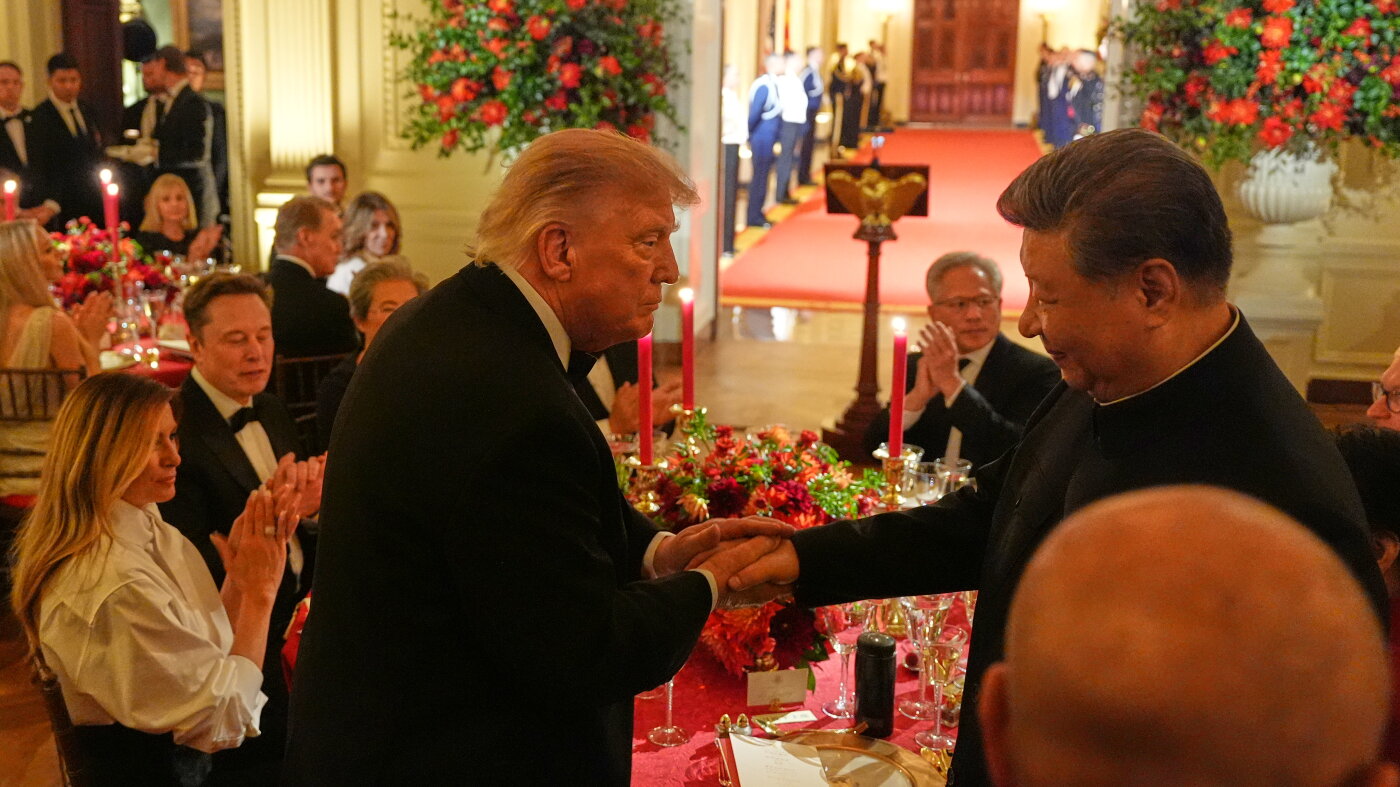
Cover image from npr.org, which was analyzed for this article
President Trump welcomed Chinese President Xi Jinping for high-profile talks on trade, tariffs, AI, and bilateral rivalry, featuring a White House tour and state dinner with tech executives. Coverage highlighted symbolic pomp over major breakthroughs, with both sides maintaining a cordial tone amid persistent tensions.
PoliticalOS
Friday, September 25, 2026 — Politics
The state dinner displayed continued personal engagement between the two leaders and the presence of American technology executives, yet the absence of Chinese business leaders and the lack of announced agreements underscore the deeper structural barriers created by years of reciprocal trade and technology restrictions.
What outlets missed
Most coverage omitted the documented sequence of U.S. entity-list designations and tariff actions from 2018 onward that directly affected which Chinese firms could participate in U.S. events. Outlets also gave limited attention to the specific Chinese retaliatory measures on rare-earth exports and the resulting supply-chain effects on U.S. manufacturers. No reporting included on-record reactions from congressional leaders or trade associations beyond a single expert quote. The lack of any announced commercial deals was noted but not placed against the prior expectation, reported by two sources, that a business delegation might still attend.
The United States and China conducted high-level diplomacy through ceremony and private talks that produced no announced agreements on tariffs, export controls or artificial intelligence governance. President Trump welcomed President Xi Jinping to the White House on September 24, 2026, for a state dinner that featured American technology executives and symbolic exchanges while both governments continued to impose restrictions on each other's companies.
The dinner menu, prepared with American ingredients and a Chinese influence, opened with yellow squash velouté, followed by sesame-crusted sea bass with baby bok choy and concluded with vanilla crémeux and White House honey ice cream. Red linens and blossoms decorated the East Room. Trump presented Xi with a bald eagle statue; Xi announced that two giant pandas named Ping Ping and Fu Shuang would go to the Atlanta zoo. During his toast Trump praised personal ties and invited guests to view the unfinished White House ballroom after dinner. Xi responded that the goals of making America great again and China's national rejuvenation could reinforce each other.
American attendees included Elon Musk, Sam Altman, Jensen Huang, Tim Cook, Jeff Bezos, Mark Zuckerberg, Satya Nadella and Mary Barra. No prominent Chinese business executives attended. Earlier in the day the leaders discussed Taiwan, trade and artificial intelligence. Trump also showed Xi a new helipad and Marine One helicopter. The absence of Chinese executives follows years of mutual tariffs, U.S. restrictions on technology exports and investment, and Chinese limits on rare-earth exports. A 2026 U.S.-China Business Council survey found that 80 percent of American firms still view the Chinese market as important, yet many face direct competition from Chinese companies in electric vehicles and artificial intelligence.
The event occurred against a backdrop of limited media access after Trump briefly banned several outlets from the White House campus. No public statements detailed specific outcomes from the private sessions.
More in Politics

Trump Rejects Iran's Seven-Day Hormuz Reopening Offer
President Trump dismissed Iran's offer to reopen the Strait of Hormuz in exchange for sanctions relief, calling it unacceptable amid ongoing Middle East tensions. The move follows indirect talks and is tied to midterm political calculations.
Democrats Outline Post-Midterm Oversight of Trump Administration
If Democrats win the midterms, expansive investigations into Trump, his family, and administration are planned, with impeachment as a possible tool.
White House Drops CNN from Air Force One Pool After Court Ruling
The Trump administration barred CNN from the presidential travel pool for a trip to Tennessee, escalating a dispute over media access despite a recent court order restoring some outlets' White House credentials. Left-leaning outlets framed it as a First Amendment crisis while right-leaning sources portrayed it as justified pushback against biased coverage.

Trump Warns Iran of Annihilation While Confirming Direct Talks
President Trump warned of annihilating Iran if no deal ends the conflict but revealed productive direct US-Iran talks in New York. Coverage spans outlets across the spectrum discussing the first high-level meeting since June and potential post-midterm deal timing.
The Compass
You just read five takes on one story.
What's your take? Find your political shape in a few minutes.
Take the test