
California Candidates Clash on Taxes, Homelessness in Volatile Debate
Cover image from theguardian.com, which was analyzed for this article
Top candidates for California governor sparred on key issues in a pivotal debate after Eric Swalwell's exit, highlighting strategies in the topsy-turvy race. Coverage focuses on policy differences and frontrunners' performances. Republicans and Democrats position for advantage.
PoliticalOS
Thursday, April 23, 2026 — Politics
California's top-two primary has created a rare opening for Republicans to reach the general election if the large Democratic field fragments the vote, yet the debate showed no candidate delivered a decisive advantage. Substantive differences over taxes, homelessness spending and whether identity or practicality should drive policy remain the real stakes. Voters should weigh the candidates' records and specific proposals rather than performative moments or unverified personal attacks.
What outlets missed
Most coverage omitted the 2025 statewide point-in-time count showing a 9 percent drop in unsheltered homelessness, the first decline in more than 15 years, which could have contextualized Democratic defenses of Newsom's record. Outlets also underplayed Mahan's discussion of regulating artificial intelligence, an issue he tied to his Silicon Valley mayoral experience and which received only glancing treatment. Bianco's recent seizure of more than 500,000 ballots from a prior election, halted by the state supreme court, drew minimal follow-up despite his onstage defense that it was a routine inquiry into election security. Finally, federal Department of Transportation pressure on California's commercial driver licensing standards for non-English speakers, documented by LAist in 2025, provided independent backing for Bianco's truck-safety argument but was rarely linked beyond the immediate exchange.
California Debate Underscores Billions Spent with Little to Show on Homelessness
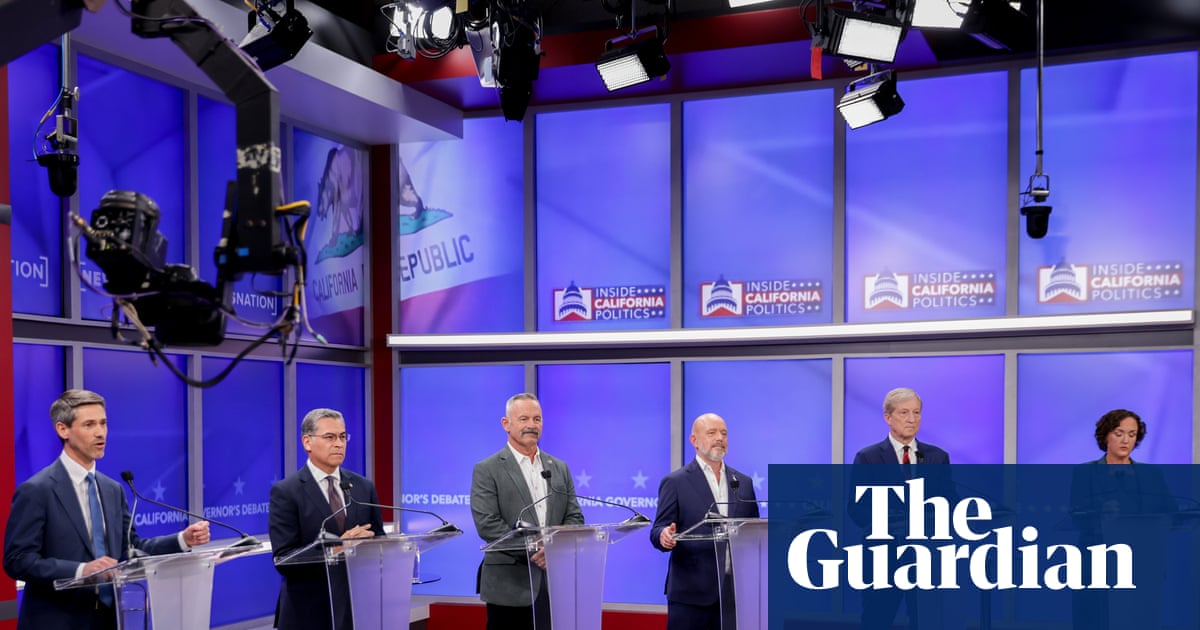
Six candidates vying to replace Gavin Newsom as California governor took the stage Wednesday in San Francisco for the first major debate of a wide open race that has no clear leader and has left a quarter of voters undecided. With ballots scheduled to drop in the mail next month ahead of the June 2 primary the evening offered voters a look at how the contenders would tackle the state's most stubborn problems yet mostly reinforced what polls have already shown. After more than sixteen years of uninterrupted Democratic control California continues to post the nation's highest number of people living on the streets even after spending billions of dollars on the issue.
Steve Hilton the former Fox News host and one time strategist to British Prime Minister David Cameron entered the debate as the Republican frontrunner with an endorsement from President Trump. He wasted little time drawing a direct line between the state's policy choices and its visible failures. Everything has taken us in the wrong direction Hilton said when asked about homelessness. He and Riverside County Sheriff Chad Bianco the other Republican on stage repeatedly pointed to the absence of measurable progress despite enormous state expenditures. Bianco described the results of Democratic governance as a system that simply is not working.
The four Democrats on the panel largely credited Newsom with sincere efforts to confront the crisis. Yet their responses revealed little appetite for rethinking the heavy government spending model that has defined the state's approach. Instead they turned their fire inward. San Jose Mayor Matt Mahan delivered one of the sharper attacks of the night telling the audience that the only housing Tom Steyer has built has been private prisons and ICE detention centers. The line echoed long standing criticism of the billionaire hedge fund founder and liberal activist who has poured more than one hundred million dollars of his own money into his campaign.
Steyer was not the only target. Xavier Becerra the former state attorney general and Biden administration health secretary who has risen in recent polls reminded viewers that Hilton once worked as a television commentator. It is interesting to watch someone who has served as a talking head on a Fox News program telling us how government should run when he never has run any government in his life Becerra said. He warned that Hilton's talk of tax cuts would blow a hole in state revenue insisting the math does not work.
Katie Porter the former congresswoman struggled to break through in a format that limited direct confrontations. She and the others focused on the broader affordability crisis that dominates daily life in California. Questions about gasoline taxes elevated housing prices and skyrocketing insurance premiums consumed much of the evening. Democrats spoke of using government tools to restrain corporate pricing and expand subsidies. Republicans countered that regulatory overload and high taxes are the root causes driving up costs and pushing residents out of the state.
The debate occurred at an awkward moment for California Democrats. Eric Swalwell a onetime frontrunner withdrew last week after facing allegations of sexual assault and misconduct. His sudden exit scrambled the field and thrust Becerra and Mahan into the top tier of Democratic contenders almost by default. Under the state's unusual primary rules the top two finishers advance to November regardless of party. Democratic strategists have worried for months that a fractured field could produce two Republicans in the general election a prospect that once seemed far fetched but now feels plausible given widespread frustration with visible disorder and rising costs.
Hilton and Bianco used the platform to frame the election as a referendum on one party rule. They argued that progressive policies on housing crime and taxation have compounded problems rather than solved them. California has some of the most restrictive building regulations in the nation yet housing remains among the least affordable. Insurance companies have pulled back from the state citing wildfire risks and regulatory uncertainty. These outcomes were referenced repeatedly by the Republicans as evidence that good intentions and large appropriations have not translated into functional governance.
The Democrats countered that many of the state's challenges stem from forces beyond Sacramento including climate change and federal immigration policy. They warned that Republican proposals would shred the social safety net without delivering relief on the street level. Yet the format offered limited time for detailed rebuttals and few candidates produced memorable moments that appeared likely to shift the race.
With less than two weeks until voting begins the contest remains fluid. Polls show Hilton competitive but no candidate has broken away. Tom Steyer and Katie Porter have hovered near the top of the Democratic lane while Becerra has gained ground. The debate did not resolve the central tension of the race. Californians are being asked to choose between continuing with variations of the policies that have governed the state for nearly two decades or risking a sharp change in direction at a time when visible failures have become impossible to ignore. The next few weeks of campaigning will determine whether dissatisfaction with results finally outweighs partisan loyalty in the nation's most populous state.
You just read Conservative's take. Want to read what actually happened?
More in Politics

Trump at 32% Approval as Gas Prices Test GOP Midterm Hopes
NYT/Siena polling showed Trump's approval at historic lows around 32 percent with Democrats leading by double digits in key districts. Early voting has surged in battleground states.

Record Early Voting Hits Battlegrounds, Shifting Partisan Shares
AP analysis found hundreds of thousands more early ballots than in 2022 in states including Texas, Ohio, Kansas, Maine, and North Carolina, shifting partisan dynamics.

Trump Backs Marshall in Kansas Senate Race Tightened by Farm Costs
President Trump rallied in deep-red Kansas for GOP Sen. Roger Marshall in a competitive race, announcing an $8 billion farm fuel relief program amid high diesel prices. Democrats see an opening to end 94 years of GOP dominance in the state.

Trump Pauses Russia Sanctions Amid Ukraine Tensions and Missile Strikes
Trump waived sanctions on Russia and floated trilateral talks with Putin and Xi as part of ending the Ukraine war, while tensions rose with Zelenskyy over Starlink and arms. Bipartisan senators engaged Zelenskyy amid the shifts.
The Compass
You just read five takes on one story.
What's your take? Find your political shape in a few minutes.
Take the test