
House Passes Two-Week FISA Extension After Conservative Revolt
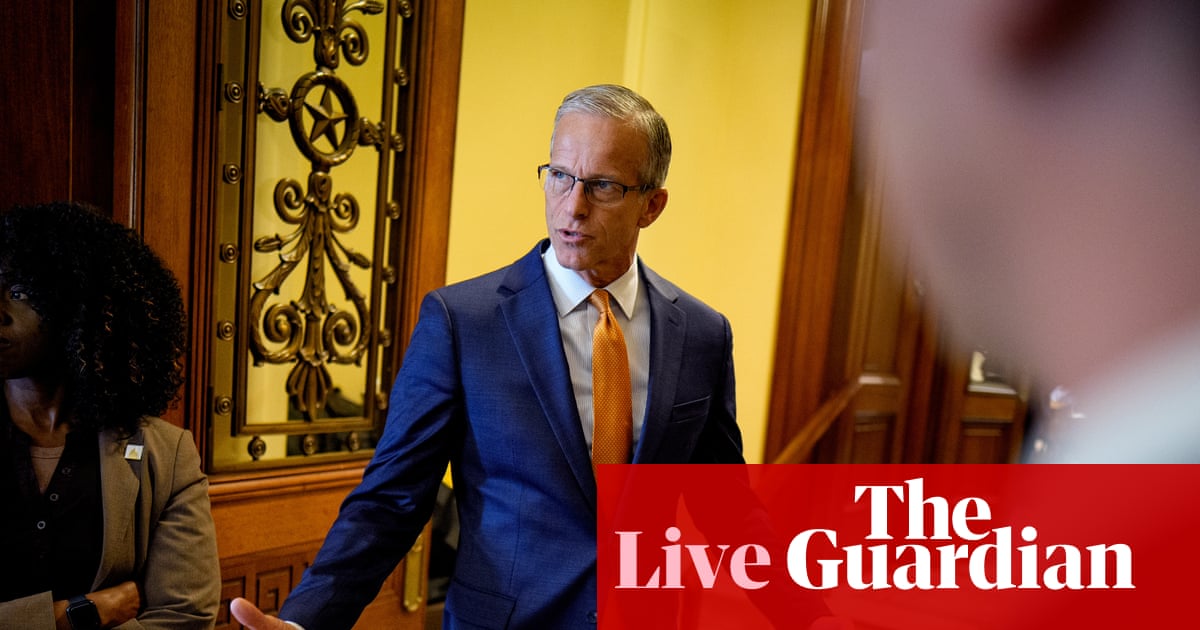
Cover image from theguardian.com, which was analyzed for this article
The House approved a brief two-week extension of FISA Section 702 warrantless surveillance powers following a late-night rebellion by conservative Republicans that sank a longer-term renewal lacking reforms. The stopgap measure prevents an immediate program lapse amid partisan fights over privacy versus security. Trump pushed for a clean bill, but divisions forced the punt to late April.
PoliticalOS
Friday, April 17, 2026 — Politics
Congress has bought two weeks to reconcile national security needs for warrantless foreign surveillance with persistent demands for warrants before querying Americans' incidental data. The conservative revolt, despite pressure from Trump and intelligence leaders, shows that past FBI abuses continue to erode trust across party lines. Readers should watch whether the final deal includes meaningful oversight or simply renews the status quo, as the underlying tension between security and privacy remains unresolved.
What outlets missed
Most coverage downplayed or omitted the more than 50 reforms Congress enacted in 2024, which Jordan cited as making a short clean extension viable now. Outlets also underplayed specific successes attributed to Section 702, including thwarting attacks at domestic venues and aiding hostage rescues, as referenced in intelligence community briefings. The fact that a recent FISA Court order allows the program to continue operating into 2027 even without statutory renewal received little attention, softening the claimed urgency of immediate lapse. Finally, bipartisan elements received uneven treatment: while some noted Democratic opposition to the GOP proposals, few detailed how progressives joined conservatives in demanding warrants, or how a handful of Democrats tried to help advance the leadership bills.
House Revolt Exposes Deep Divisions Over Warrantless Spying as Congress Buys Time
WASHINGTON — In a striking display of Republican infighting, the House of Representatives voted early Friday to temporarily extend the government's warrantless surveillance powers for just 10 days after a bloc of 20 GOP lawmakers joined Democrats to derail President Donald Trump's push for a longer renewal of a controversial program that has long raised alarms about domestic privacy violations.
The stopgap measure for Section 702 of the Foreign Intelligence Surveillance Act passed by voice vote shortly after 2 a.m., kicking the deadline to April 30 and forcing the Senate to convene for a rare Friday session. It came after two dramatic failures: first a proposed five-year extension with limited reforms, then an 18-month renewal that Trump had personally demanded and House Speaker Mike Johnson had backed. Both efforts collapsed when conservative Republicans balked, citing insufficient protections against government abuse.
The episode laid bare the persistent tensions surrounding a law first enacted in 2008 that allows U.S. intelligence agencies to vacuum up the electronic communications of foreign targets overseas without warrants. In practice, those collections routinely sweep in the calls, texts and emails of Americans in contact with those targets — creating a massive database that the FBI, CIA and NSA can search. Privacy advocates from both parties have spent years demanding that agents be required to obtain court warrants before querying that data for information on U.S. persons. Intelligence officials insist such a requirement would cripple national security operations.
Trump's reversal on the issue has been particularly jarring. Just two years ago, he urged supporters to "KILL FISA" after accusing the FBI of misusing the law to spy on his 2016 campaign. On Wednesday, he flipped, posting on Truth Social that the program is an "effective tool to keep Americans safe" and "extremely important to our military," especially amid tensions involving Iran. His pressure on Republicans to pass a clean extension without stronger privacy guardrails appeared to backfire.
Johnson tried to thread the needle with a compromise package that included new warrant requirements in some scenarios, stricter criminal penalties for misuse, and a ban on intentionally targeting U.S. citizens without court approval. Yet it was not enough for libertarian-leaning Republicans who have long viewed the program as an unconstitutional expansion of the surveillance state. Rep. Thomas Massie and others argued that any reauthorization must include far more robust reforms. Sen. Ron Wyden, a leading Democratic critic, amplified those concerns on social media, noting his own classified warnings about secret interpretations of the law that should worry every American.
Democrats seized on the chaos, blasting GOP leadership for dragging the House into the middle of the night with what Rep. Jim McGovern of Massachusetts called amateur-hour governance. "Are you kidding me? Who the hell is running this place?" he demanded during floor debate. While most Democrats opposed the longer extensions without stronger reforms, a handful crossed party lines in procedural votes, underscoring that skepticism of unchecked surveillance crosses traditional ideological lines.
The program's defenders point to real successes. Intelligence officials credit Section 702 with helping rescue hostages and thwarting a planned terror attack at a Taylor Swift concert in Vienna. Yet civil liberties groups counter that these benefits have come at an enormous cost to Fourth Amendment protections, with repeated FBI compliance failures documented in court filings and inspector general reports. The incidental collection of Americans' communications has created what critics describe as a backdoor warrantless search mechanism that undermines constitutional norms.
This week's events represent a significant setback for both the White House and Johnson, who had hoped to resolve the issue before the program's Monday expiration. The speaker sounded optimistic in the early morning hours, telling reporters, "We were very close tonight. There's some nuances with the language and some questions that need to be answered and we'll get it done." But the revolt signals that negotiations over the next two weeks will be anything but smooth. Conservative hardliners are demanding more concessions, while privacy-minded Democrats and some Republicans warn that a clean reauthorization would entrench one of the most expansive spying authorities in American law.
The episode also highlights broader dysfunction in a Congress racing against the clock. With the Senate now forced to act quickly, the coming days will test whether lawmakers can bridge deep philosophical divides over security versus liberty or whether another short-term patch will simply delay the inevitable confrontation. For those who have tracked the steady expansion of post-9/11 surveillance powers, the rebellion — however limited — offers a rare moment of accountability in a process that has too often occurred in the shadows.
Critics like Rep. Ro Khanna have been vocal that extending these powers without meaningful reform effectively hands any president, including Trump, dangerous tools for warrantless monitoring of Americans. Whether the next two weeks produce genuine guardrails or another extension of the status quo remains to be seen. What is clear is that the fight over Section 702 is no longer a sleepy procedural matter. It has become a proxy battle over the scope of government power in an era when trust in institutions is already dangerously low. The surveillance state's defenders may ultimately prevail, but Friday's late-night drama showed that opposition remains fierce, bipartisan and unwilling to be steamrolled.
You just read Progressive's take. Want to read what actually happened?
More in Politics

Trump at 32% Approval as Gas Prices Test GOP Midterm Hopes
NYT/Siena polling showed Trump's approval at historic lows around 32 percent with Democrats leading by double digits in key districts. Early voting has surged in battleground states.

Record Early Voting Hits Battlegrounds, Shifting Partisan Shares
AP analysis found hundreds of thousands more early ballots than in 2022 in states including Texas, Ohio, Kansas, Maine, and North Carolina, shifting partisan dynamics.

Trump Backs Marshall in Kansas Senate Race Tightened by Farm Costs
President Trump rallied in deep-red Kansas for GOP Sen. Roger Marshall in a competitive race, announcing an $8 billion farm fuel relief program amid high diesel prices. Democrats see an opening to end 94 years of GOP dominance in the state.

Trump Pauses Russia Sanctions Amid Ukraine Tensions and Missile Strikes
Trump waived sanctions on Russia and floated trilateral talks with Putin and Xi as part of ending the Ukraine war, while tensions rose with Zelenskyy over Starlink and arms. Bipartisan senators engaged Zelenskyy amid the shifts.
The Compass
You just read five takes on one story.
What's your take? Find your political shape in a few minutes.
Take the test