
King Charles Urges UK-US Alliance Renewal in Historic Congress Address
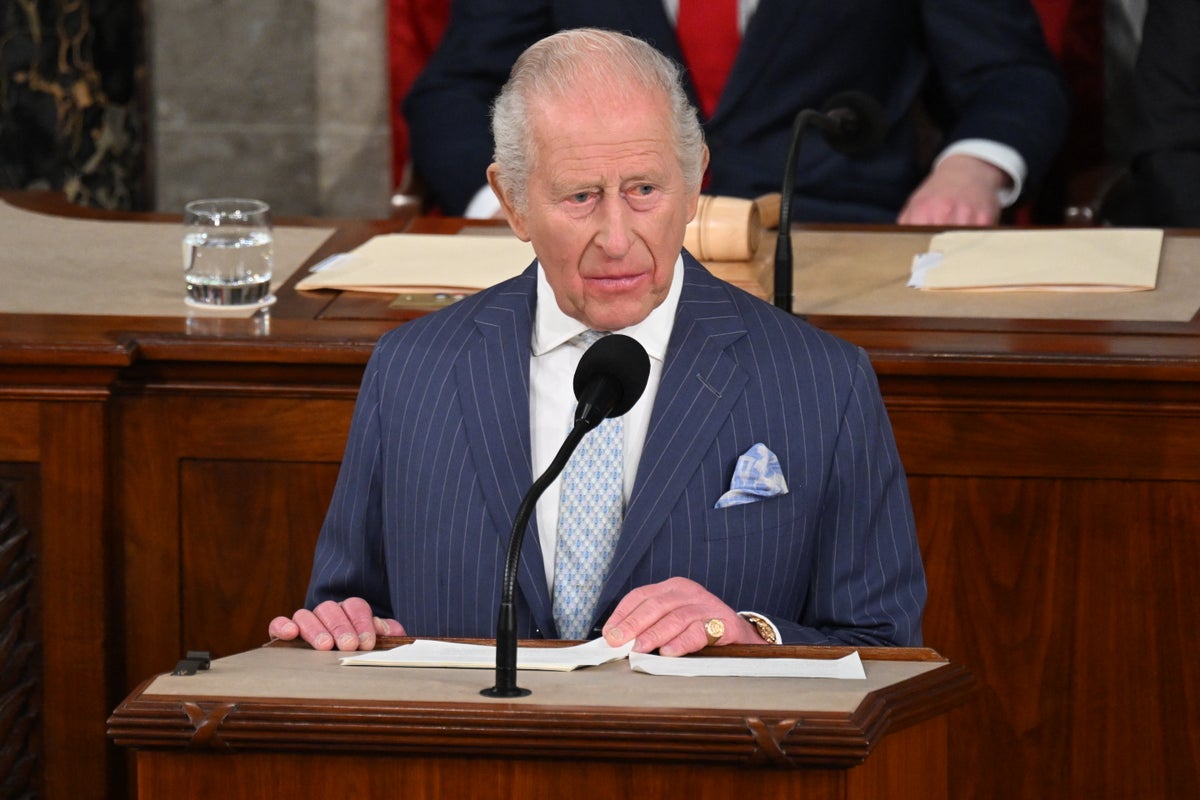
Cover image from independent.co.uk, which was analyzed for this article
King Charles III gave a historic address to a joint session of US Congress, receiving ovations for his call for checks and balances and praise of the UK-US alliance on its 250th anniversary. He and Queen Camilla attended a state dinner hosted by President Trump, featuring toasts to the 'indispensable alliance' and light-hearted moments. The visit continues to New York to honor 9/11 victims.
PoliticalOS
Wednesday, April 29, 2026 — Politics
Despite policy differences over Iran, defense spending and Ukraine, King Charles’s address to Congress and the subsequent state dinner reaffirmed the depth of the UK-US alliance with repeated bipartisan applause, historical references to shared democratic values, and light-hearted exchanges that underscored 250 years of partnership. The visit’s continuation to New York for 9/11 remembrance further emphasized solidarity forged in crisis. Readers should recognize these events as deliberate public diplomacy that signals continuity in transatlantic security cooperation beyond any single administration’s disputes.
What outlets missed
Most coverage downplayed or omitted the speech's explicit references to post-9/11 NATO Article 5 invocation, joint F-35 production, the AUKUS submarine program with Australia, and the precise UK defense spending target of 2.5 percent of GDP by 2027, details carried only in full transcripts from C-SPAN and cross-checked government releases. The full White House guest list's absence of any Democratic lawmakers or liberal Supreme Court justices was reported by the Times but rarely placed in the broader context that state dinners under multiple administrations have historically favored the host's political allies. Few outlets noted the Palace's legal caution against meetings with Epstein-related litigants, or that the King's oblique reference to societal ills was not tied to any specific scandal in verified transcripts. The extension of the trip to Bermuda as Charles's first visit as sovereign to a British overseas territory received almost no attention despite its symbolic weight for Commonwealth ties.
King Charles Appeals for Enduring Alliance as He Warns Congress of Dangerous Era
Washington — King Charles III stood before a joint session of Congress on Tuesday and delivered a carefully calibrated message: the partnership between the United States and the United Kingdom remains indispensable at a moment when global order feels increasingly fragile. The speech, only the second by a British monarch to Congress, came amid visible strains in the relationship and was widely interpreted as a diplomatic effort to reinforce shared institutions at a time of political volatility.
The King spoke in the House chamber to an audience that included Vice President JD Vance, lawmakers from both parties, and a large diplomatic contingent. He received a standing ovation before uttering a word and roughly a dozen more throughout the address. His central theme was continuity forged from past rupture. “The story of the United Kingdom and the United States is at its heart a story of reconciliation, renewal, and remarkable partnership,” he said, invoking the spirit of 1776 while insisting that differences between the two democracies have historically strengthened rather than severed their bond.
That framing mattered. The visit coincides with preparations to mark 250 years of American independence, an occasion that could have highlighted historical grievances. Instead, the King used it to argue for renewed commitment. He warned of “times of great uncertainty” and “conflict from Europe to the Middle East” that “pose immense challenges.” He spoke of the need to sustain NATO as the cornerstone of transatlantic security, to continue supporting “the defence of Ukraine and her most courageous people,” and to resist the instinct to turn “ploughshares into swords.”
These points landed with particular resonance given recent policy disagreements. The Trump administration has pressed allies to increase defense spending and has clashed with Prime Minister Keir Starmer’s government over the scope of support for operations against Iran. The King quoted Starmer directly: “Ours is an indispensable partnership. We must not disregard everything that has sustained us for the last 80 years. Instead, we must build on it.” He also condemned political violence, a clear reference to the attempted assassination of President Trump at the White House Correspondents’ Dinner on Saturday.
Later that evening, at a state dinner in the White House East Room, both leaders sought to project warmth. Trump called the visit “historic” and praised the King’s congressional speech, joking that Charles had accomplished what he never could: earning standing ovations from Democrats. The King responded by speaking of an “unbreakable bond of history and heritage, culture and commerce, industry and invention.” He presented Trump with a polished brass bell from the conning tower of HMS Trump, a British submarine that served in the Pacific during World War II. The president appeared visibly moved.
The diplomacy reflects deeper anxieties. Britain has shown reluctance to fully endorse certain joint U.S.-Israeli actions in the Middle East, while Washington has criticized London over defense budgets and tariffs. In that context, the King’s emphasis on collective security and democratic values functions as both reassurance and subtle pressure. His references to supporting survivors of sexual abuse, in the shadow of the Jeffrey Epstein revelations, further underscored an appeal to shared moral commitments beyond immediate geopolitical disputes.
The visit continues Wednesday in New York, the first trip to the city by a reigning British monarch since Queen Elizabeth II in 2010. Charles and Queen Camilla will lay a wreath at the National 9/11 Memorial, meet with first responders and victims’ families, and attend a ceremony with Mayor Zohran Mamdani. The Queen is scheduled to deliver a new “Roo” doll to the New York Public Library’s collection of Winnie-the-Pooh artifacts, marking the character’s centenary. The King will visit an urban farming program that works with food-insecure youth and meet with business leaders in Manhattan.
These stops are not merely ceremonial. They reinforce the personal and cultural ties that underpin the political alliance. New Yorkers offered their own suggestions for a “real” New York itinerary, from the Brooklyn Botanical Garden to the Statue of Liberty, but the official schedule remains tightly focused on remembrance, education, and economic dialogue.
For all the pomp, the week’s events reveal a persistent truth about Anglo-American relations: they are resilient precisely because they have never been automatic. The King’s address and the subsequent state dinner served as a public recommitment to the architecture of cooperation built over eight decades. In an era of rapid realignment, that architecture looks less like an inherited luxury than a deliberate choice requiring constant renewal. The standing ovations in Congress suggested many lawmakers, regardless of party, recognize the stakes. Whether that recognition translates into sustained policy alignment remains the harder test ahead.
You just read Liberal's take. Want to read what actually happened?
More in Politics
Trump at 32% Approval as Gas Prices Test GOP Midterm Hopes
NYT/Siena polling showed Trump's approval at historic lows around 32 percent with Democrats leading by double digits in key districts. Early voting has surged in battleground states.

Record Early Voting Hits Battlegrounds, Shifting Partisan Shares
AP analysis found hundreds of thousands more early ballots than in 2022 in states including Texas, Ohio, Kansas, Maine, and North Carolina, shifting partisan dynamics.
Trump Backs Marshall in Kansas Senate Race Tightened by Farm Costs
President Trump rallied in deep-red Kansas for GOP Sen. Roger Marshall in a competitive race, announcing an $8 billion farm fuel relief program amid high diesel prices. Democrats see an opening to end 94 years of GOP dominance in the state.

Trump Pauses Russia Sanctions Amid Ukraine Tensions and Missile Strikes
Trump waived sanctions on Russia and floated trilateral talks with Putin and Xi as part of ending the Ukraine war, while tensions rose with Zelenskyy over Starlink and arms. Bipartisan senators engaged Zelenskyy amid the shifts.
The Compass
You just read five takes on one story.
What's your take? Find your political shape in a few minutes.
Take the test