
Newark Curfew at ICE Site Met With Continued Protests and Arrests
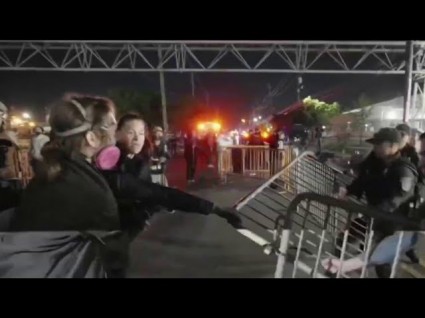
Cover image from crooksandliars.com, which was analyzed for this article
Demonstrations erupted outside the Newark ICE facility with reports of curfews and clashes, while Democrats criticized Trump administration detention policies. Coverage highlighted broader tensions over immigration enforcement and sanctuary city rules.
PoliticalOS
Monday, June 1, 2026 — Politics
Newark authorities imposed a curfew after a week of protests at an ICE facility escalated, resulting in arrests when demonstrators remained in place. Parallel legal and operational disputes over detention practices unfolded in multiple states with limited cross-verification of scale or triggers. Readers should weigh official statements on safety against documented increases in transfers and activist accounts of conditions.
What outlets missed
Most coverage omitted the specific sequence of reported protester actions, such as attacks on barricades and tire fires, that preceded the curfew announcement in Newark. Details on the exact number of arrests or weapons recovered during the May 31 operation could not be independently verified across outlets. Operational rationales for detainee transfers, including facility capacity management, received little attention outside data-focused reporting. Court records on the Broadview case showed subsequent internal reforms by the U.S. Attorney's office that were downplayed in interpretive accounts.
ICE Detainee Transfers Accelerate Amid Expanding Enforcement Network
Rapid transfers of immigration detainees have more than tripled in frequency since the start of the current administration, according to data compiled by the Marshall Project, creating new obstacles for legal representation and family contact. The pattern reflects the operational demands of a detention system that has grown sharply in scale while facing repeated local challenges.
Abdullahi Mohamed’s experience illustrates the effect. After his detention near Portland, Maine, Mohamed was moved across multiple states in quick succession, with his lawyer learning of his location only through scattered updates from other detainees’ relatives. Similar transfers, often completed within 24 hours and across state lines, have increased markedly from the prior year, complicating filings that must be made in the correct jurisdiction and limiting access to counsel.
These movements coincide with heightened activity at existing facilities. Protests outside the Broadview center near Chicago and Delaney Hall in Newark have drawn large crowds, prompting curfews, deployment of riot police, and occasional use of less-lethal munitions. In Newark, city officials cited weapons found among some demonstrators when imposing nightly restrictions around the GEO Group-run site. Federal prosecutors in Chicago initially pursued charges against six protesters before a judge identified irregularities in the grand-jury process, leading to dismissal of the cases.
At the same time, the administration is pursuing additional capacity. Plans for a large facility in Social Circle, Georgia, have triggered a lawsuit from the town of roughly 5,000 residents. The complaint alleges violations of both federal environmental review requirements and state public-nuisance law, arguing that the projected scale would strain local services. Similar concerns have surfaced in other rural communities selected for new or expanded centers.
Preparations for the upcoming World Cup have added another layer of coordination. Immigrant-rights organizations in host cities are distributing legal resources and issuing advisories, while administration officials have offered conflicting signals about enforcement near match venues. Labor groups representing hospitality workers have threatened work stoppages if agents operate inside stadiums.
Former Border Patrol official Greg Bovino, removed earlier this year after operations linked to civilian deaths, has publicly criticized the pace of removals, claiming internal advisers have moderated the original approach. Current leadership has emphasized continued expansion despite these frictions.
The combination of accelerated transfers, facility siting disputes, and protest-related litigation points to structural pressures on an enforcement apparatus operating at higher volume. Court records and agency statistics suggest that procedural shortcuts intended to increase throughput are generating downstream legal and logistical complications that may slow implementation over time.
You just read Liberal's take. Want to read what actually happened?
More in Politics

Trump Defends Ramaswamy Ad Using Estranged Mother in Ohio Race
President Trump defended a GOP nominee's ad featuring a Democratic opponent's estranged mother, calling it powerful, while drawing criticism from some Republicans including Ohio Gov. Mike DeWine. The ad has sparked internal GOP tensions ahead of midterms.

Federal Raid Targets Omar Amid Unresolved Name and Marriage Allegations
Agents searched Rep. Ilhan Omar's DC residence over immigration fraud allegations; she called it bizarre. Reports and commentary questioned her birth name and past marriage details.

Supreme Court Upholds New Hampshire Student ID Voting Ban
The Supreme Court upheld New Hampshire's ban on student IDs as valid voter identification just before midterms, affecting a tight Senate race.
Early Voting Hits 21 Million as Most Trust Midterm Accuracy
Millions have already voted early as parties make final appeals amid $1.4 billion in ad spending; polls show confidence in election accuracy.
The Compass
You just read five takes on one story.
What's your take? Find your political shape in a few minutes.
Take the test