
Newark Curfew at ICE Site Met With Continued Protests and Arrests
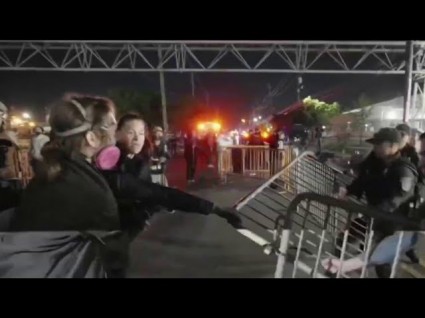
Cover image from crooksandliars.com, which was analyzed for this article
Demonstrations erupted outside the Newark ICE facility with reports of curfews and clashes, while Democrats criticized Trump administration detention policies. Coverage highlighted broader tensions over immigration enforcement and sanctuary city rules.
PoliticalOS
Monday, June 1, 2026 — Politics
Newark authorities imposed a curfew after a week of protests at an ICE facility escalated, resulting in arrests when demonstrators remained in place. Parallel legal and operational disputes over detention practices unfolded in multiple states with limited cross-verification of scale or triggers. Readers should weigh official statements on safety against documented increases in transfers and activist accounts of conditions.
What outlets missed
Most coverage omitted the specific sequence of reported protester actions, such as attacks on barricades and tire fires, that preceded the curfew announcement in Newark. Details on the exact number of arrests or weapons recovered during the May 31 operation could not be independently verified across outlets. Operational rationales for detainee transfers, including facility capacity management, received little attention outside data-focused reporting. Court records on the Broadview case showed subsequent internal reforms by the U.S. Attorney's office that were downplayed in interpretive accounts.
ICE Crackdown Fuels Protests and Legal Pushback Nationwide
Immigration authorities have accelerated the movement of detainees across state lines in recent months, leaving families and lawyers struggling to track loved ones held in a sprawling network of facilities. A Marshall Project investigation found that the number of people transferred five or more times more than tripled from the final year of the Biden administration into President Donald Trump’s second term, with many moved out of state within twenty-four hours. Lawyers described the practice as a deliberate tactic that disrupts legal representation and heightens distress for those in custody.
The rapid transfers coincide with a wave of protests at detention sites. In Newark, demonstrators gathered for more than a week outside the Delaney Hall facility operated by the GEO Group, where reports emerged of a hunger strike among detainees. City officials imposed a nightly curfew covering a half-mile radius, yet hundreds defied the order. State police responded with rubber bullets, tear gas, and mounted officers, leading to arrests and the removal of journalists from the area. New Jersey Governor Mikie Sherrill’s administration defended the deployment as necessary to restore order, though critics pointed to the force used against crowds that included veterans and local residents.
Similar tensions have surfaced in Georgia, where the small town of Social Circle filed suit to block construction of what would become the nation’s largest immigration detention center. The lawsuit claims federal agencies violated both environmental review requirements and the Administrative Procedure Act by failing to consider impacts on local health services and public safety. Residents argue that housing up to ten thousand people in a warehouse on the edge of a community of roughly five thousand would strain already limited resources.
Advocates in World Cup host cities are preparing parallel efforts. More than one hundred groups issued travel advisories warning visitors of possible arbitrary stops and detentions near stadiums. In Los Angeles, a hospitality workers’ union threatened to strike if agents enter SoFi Stadium, while groups in Dallas distributed whistle kits and legal information in neighborhoods surrounding match venues.
Federal prosecutors have also targeted demonstrators. In Chicago, charges against six protesters at the Broadview facility were dropped after a judge found that government attorneys had improperly redacted grand jury transcripts. The case collapse follows other unsuccessful attempts to prosecute resistance to enforcement operations.
Former ICE official Greg Bovino, removed earlier this year after a deadly incident during an operation in Minneapolis, publicly criticized the administration at a European conference for scaling back aggressive tactics. He singled out senior adviser Susie Wiles for diluting the deportation push and questioned the qualifications of current homeland security leadership.
Across these sites, the pattern is consistent: expanded detention capacity paired with swift movement of people in custody and heightened policing of those who object. Families continue to receive fragmented updates on relatives’ locations, while communities weigh the costs of hosting larger facilities.
You just read Progressive's take. Want to read what actually happened?
More in Politics

Trump at 32% Approval as Gas Prices Test GOP Midterm Hopes
NYT/Siena polling showed Trump's approval at historic lows around 32 percent with Democrats leading by double digits in key districts. Early voting has surged in battleground states.

Record Early Voting Hits Battlegrounds, Shifting Partisan Shares
AP analysis found hundreds of thousands more early ballots than in 2022 in states including Texas, Ohio, Kansas, Maine, and North Carolina, shifting partisan dynamics.

Trump Backs Marshall in Kansas Senate Race Tightened by Farm Costs
President Trump rallied in deep-red Kansas for GOP Sen. Roger Marshall in a competitive race, announcing an $8 billion farm fuel relief program amid high diesel prices. Democrats see an opening to end 94 years of GOP dominance in the state.

Trump Pauses Russia Sanctions Amid Ukraine Tensions and Missile Strikes
Trump waived sanctions on Russia and floated trilateral talks with Putin and Xi as part of ending the Ukraine war, while tensions rose with Zelenskyy over Starlink and arms. Bipartisan senators engaged Zelenskyy amid the shifts.
The Compass
You just read five takes on one story.
What's your take? Find your political shape in a few minutes.
Take the test