
GOP Amasses Cash Edge for 2026 Midterms Amid Enthusiasm Warnings
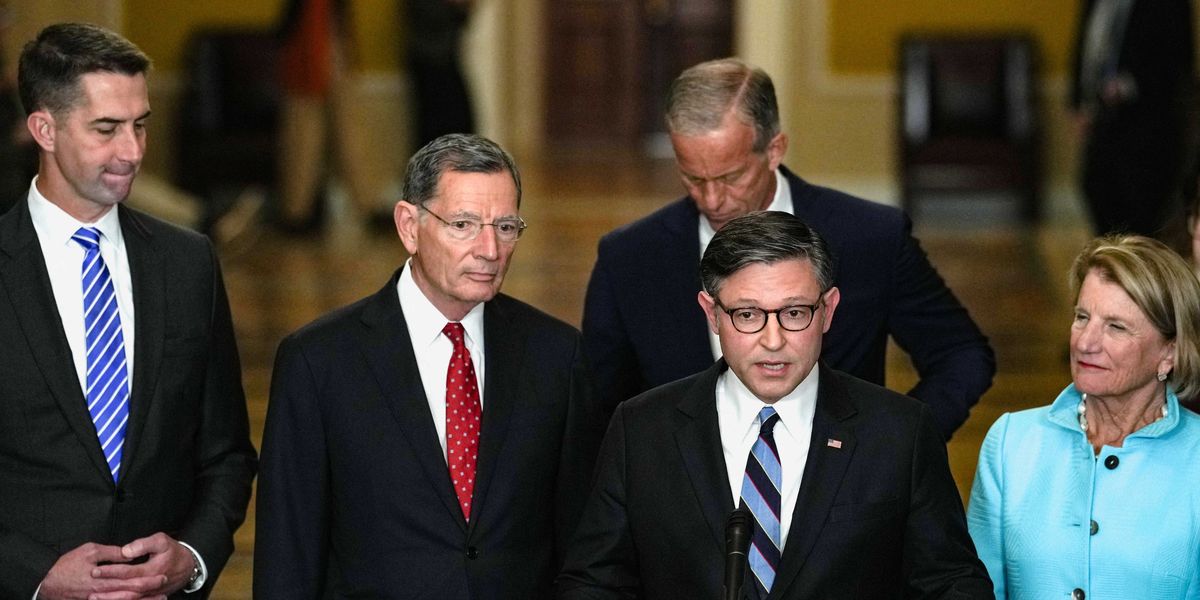
Cover image from rawstory.com, which was analyzed for this article
GOP fundraising dwarfs Democrats as 2026 midterms loom, with Republicans crafting a winning message despite left warnings that Trump drags the party down. Analysts note Trump's picks may not mobilize voters. Primaries provide early indicators of the landscape.
PoliticalOS
Tuesday, May 5, 2026 — Politics
Republicans hold a verified, substantial financial advantage heading into the 2026 midterms that could reshape the playing field months ahead of Election Day. At the same time, early primary data and warnings from GOP pollsters point to an enthusiasm gap among moderate Republicans and signs that Trump's endorsements are less potent than in previous cycles. The decisive factor will be whether the party converts its resources into a message that mobilizes its full coalition or whether dissatisfaction with the administration's direction keeps enough voters home to defy the cash edge.
What outlets missed
Most coverage omitted the precise 23 percent primary win rate for Trump-backed challengers as of April 2026 tracked by Ballotpedia, which places current results in the range of typical anti-incumbent efforts rather than a historic collapse. Outlets on both sides underplayed the full scope of Democratic strength in individual Senate race fundraising, where candidates like Georgia's Jon Ossoff reported $14 million in the first quarter against far less for their Republican opponents. Coverage also gave short shrift to Anderson's day job running Echelon Insights, a firm ranked highly for polling accuracy with Republican clients; her warnings function as strategic advice for GOP improvement rather than neutral prediction of defeat. Finally, few pieces noted that small-dollar online fundraising continues to favor Democrats via platforms like ActBlue, which reported $568 million in the first quarter, a metric that fuels turnout infrastructure beyond committee cash totals.
Republicans Face Mounting Warnings of Voter Revolt as Trump's Influence Fades Ahead of Midterms
As Republicans gear up for the 2026 midterms, a growing body of evidence suggests that Donald Trump's second term is eroding support within his own party, alienating the very voters the GOP needs to defy historical trends and avoid significant losses. Despite a commanding financial advantage that has party operatives stockpiling nearly $850 million for the cycle, internal alarms are sounding over Trump's declining appeal and the party's inability to broaden its coalition beyond the most devoted MAGA loyalists.
Longtime Republican pollster Kristen Soltis Anderson delivered a stark assessment in a New York Times opinion piece this week, describing what she calls "normie" Republicans as increasingly fed up with the direction of a party reshaped by Trump. These voters, who do not primarily identify as Trump supporters or MAGA adherents, view his combative social media habits as actively harmful to the Republican cause. Anderson warned that this disaffection represents the GOP's most immediate political challenge and "ought to be a powerful alarm bell for Republican candidates looking to win the 2026 elections."
The data backs her up. Since last year, the share of Republicans who feel very favorably toward Trump has dropped by 10 points. Only 44 percent strongly approve of his performance, a troubling sign for a president whose approval rating has slipped even as some individual policies, such as the deportation of criminal immigrants, retain popularity in certain polls. Anderson noted that these mainstream conservatives have grown disaffected with the overall direction of the country under Trump's administration, suggesting that the chaos and divisiveness associated with his leadership are taking a measurable toll.
This erosion comes at a particularly dangerous moment. Trump's attempts to assert dominance in upcoming primaries are falling flat, according to multiple reports. In Indiana, Louisiana, Kentucky, Alabama, and Georgia, candidates hand-picked by the president to punish Republican incumbents who have occasionally broken ranks are struggling to gain traction with voters and donors. Politico described Trump as standing on "rocky ground," with his interventions failing to move the needle in races targeting figures like Rep. Tom Massie of Kentucky and Sen. Bill Cassidy of Louisiana.
Former Rep. Adam Kinzinger, no ally of Trump's, told Politico that the former president "has hit his max power and now you're seeing the backside of that power curve." Some Republicans involved in the races themselves acknowledge that the MAGA movement appears to be developing a mind of its own as the party looks beyond the Trump era. This fracturing suggests that even core supporters may not blindly follow when the president demands ideological purity tests or revenge against perceived disloyalty.
The financial picture tells a different story, one of structural dominance that could still cushion some blows. Republican campaign committees have built enormous war chests. The National Republican Congressional Committee holds an $8 million cash-on-hand lead over its Democratic counterpart, while the National Republican Senatorial Committee enjoys a similar advantage. When outside groups and Trump's own MAGA Inc. super PAC are included, the GOP's total resources approach $850 million. That money is being deployed early to define races and shield vulnerable incumbents in what operatives hope will be a defensive battle.
Yet cash cannot easily solve the deeper problem of voter enthusiasm. Even conservative commentators acknowledge the bind. An opinion piece in the New York Post this week noted that while Democrats remain disorganized and lack a compelling message beyond opposition to Trump, Republicans cannot simply coast on anti-Democratic sentiment. The piece urged the GOP to articulate a positive vision, recalling Newt Gingrich's Contract with America from three decades ago. Historical patterns offer little comfort: the president's party almost always loses seats in midterms, and Trump himself has mused that even strong presidents cannot escape that fate.
The tension is palpable. House Speaker Mike Johnson and Senate Republican leaders have spent recent weeks projecting confidence in front of the cameras, but the data tells a story of a party caught between a shrinking base of Trump true believers and a broader electorate weary of the drama, the infighting, and the results of his administration. Anderson's warning about "normie" Republicans is particularly damaging because it comes from within the conservative movement itself, not from partisan critics.
Democrats, for their part, are said to be debating internally whether to run on a detailed policy platform or simply highlight the perceived failures and excesses of Trump 2.0. Republicans dismiss the former approach as radical, but the latter may prove effective if public dissatisfaction with the president's leadership continues to spread beyond the usual suspects.
With primaries testing Trump's kingmaker status in the coming weeks, the early results could either validate these internal warnings or offer the GOP a path to stabilization. For now, the alarm bells are ringing loudly. A party flush with cash but short on broad appeal enters the midterm cycle facing the very real prospect that Trump's gravitational pull is dragging it backward at the worst possible time. The question is whether Republican candidates will heed the warnings from their own pollsters and strategists or double down on a formula that appears to be losing its magic.
You just read Progressive's take. Want to read what actually happened?
More in Politics

Trump at 32% Approval as Gas Prices Test GOP Midterm Hopes
NYT/Siena polling showed Trump's approval at historic lows around 32 percent with Democrats leading by double digits in key districts. Early voting has surged in battleground states.

Record Early Voting Hits Battlegrounds, Shifting Partisan Shares
AP analysis found hundreds of thousands more early ballots than in 2022 in states including Texas, Ohio, Kansas, Maine, and North Carolina, shifting partisan dynamics.

Trump Backs Marshall in Kansas Senate Race Tightened by Farm Costs
President Trump rallied in deep-red Kansas for GOP Sen. Roger Marshall in a competitive race, announcing an $8 billion farm fuel relief program amid high diesel prices. Democrats see an opening to end 94 years of GOP dominance in the state.

Trump Pauses Russia Sanctions Amid Ukraine Tensions and Missile Strikes
Trump waived sanctions on Russia and floated trilateral talks with Putin and Xi as part of ending the Ukraine war, while tensions rose with Zelenskyy over Starlink and arms. Bipartisan senators engaged Zelenskyy amid the shifts.
The Compass
You just read five takes on one story.
What's your take? Find your political shape in a few minutes.
Take the test