
Supreme Court Narrows Path for Minority Voting Protections
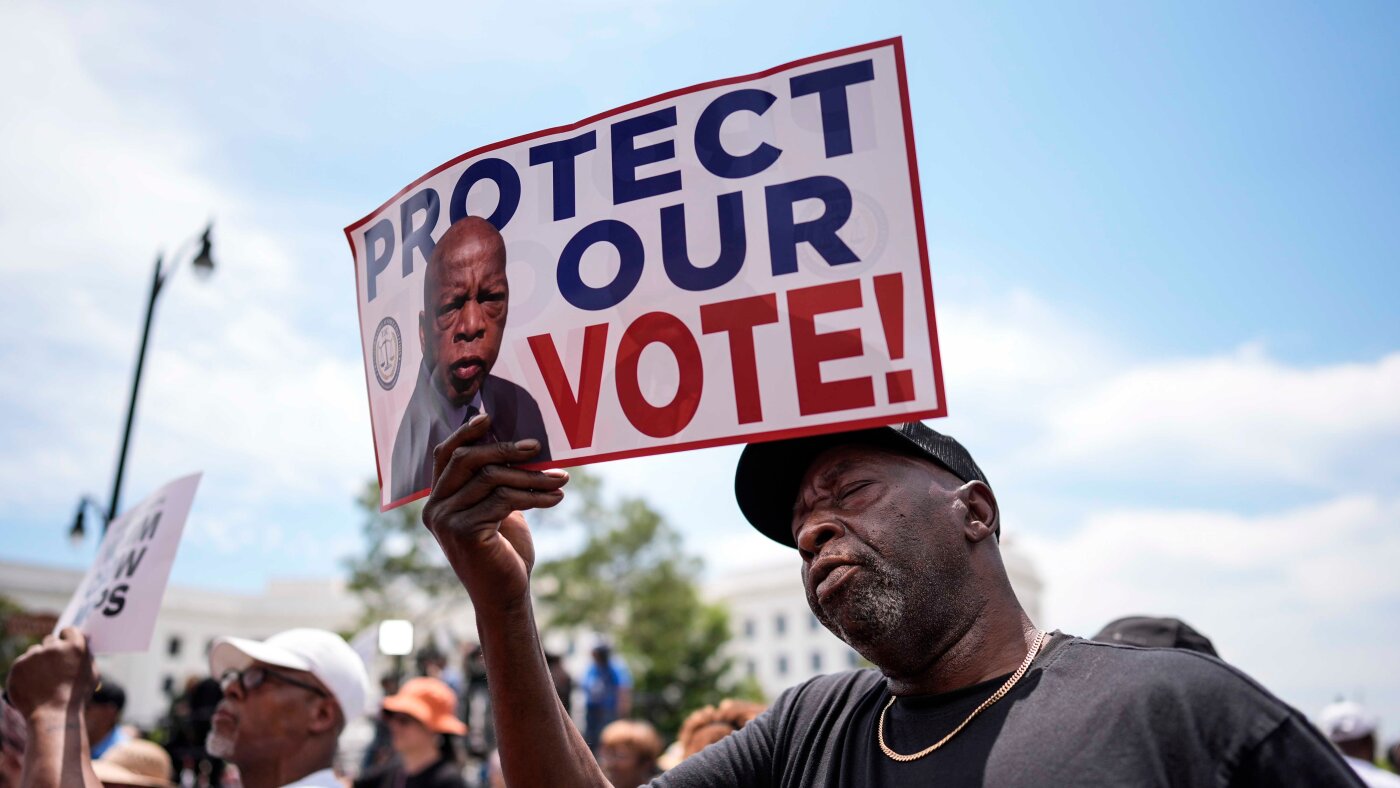
Cover image from npr.org, which was analyzed for this article
After a key Supreme Court decision, states are exploring state-level voting rights laws and redistricting as alternatives for protecting minority voting access.
PoliticalOS
Friday, June 5, 2026 — Politics
The Supreme Court has curtailed the practical reach of Section 2 of the Voting Rights Act in redistricting disputes. States now pursue narrower alternatives whose effectiveness will vary sharply by partisan control and future litigation. No single approach currently on the table restores the nationwide scope previously available under federal law.
What outlets missed
Neither outlet quoted or summarized the majority’s equal-protection analysis that formed the core of the Callais holding. Alabama officials’ statements defending the practical effects of the retained maps received no direct coverage. The precise statutory language of pending state voting rights bills and the text of the new federal lawsuit against Illinois’ law were omitted, leaving readers without primary documents against which to weigh competing claims.
The Supreme Court’s June 2026 rulings in Louisiana v. Callais and a related Alabama redistricting case have made it substantially harder for plaintiffs to win claims under Section 2 of the Voting Rights Act when challenging congressional maps. Those decisions leave minority voters with narrower federal remedies against alleged racial discrimination in district lines and shift attention to state laws and map-drawing tactics whose reach and durability remain uncertain.
The Court permitted Alabama to retain a map a lower court had found intentionally diluted Black voting strength. In the Louisiana case it held that a map creating an additional majority-Black district constituted an unconstitutional racial gerrymander under the Equal Protection Clause. Legal experts cited in contemporaneous coverage noted that these outcomes effectively limit the circumstances in which Section 2 can compel the creation or preservation of majority-minority districts.
State-level voting rights statutes have emerged as one immediate response. Democratic lawmakers in Michigan, New Jersey, and Delaware have advanced or introduced measures modeled on the federal law. Roughly a dozen states already have such statutes, though none with unified Republican control. These laws apply only to state and local elections and face pending constitutional challenges, including a suit filed by the Public Interest Legal Foundation against Illinois’ statute.
Democratic-controlled states are also examining whether they can redraw maps to increase their House seats while preserving existing minority-opportunity districts. Harvard Law School professor Nick Stephanopoulos has argued that large Democratic states such as California, New York, and Illinois can achieve both goals simultaneously by distributing Democratic voters into more competitive but still winnable districts. California’s recently upheld map, which added five Democratic seats without eliminating minority-opportunity districts, is cited as an example.
Longer-term federal legislation faces steeper obstacles. House Minority Leader Hakeem Jeffries stated hours after the Callais decision that Democrats would continue pursuing the John R. Lewis Voting Rights Advancement Act. Passage would require Democratic majorities in both chambers of Congress and the White House; even then, the current Court’s composition could limit the statute’s reach. Some reformers have proposed replacing single-member districts with proportional representation, but that change would require amending federal law.
Alabama Attorney General Steve Marshall welcomed the rulings as ending compelled racial classifications in map-drawing. Groups that filed amicus briefs supporting the prevailing side, including the Public Interest Legal Foundation and Pacific Legal Foundation, described the decisions as reinforcing that the Constitution protects individuals rather than racial groups. Progressive analysts, citing donation data from True North Research, noted that seven nonprofits filing such briefs received approximately $105 million through donor-advised funds between 2021 and 2024, seven times the amount received in the prior three-year period.
The central unresolved question is whether any combination of state statutes, strategic redistricting, and future federal legislation can replicate the nationwide scope that Section 2 once provided in polarized Southern states.
More in Politics

Trump at 32% Approval as Gas Prices Test GOP Midterm Hopes
NYT/Siena polling showed Trump's approval at historic lows around 32 percent with Democrats leading by double digits in key districts. Early voting has surged in battleground states.

Record Early Voting Hits Battlegrounds, Shifting Partisan Shares
AP analysis found hundreds of thousands more early ballots than in 2022 in states including Texas, Ohio, Kansas, Maine, and North Carolina, shifting partisan dynamics.

Trump Backs Marshall in Kansas Senate Race Tightened by Farm Costs
President Trump rallied in deep-red Kansas for GOP Sen. Roger Marshall in a competitive race, announcing an $8 billion farm fuel relief program amid high diesel prices. Democrats see an opening to end 94 years of GOP dominance in the state.

Trump Pauses Russia Sanctions Amid Ukraine Tensions and Missile Strikes
Trump waived sanctions on Russia and floated trilateral talks with Putin and Xi as part of ending the Ukraine war, while tensions rose with Zelenskyy over Starlink and arms. Bipartisan senators engaged Zelenskyy amid the shifts.
The Compass
You just read five takes on one story.
What's your take? Find your political shape in a few minutes.
Take the test