
Supreme Court Narrows Path for Minority Voting Protections
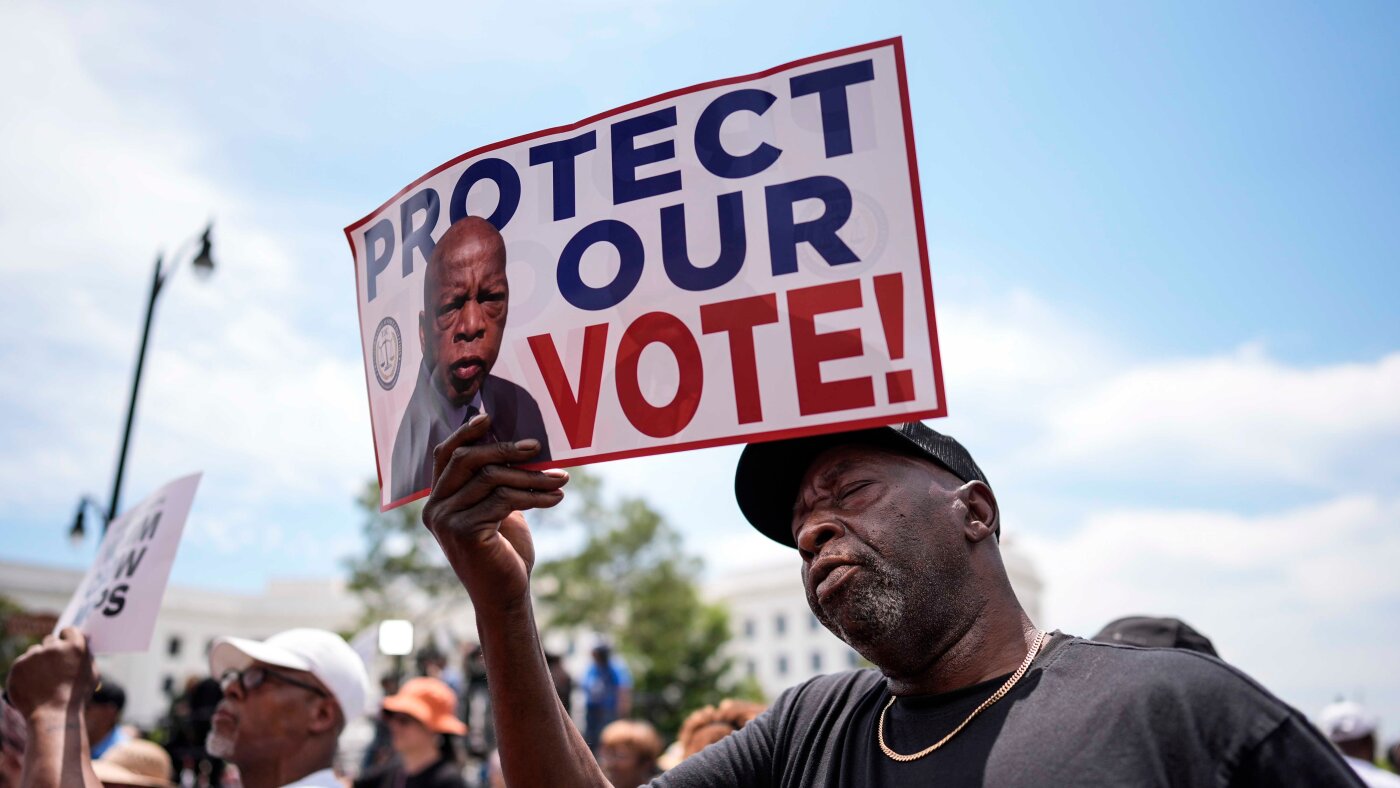
Cover image from npr.org, which was analyzed for this article
After a key Supreme Court decision, states are exploring state-level voting rights laws and redistricting as alternatives for protecting minority voting access.
PoliticalOS
Friday, June 5, 2026 — Politics
The Supreme Court has curtailed the practical reach of Section 2 of the Voting Rights Act in redistricting disputes. States now pursue narrower alternatives whose effectiveness will vary sharply by partisan control and future litigation. No single approach currently on the table restores the nationwide scope previously available under federal law.
What outlets missed
Neither outlet quoted or summarized the majority’s equal-protection analysis that formed the core of the Callais holding. Alabama officials’ statements defending the practical effects of the retained maps received no direct coverage. The precise statutory language of pending state voting rights bills and the text of the new federal lawsuit against Illinois’ law were omitted, leaving readers without primary documents against which to weigh competing claims.
Supreme Court Decision Narrows Paths for Minority Voting Protections
The Supreme Court’s recent decision to let Alabama use a congressional map that a lower court found intentionally discriminated against Black voters has sharply reduced the practical reach of the Voting Rights Act’s Section 2. That provision had long served as the main federal tool for challenging district lines that dilute minority voting strength. With enforcement now described by many legal experts as nearly impossible in its prior form, attention has shifted to state-level measures and map-drawing tactics that are available mainly in Democratic-controlled states.
The Alabama ruling follows years of litigation over maps drawn after the 2020 census. Lower courts had determined that the state’s plan packed Black voters into a single district while dispersing others, reducing their ability to elect candidates of choice in a state where voting patterns remain sharply polarized along racial lines. By allowing the map to stand, the Court signaled that future challenges under Section 2 will face steeper procedural and evidentiary barriers, particularly in the South where most Black Americans reside and where white Republican majorities often control redistricting.
Analysts note that this outcome fits a longer pattern of judicial narrowing of federal voting protections. The 2013 Shelby County decision already removed preclearance requirements that had blocked discriminatory changes before they took effect. The latest ruling compounds that shift by making it harder to prove and remedy intentional dilution after maps are enacted. Wilfred Codrington III, a constitutional law professor at Cardozo School of Law, observed that retrenchment has concentrated in states of the former Confederacy, where demographic and partisan divides align most closely with race.
States retain some tools. Several Democratic-led states have passed their own voting rights statutes modeled on the federal law, and independent redistricting commissions in places such as Michigan and New York can produce maps that avoid extreme racial packing or cracking. These approaches, however, operate only within individual states and lack the nationwide consistency once provided by Section 2. In Republican-controlled legislatures, the same options are politically unavailable, leaving minority voters there with fewer avenues for relief.
The legal campaign against Section 2 drew substantial financial support from conservative networks. Seven nonprofits that filed briefs supporting the weakening of the provision received nearly $105 million through donor-advised funds between 2021 and 2024, roughly seven times the amount they collected in the prior three-year span. The largest recipient, America First Legal Foundation, took in more than $58 million. The organization was co-founded by figures tied to the Trump administration, including Stephen Miller and Mark Meadows. Researchers tracking the funds describe the inflow as part of a broader effort to reshape election law through litigation and advocacy.
The combined effect leaves minority voting rights more dependent on the partisan control of state government than at any point since the 1965 Voting Rights Act. Where one party holds unified power, map-drawing and enforcement standards now reflect that party’s priorities with reduced federal oversight. Where power is divided or independent commissions exist, narrower protections may persist. This patchwork arrangement replaces the uniform national standard that Section 2 once supplied, and it does so at a time when demographic change continues to increase the share of minority voters in many states.
You just read Liberal's take. Want to read what actually happened?
More in Politics

Trump at 32% Approval as Gas Prices Test GOP Midterm Hopes
NYT/Siena polling showed Trump's approval at historic lows around 32 percent with Democrats leading by double digits in key districts. Early voting has surged in battleground states.

Record Early Voting Hits Battlegrounds, Shifting Partisan Shares
AP analysis found hundreds of thousands more early ballots than in 2022 in states including Texas, Ohio, Kansas, Maine, and North Carolina, shifting partisan dynamics.

Trump Backs Marshall in Kansas Senate Race Tightened by Farm Costs
President Trump rallied in deep-red Kansas for GOP Sen. Roger Marshall in a competitive race, announcing an $8 billion farm fuel relief program amid high diesel prices. Democrats see an opening to end 94 years of GOP dominance in the state.

Trump Pauses Russia Sanctions Amid Ukraine Tensions and Missile Strikes
Trump waived sanctions on Russia and floated trilateral talks with Putin and Xi as part of ending the Ukraine war, while tensions rose with Zelenskyy over Starlink and arms. Bipartisan senators engaged Zelenskyy amid the shifts.
The Compass
You just read five takes on one story.
What's your take? Find your political shape in a few minutes.
Take the test