
Supreme Court Tightens Rules on Race in Redistricting, Limiting Voting Rights Act Claims
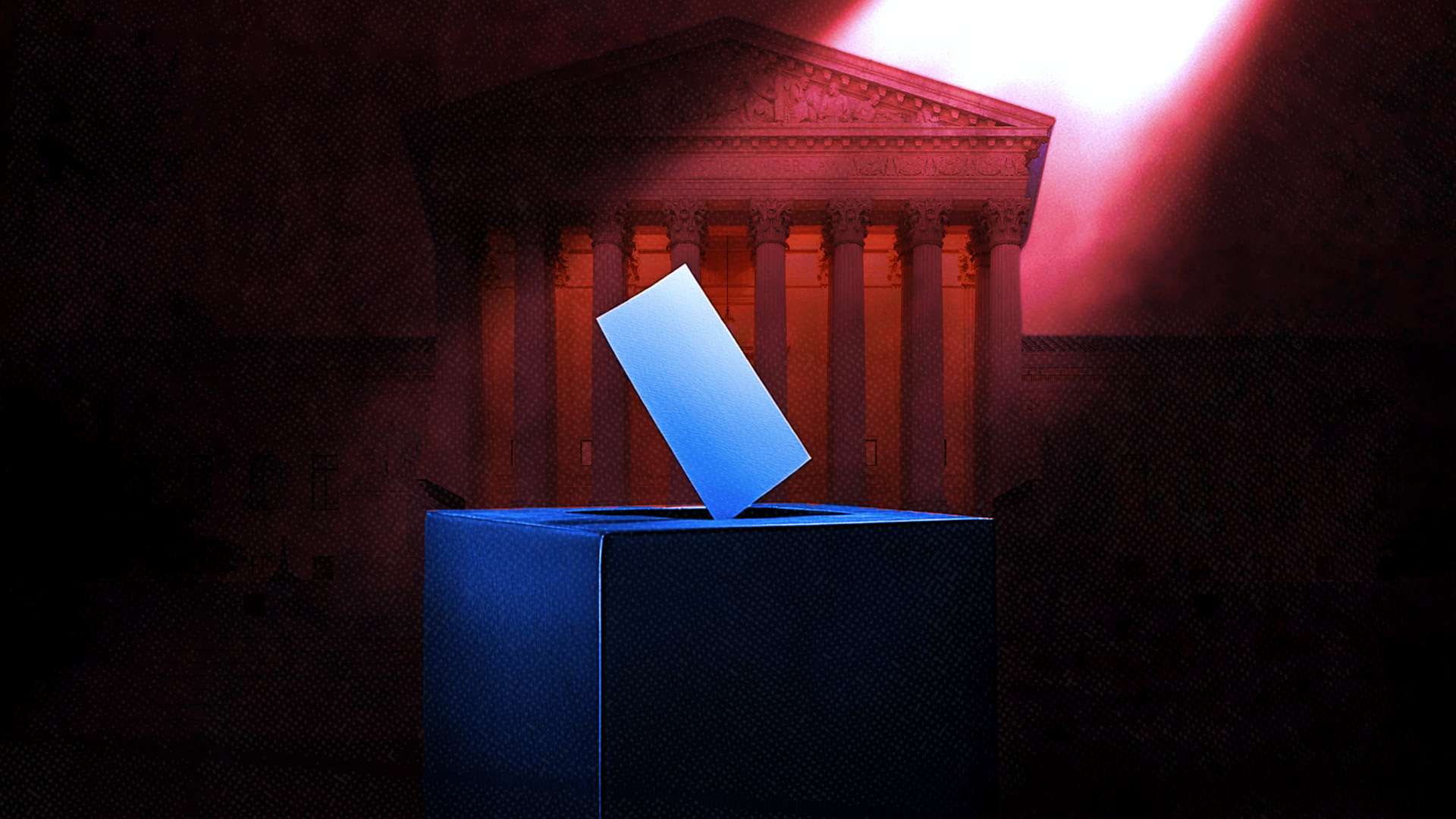
Cover image from reason.com, which was analyzed for this article
The Supreme Court issued a ruling restricting a key provision of the Voting Rights Act that prohibits racial gerrymandering, making it harder for challengers to prove race was the predominant factor in drawing district lines. Left-leaning outlets decry the decision as undermining minority voting power and enabling GOP advantages, while right-leaning sources celebrate it as a victory against racial preferences in politics. The ruling could force states to redraw maps and shift House seats ahead of future elections.
PoliticalOS
Thursday, April 30, 2026 — Politics
The Supreme Court has clarified that the Voting Rights Act cannot compel states to draw districts in which race is the predominant factor; such maps must still satisfy strict constitutional scrutiny. This narrows—but does not eliminate—Section 2's role in protecting against vote dilution. The single most important thing to understand is that the ruling enforces a boundary between remedying discrimination and engaging in racial classification, leaving legislatures and lower courts to apply the tighter standard going forward.
What outlets missed
Most coverage omitted that the invalidated Louisiana district connected disparate Black communities across 200 miles in a non-compact shape, a detail the majority opinion cited as proof race predominated over traditional criteria. The procedural sequence received short shrift: the map was drawn to comply with a lower-court finding of vote dilution under Section 2; a separate suit by non-Black voters then successfully challenged it as an unconstitutional racial gerrymander. Several outlets failed to note that some Black voters supported the challengers, objecting to being sorted primarily by race. Claims of 12 to 19 specific House seats at immediate risk were frequently repeated without attribution to verifiable data and were not corroborated across neutral legal sources such as SCOTUSblog. The majority did not strike down Section 2 or overrule its core precedents; it clarified that the statute cannot compel maps that violate the Equal Protection Clause.
Supreme Court Limits Race Based Redistricting Under Voting Rights Act
The Supreme Court on Wednesday curtailed the use of race in drawing congressional districts, ruling that Section 2 of the Voting Rights Act cannot require states to create majority minority districts when doing so amounts to unconstitutional racial gerrymandering. The 6 3 decision in Louisiana v. Callais is likely to reshape Southern congressional maps in coming years, reducing the number of safe seats drawn explicitly around racial lines and prompting fresh debates over whether such practices have outlived their usefulness after six decades of dramatic social change.
Justice Samuel Alito wrote for the conservative majority that the Voting Rights Act enforces the Constitution's prohibition on racial discrimination rather than demanding it. The case began after the 2020 census showed Louisiana's population is roughly one third Black. State lawmakers drew a congressional map with one majority Black district out of six. Federal courts ordered a second such district to comply with Section 2, which bars practices that dilute minority voting strength. A separate group of voters then sued, arguing the new map sorted citizens by race in violation of the Fourteenth and Fifteenth Amendments.
Alito's opinion revised the longstanding Thornburg v. Gingles framework from 1986. Lower courts had interpreted that precedent to focus mainly on whether minority voters could elect preferred candidates. The new standard requires plaintiffs to show that any dilution stems from intentional racial discrimination rather than ordinary partisan considerations. The Court concluded that Louisiana's initial map did not violate Section 2 and that the remedial second Black majority district crossed into forbidden racial predominance. States may still consider race as one factor among many but cannot subordinate traditional districting principles such as compactness and respect for political subdivisions to racial targets.
The ruling arrives more than sixty years after Congress passed the Voting Rights Act in response to systematic disenfranchisement across the South. Literacy tests, poll taxes, and outright violence kept Black registration rates minuscule in many states. The law produced swift gains. Black voter registration in the South rose from under 30 percent in 1964 to near parity with white registration by the 1980s. Black elected officials increased at every level of government. Today Black Americans vote at rates comparable to other groups in presidential elections, and the current Congress opened with a record 66 Black members according to Pew Research Center data.
Civil rights organizations and Democratic leaders described the decision as a severe setback. Former President Barack Obama said it would allow legislatures to weaken minority voting power under the cover of partisanship. Justice Elena Kagan wrote in dissent that the majority ignored Congress's repeated reauthorization of the law and the persistence of racially polarized voting in certain regions. She warned that cracking cohesive minority communities would render their ballots ineffective even if cast freely. Groups including the NAACP and ACLU called the outcome a license for mapmakers to dilute Black and Hispanic influence, predicting the largest drop in Black congressional representation since Reconstruction.
Republican officials and conservative legal analysts welcomed the decision as a correction. They argued that race based districts had hardened into a form of political segregation, producing representatives elected mainly by racial appeals and insulated from broader accountability. By treating voters as members of demographic blocs rather than individuals, the practice entrenched the very racial consciousness it once sought to overcome. Election law specialists noted that modern population shifts, including rapid growth in multiracial, Latino, and Asian populations, have altered the electoral landscape since 1965. The South has gained millions of new residents from other regions, many of them moving into suburban areas where voting patterns reflect economic and cultural concerns more than strict racial divides.
Immediate effects on the 2026 midterms appear limited. Most states have advanced far in their primary calendars, and courts are unlikely to order wholesale map changes before ballots are printed. Longer term, Republican legislatures in states such as Georgia, Alabama, and Louisiana may redraw lines to eliminate or dilute several majority minority districts without triggering successful Section 2 lawsuits under the tightened standard. Analysts estimate a net gain of up to a dozen House seats for Republicans by 2028, though much depends on how aggressively states act and whether new maps survive further litigation.
The decision continues a line of cases in which the Court has narrowed the Voting Rights Act's extraordinary remedies as their original conditions recede. Earlier rulings curtailed the preclearance formula that required certain jurisdictions to obtain federal approval before changing election rules. The majority has repeatedly signaled that the law remains vital against intentional discrimination but cannot serve as a perpetual mandate for proportional racial outcomes in every legislative body. Data on voter turnout and officeholding support the view that legal barriers to ballot access have largely fallen. Persistent gaps in representation now trace more to choices of where people live, whom they prefer as candidates, and how parties organize turnout than to formal exclusion.
Critics on the left contend the ruling ignores continued racial polarization in Southern voting, in which large majorities of white voters back Republican candidates and Black voters back Democrats. They fear mapmakers will crack urban and rural Black populations across district lines, spreading their influence too thinly to elect candidates of choice. Supporters counter that partisanship, not race, now drives most redistricting disputes. Both parties have engaged in aggressive map drawing when holding power. The difference is that the Voting Rights Act had been used almost exclusively to protect Democratic leaning minority districts, creating asymmetric legal exposure for Republican legislatures.
The practical result may be maps that more closely track communities of interest defined by economics, geography, and shared policy priorities rather than census categories. Black voters remain a critical Democratic constituency and are showing modest but measurable openness to Republican messaging on issues such as school choice and criminal justice. Treating them as interchangeable members of a racial category for mapmaking purposes may have once been necessary. Whether it remains wise after two generations of progress is the question the Court answered Wednesday. By requiring states to avoid sorting citizens primarily by skin color, the justices returned districting to more traditional criteria and placed greater faith in voters to form coalitions the old fashioned way, through persuasion rather than judicially engineered racial balance.
You just read Conservative's take. Want to read what actually happened?
More in Politics
Trump at 32% Approval as Gas Prices Test GOP Midterm Hopes
NYT/Siena polling showed Trump's approval at historic lows around 32 percent with Democrats leading by double digits in key districts. Early voting has surged in battleground states.

Record Early Voting Hits Battlegrounds, Shifting Partisan Shares
AP analysis found hundreds of thousands more early ballots than in 2022 in states including Texas, Ohio, Kansas, Maine, and North Carolina, shifting partisan dynamics.
Trump Backs Marshall in Kansas Senate Race Tightened by Farm Costs
President Trump rallied in deep-red Kansas for GOP Sen. Roger Marshall in a competitive race, announcing an $8 billion farm fuel relief program amid high diesel prices. Democrats see an opening to end 94 years of GOP dominance in the state.

Trump Pauses Russia Sanctions Amid Ukraine Tensions and Missile Strikes
Trump waived sanctions on Russia and floated trilateral talks with Putin and Xi as part of ending the Ukraine war, while tensions rose with Zelenskyy over Starlink and arms. Bipartisan senators engaged Zelenskyy amid the shifts.
The Compass
You just read five takes on one story.
What's your take? Find your political shape in a few minutes.
Take the test