
Supreme Court Rulings Set to Influence 2026 Midterm Maps
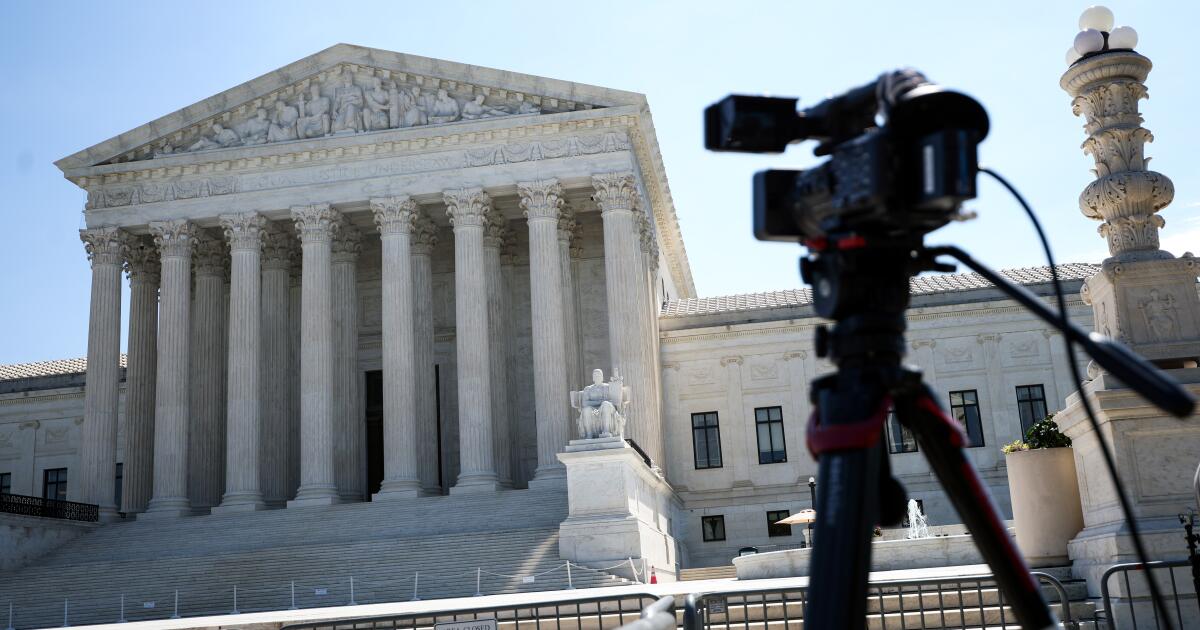
Cover image from latimes.com, which was analyzed for this article
The Supreme Court is set to decide major cases in June that could significantly impact the 2026 midterm elections and voting rights enforcement.
PoliticalOS
Sunday, May 31, 2026 — Politics
The June decisions on coordinated party spending and mail-ballot receipt deadlines carry the clearest potential to shift resources and turnout mechanics for the 2026 midterms. Earlier redistricting changes already favor Republican map-drawing in multiple states. Readers should track whether the court applies the Purcell principle to keep current voting rules in place through November.
What outlets missed
Neither outlet supplied Federal Election Commission data confirming or correcting the $251 million Republican cash figure. The Louisiana Voting Rights Act decision’s precise statutory holding received only summary treatment. No outlet examined whether the Purcell principle would actually shield the Mississippi mail-ballot rule from immediate change. The Temporary Protected Status case and independent-agency removal disputes were omitted from midterm-impact analysis despite their potential to affect voter rolls and regulatory continuity.
Control of Congress after the November 2026 elections depends in part on how the Supreme Court resolves several cases scheduled for decision by the end of June. The outcomes could alter campaign spending rules, mail ballot deadlines, and the reach of Voting Rights Act challenges already reshaping district lines.
The court’s 6-3 conservative majority has already acted in one redistricting dispute. In April it limited the scope of Section 2 of the Voting Rights Act in a Louisiana case, a move that has prompted Republican-led states to redraw several House districts previously held by Democrats. Legal observers project a net gain of up to a dozen seats for Republicans in the South as a result, though the full effect will appear in 2028 and 2030.
Two additional election-related cases remain. In the Mississippi mail-ballot dispute, Republican officials seek to bar counting of ballots received after Election Day even if postmarked by then. Fourteen states plus several territories currently allow such ballots under varying grace periods. During March arguments a majority of justices signaled they may invalidate the Mississippi law, but application of the Purcell principle could keep the existing rule in place for the midterms to avoid voter confusion.
A second case, brought by then-Senator JD Vance and other Republicans, challenges federal limits on coordinated spending between party committees and candidates. The National Republican Senatorial Committee, National Republican Congressional Committee, and Republican National Committee reported combined cash reserves of roughly $251 million at the end of April with no debt, compared with roughly $125 million and more than $17 million in debt for their Democratic counterparts. A ruling striking down the limits would allow immediate coordination on advertising purchases.
The same docket includes challenges to President Trump’s executive order narrowing birthright citizenship, state laws restricting firearms for habitual drug users, state bans on transgender athletes in girls’ sports, and the president’s authority to remove officials from independent agencies. Those rulings will also be issued before the justices recess, yet their direct bearing on the 2026 ballot is narrower than the campaign-finance and voting-procedure questions.
More in Politics

Trump at 32% Approval as Gas Prices Test GOP Midterm Hopes
NYT/Siena polling showed Trump's approval at historic lows around 32 percent with Democrats leading by double digits in key districts. Early voting has surged in battleground states.

Record Early Voting Hits Battlegrounds, Shifting Partisan Shares
AP analysis found hundreds of thousands more early ballots than in 2022 in states including Texas, Ohio, Kansas, Maine, and North Carolina, shifting partisan dynamics.

Trump Backs Marshall in Kansas Senate Race Tightened by Farm Costs
President Trump rallied in deep-red Kansas for GOP Sen. Roger Marshall in a competitive race, announcing an $8 billion farm fuel relief program amid high diesel prices. Democrats see an opening to end 94 years of GOP dominance in the state.

Trump Pauses Russia Sanctions Amid Ukraine Tensions and Missile Strikes
Trump waived sanctions on Russia and floated trilateral talks with Putin and Xi as part of ending the Ukraine war, while tensions rose with Zelenskyy over Starlink and arms. Bipartisan senators engaged Zelenskyy amid the shifts.
The Compass
You just read five takes on one story.
What's your take? Find your political shape in a few minutes.
Take the test